The Submerged Crystal Atrium House
Abandoned Victorian structure rising from a shallow blackwater lake, formed as a fractured crystalline atrium where architecture appears to have shattered into geometric shards before partially sinking into the water. Only the upper segments of the house remain above the surface, while the submerged portions are visible below as distorted, luminous silhouettes warped by depth and refraction. The entire structure feels suspended between solid form and liquid dissolution.
The exposed architecture is composed of dark wrought iron, pale limestone, and faceted stained glass panels in deep emerald, smoky violet, and muted amber. Some glass planes remain intact, reflecting the sky in sharp angular fragments, while others are missing entirely, leaving open Victorian frames where black water flows through interior space.
The geometry is unstable yet physically coherent, with skewed arches and tilted walls forming a controlled but fractured crystalline logic.
Beneath the waterline, the house continues downward in stacked submerged layers. Entire wings glow faintly through algae-tinted water, revealing deeper rooms that appear intact yet unreachable. Fish move through broken windows and doorframes as if the building has become part of the lake’s ecosystem rather than an abandoned structure.
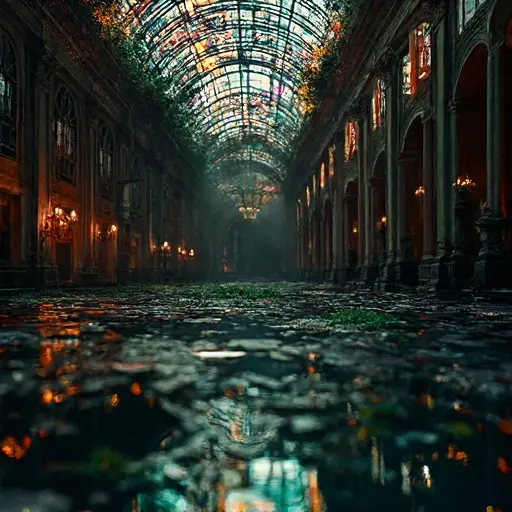
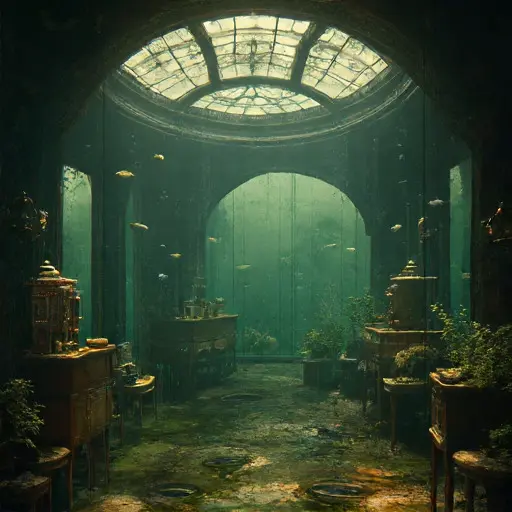
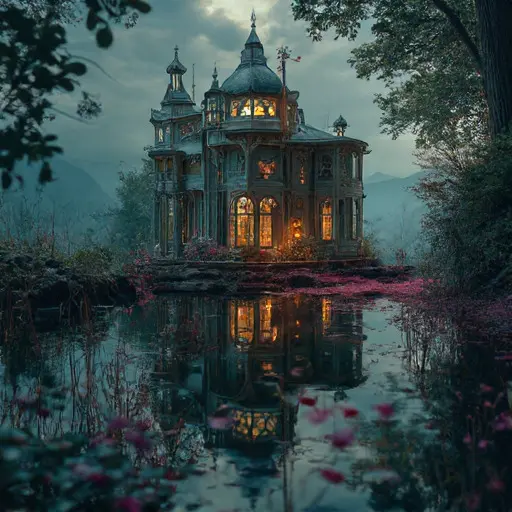
The surrounding lake is unnaturally still, its surface black and mirror-like, reflecting the fractured atrium in near-perfect inverted symmetry. Beneath this reflective plane, submerged architecture reveals deeper structural layers, where rooms stack downward like a sinking palace preserved in water and memory. The effect is both geological and architectural, as if the building is slowly becoming sediment.
Along the shoreline, vegetation grows in intense saturated clusters—deep green reeds, dense moss carpets, and wildflowers in electric magenta, cobalt blue, and warm golden yellow. Tree roots extend directly into the lake, wrapping around submerged foundations like living anchors that stabilize rather than destroy the structure.
A fractured glass bridge extends from the shore toward the atrium but stops abruptly mid-span, ending in empty air above the water. Rusted lantern chains hang beneath it, still emitting a faint warm glow that scatters amber reflections across the rippling surface. This broken threshold emphasizes the sense of interrupted passage between land, structure, and submersion.
Lighting is late golden sunset filtered through water, glass, and iron. Refractions scatter color across stone and submerged interiors, producing layered optical distortions without losing physical plausibility. The entire scene reads as a photoreal architectural submersion event—Victorian structure transformed into crystalline ruin, preserved simultaneously above and below the waterline.