Spiral House of Falling Rooms
Abandoned Victorian house shaped like a broken spiral staircase erupting from the earth, twisting upward in a slow, impossible coil where architecture no longer obeys gravity or convention. The structure rises in fragmented loops, each turn forming mismatched rooms that hang like suspended boxes in midair. Deep crimson brick dissolves into jade-green plaster and midnight blue timber panels, all surfaces intensely saturated yet softened by age, moisture, and time. The entire building feels like a frozen motion event—mid-collapse, mid-growth, and somehow still inhabitable.
At the center of the spiral is a vertical black glass atrium, a void-like core that runs through the entire structure.
Inside it, dust drifts in slow suspension alongside faint floating petals, as if gravity behaves differently within this column. Rooms attach to the spiral at irregular intervals: some tilt sideways, others rotate slightly upside down, and a few appear partially detached yet still held in place by curved stair bridges that loop between them. These bridges are wrapped in glowing orange lantern vines, their light diffusing through the spiral gaps like embers caught in motion.
The exterior is fully exterior and materially grounded despite its impossible geometry. Brickwork shows subtle erosion along edges where wind and rain have cut into the spiral’s exposed curvature. Timber panels retain visible grain compression and paint layering, revealing the house’s long history of repainting and repair attempts across shifting surfaces. Iron brackets and structural supports twist with the architecture itself, bending into forms that appear engineered yet increasingly organic in their deformation.
The surrounding garden has become an overgrown, almost jungle-like field of emerald grass and oversized aquatic lilies. These lilies bloom in surreal tones of neon pink, violet, and gold, their reflections rippling across shallow water channels that weave between the spiral’s base. A collapsed gazebo lies half-submerged in a reflective pond nearby, its fractured roofline mirrored perfectly in the water, creating the illusion of a second inverted structure beneath the surface.
Sunset light slices through the open coils of the spiral house in long, cinematic beams. As the sun moves, shadows stretch and twist across rooms that hang at different angles, creating constantly shifting interior geometries. The contrast between warm golden light and deep architectural shadow gives the entire structure a suspended, theatrical presence—like a frozen moment from a collapsing memory.
Interior impressions:
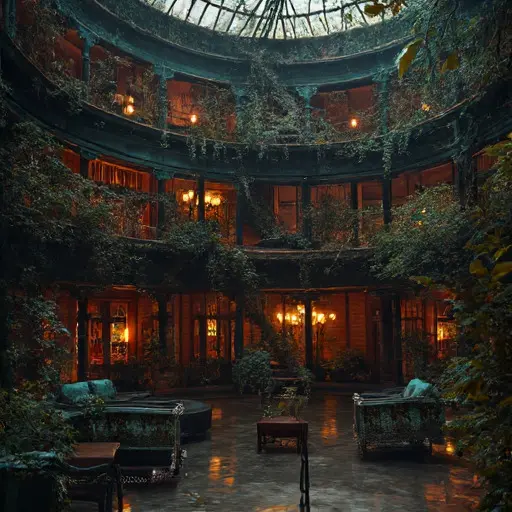
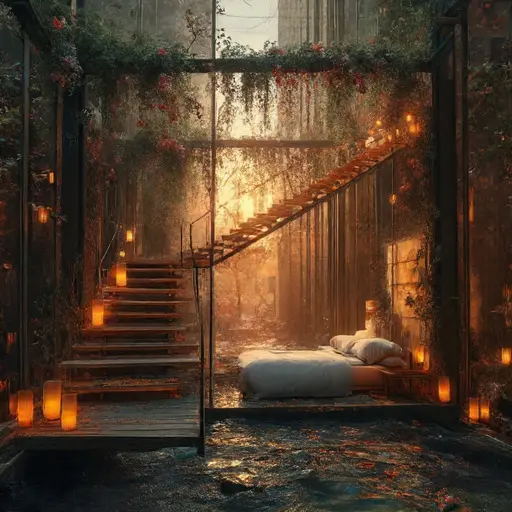
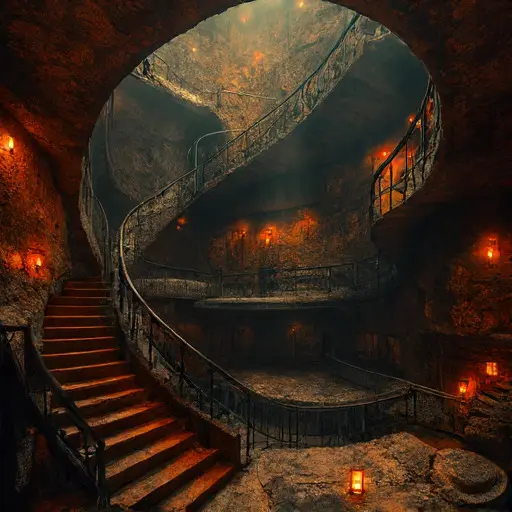
The entire scene reads like a high-resolution architectural photograph of an impossible Victorian structure frozen at the edge of collapse and creation. Gravity feels optional, but material reality remains precise—brick, wood, glass, and vine all behaving with believable weight inside an unbelievable form. The house is not ruined; it is still falling.