Brackenflow River-Edge Residence
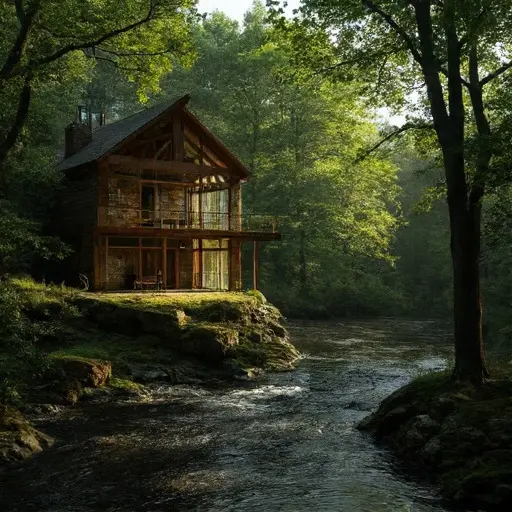
Abandoned Victorian house, pale river-polished basalt cobble construction with tight mortar seams, deep weather-aged cedar shingles bleached into layered silver-brown tones, and wrought iron detailing in oxidized iron-gray with subtle copper undertones where protective layers have worn away. A compact Victorian forest-edge residence sits at the boundary of an old-growth woodland and a shallow braided river system, where shifting water channels and dense canopy shadow define the architecture’s relationship to light and moisture.
The structure is compact and horizontally stable, composed of a central living block with a low roofline, a side sunroom enclosed in aged glass for botanical observation, and a narrow service wing that extends toward the riverbank for water access. The roof is steep cedar-shingle, heavily weathered by humidity and seasonal rainfall, with irregular tone variation from dark umber-brown under sheltered eaves to pale silvered wood on exposed slopes. Copper flashing has oxidized into soft green-gray streaks that follow natural runoff paths.
The façade is fully exterior and materially realistic. Basalt cobbles are tightly fitted but visibly irregular, with surface smoothing on river-facing sides from long-term wind and water exposure. Mortar joints show slight erosion and color variation where repairs were made over time. Timber framing is structural and functional, with visible grain, minor warping, and layered aging from alternating wet and dry forest conditions. Iron fixtures—window latches, rail brackets, and water access fittings—show uneven corrosion concentrated in moisture-heavy zones.
The surrounding environment is a dense forest-river interface. Tall trees form a broken canopy overhead, allowing shifting patches of light to reach the ground in irregular patterns. The river system splits into shallow braided channels that move slowly through gravel beds and moss-covered stones. Water clarity varies between clear and sediment-tinted depending on flow depth, creating subtle variation in reflection and color.
Vegetation is rich and naturally layered. Ferns dominate shaded areas near the structure, forming dense green undergrowth. Moss spreads across stone surfaces in thick, damp patches. Small shrubs and saplings emerge along river edges, while wildflowers appear in scattered clusters: soft white woodland blooms, muted violet forest flowers, and pale yellow blossoms growing in filtered light gaps.
A partially collapsed wooden waterwheel mechanism sits near the river-facing side of the residence, its paddles broken and partially submerged, with the central axle still faintly visible. Nearby, a stone water intake channel once used to direct river flow into the house’s utility system is partially filled with sediment and forest debris. A narrow wooden footbridge extends from the service wing toward the opposite bank, but several planks are missing or misaligned due to long-term moisture damage and shifting ground.
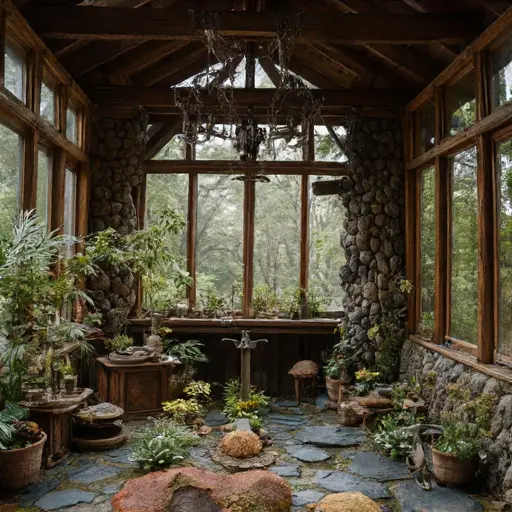
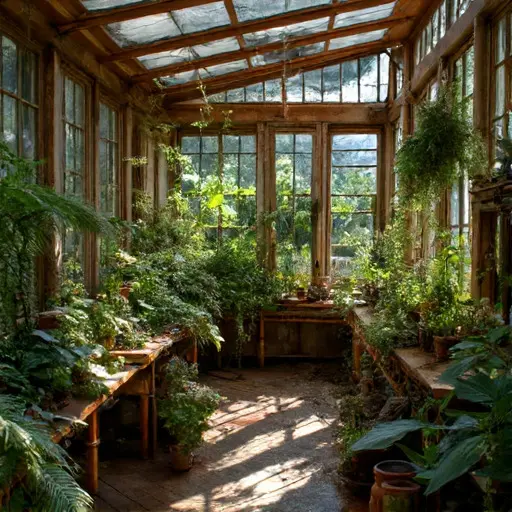
Window systems are deep-set and irregularly aged, with slightly warped glass that distorts reflections of trees, water, and sky into layered fragments. Interior spaces are dimly visible—only structural outlines of beams, shelving, and empty observation surfaces designed for botanical and hydrological study.
Lighting is realistic forest-edge diffuse daylight filtered through canopy gaps, producing soft, shifting illumination with strong green bounce from surrounding vegetation and muted highlights on wet stone and wood surfaces. Shadow patterns are complex but natural, driven by leaf movement and water reflection rather than artificial contrast.
The entire scene reads like a precise architectural field photograph of a Victorian forest-river residence—hydrologically connected, ecologically integrated, and shaped by water, canopy cover, and seasonal moisture cycles rather than ornament or narrative styling. A place defined by flow, shade, and long-term interaction between structure and living landscape.