Horizonline Observatory Residence
Abandoned Victorian house, pale chalk-ash concrete rendered over hand-laid stone, deep faded ink-brown hardwood framing that has softened into gray walnut tones, and forged ironwork in matte iron-black with fine pitting from decades of wind-driven sand abrasion. A compact Victorian steppe observatory residence sits alone on a vast grassland plateau where visibility stretches uninterrupted in every direction, and the horizon line feels almost mathematical in its simplicity. The structure is intentionally low and aerodynamic in profile, built to resist constant horizontal winds rather than vertical weather loads.
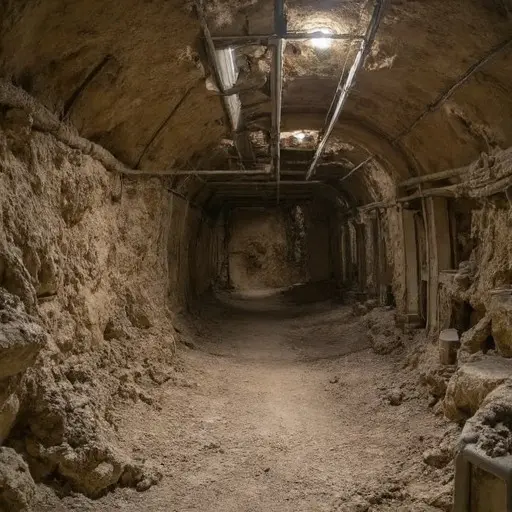
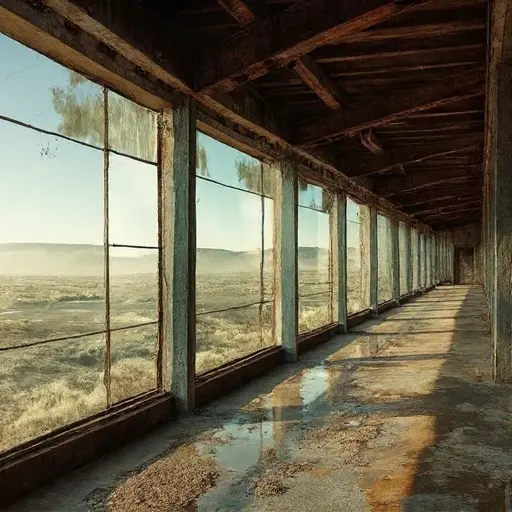
The architecture is composed of a central grounded core with thick insulating walls, a semi-submerged lower level partially insulated by earth berms, and a narrow elevated observation gallery that runs along the windward side like a protective viewing corridor. A small geometric dome rises slightly off-center, once used for astronomical and atmospheric tracking.
The roof is shallow and reinforced, made of slate slabs and compressed stone tiles in varied tones of dust-gray, muted blue, and weather-softened charcoal, with wind-polished edges and minimal overhangs to reduce lift.
The façade is fully exterior and materially restrained. Chalk-ash render shows fine wind-scouring patterns that create directional texture across surfaces, subtly indicating prevailing wind direction over decades. Timber framing is structural and visible in selective recesses, showing grain compression and tonal fading rather than paint-driven color. Iron elements—vent covers, anchors, and gallery supports—are functional, with erosion patterns that appear sand-blasted rather than rust-heavy, producing a matte, physically abraded finish.
The surrounding environment is an expansive grassland steppe with no enclosure or visual interruption. Grass grows in long, continuous fields that form visible wave patterns under constant wind. These waves are not stylized but physically driven, with direction shifts that can be read across the terrain like atmospheric data. The ground is mostly stable but subtly uneven, shaped by centuries of wind deposition and soil movement.
Vegetation is sparse but widespread. Hardy grasses dominate, with variations in height forming natural gradients across the plateau. Small clusters of low wildflowers appear intermittently: pale off-white blossoms, muted lavender steppe flowers, and occasional desaturated yellow blooms that only survive in micro-sheltered depressions. No dense vegetation clusters exist; everything is distributed according to wind exposure and soil consistency.
A collapsed wind measurement mast lies near the structure, its segmented metal frame partially buried in soil and grass. Nearby, a broken stone compass platform once used for directional calibration remains embedded in the ground, its radial markings softened but still faintly visible beneath erosion. A narrow stone walkway extends outward from the observation gallery, but it fragments quickly into grassland, losing continuity within a short distance.
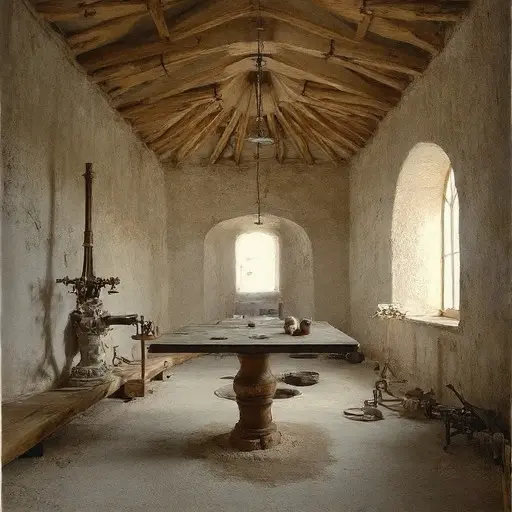
Window systems are deep-set and minimal, designed for insulation against wind pressure. Glass is thick and slightly tinted by age, producing subdued reflections of sky and grass movement. Interior visibility is limited to structural silhouettes—support ribs, measurement stations, and empty observational desks—without any decorative or domestic detail.
Lighting is high, diffuse overcast with strong atmospheric clarity typical of open plains. The absence of obstacles creates uniform light distribution, with subtle tonal variation driven primarily by wind-driven grass movement rather than shadow casting. Distant atmospheric haze gently compresses the horizon, emphasizing scale without dramatic contrast.
The entire scene reads like a precise architectural survey photograph of a Victorian steppe observatory residence—engineered for exposure, isolation, and atmospheric study, shaped by wind, distance, and open horizon rather than ornament or narrative. A place defined by emptiness, measurement, and environmental force over time.