The Hillside Railway Overlook House Left Watching Empty Tracks
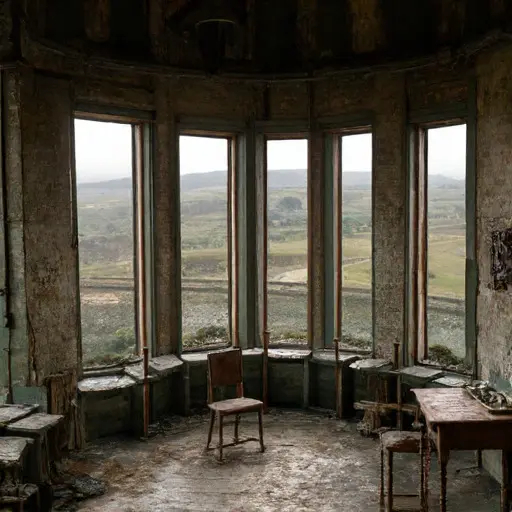
The hillside railway-overlook residence was constructed in 1898 during the expansion of rural rail infrastructure through the valley cutting below. It was commissioned not as a station building but as a private observational home for a railway engineer employed to oversee track stability along the steep ridge section above the line. The structure was intentionally placed at a high vantage point where visibility extended across multiple kilometers of winding track, embankments, and signal posts.
The original occupant, Chief Railway Surveyor Harold Wren, designed the house with constant observation in mind. The tall asymmetrical bay window and elevated reading observatory were intended for monitoring rail movement, weather conditions, and structural stress along the valley line. For nearly two decades, the home functioned as both residence and unofficial observation post, with detailed logs maintained daily regarding train frequency, maintenance schedules, and environmental changes affecting the railway corridor.
By the early 1920s, rail traffic through the valley began to decline as alternate routes were developed on more stable ground. Maintenance budgets were reduced, and the hillside segment became increasingly secondary in the regional network. While trains still passed occasionally, their frequency diminished steadily, and the house gradually shifted from active observation point to quiet lookout over a fading system.
Signs of Gradual Abandonment
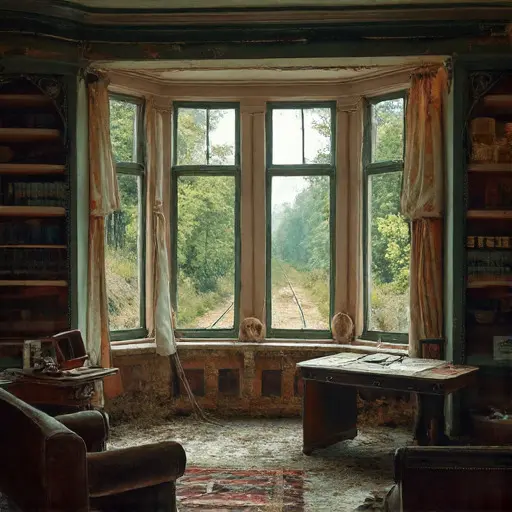
During the 1930s the residence began to fall into partial disuse. Harold Wren’s retirement coincided with the formal reduction of oversight responsibility for the valley line. Although he remained in the house for some time, official duties ceased entirely, and no replacement observer was appointed.
Without its original purpose, the observatory room became rarely used. The railway below, once a constant source of motion and sound, grew increasingly quiet. Administrative records indicate that maintenance visits to the line became sporadic, with long intervals of inactivity between inspections.
As income stabilized on a modest pension, upkeep of the house gradually declined. Exterior timber began to fade. Ironwork lost its original sheen, developing a muted teal-bronze patina. Sections of the roof required repair after seasonal storms, but work was often delayed due to cost and isolation of the site.
By the early 1940s, Harold’s health had deteriorated, limiting his ability to manage the steep terrain surrounding the property. Neighbors in the lower valley reported seeing lights in the observatory only occasionally, usually during winter months when visibility across the ridge was at its clearest.
The Final Years of Stillness
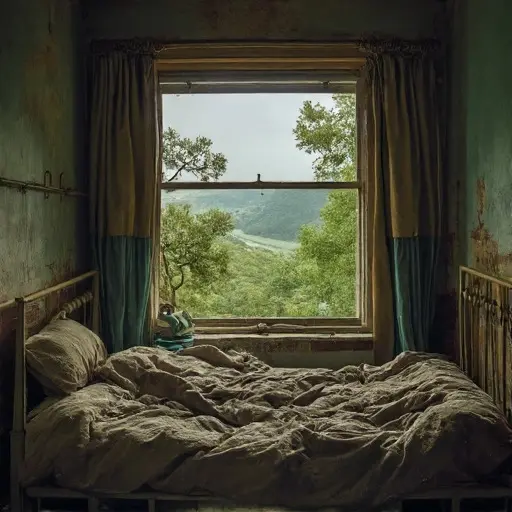
By 1947 the residence was recorded as permanently unoccupied following the relocation of its final resident to assisted care in a nearby town. No formal sale or redevelopment was pursued due to unclear inheritance arrangements and the building’s isolated position on unstable ridge terrain.
With no continued oversight, the property transitioned into a state of quiet abandonment. The surrounding landscape began to reclaim structural edges. Grass advanced along stone retaining walls. Wildflowers spread across the hillside in irregular but persistent patterns, following the contours of wind and slope.
The railway line below was officially decommissioned shortly thereafter. Tracks remained physically intact, but maintenance ceased entirely. Gravel beds softened under vegetation, and signal posts gradually leaned under wind exposure and lack of structural reinforcement.
Today the hillside railway-overlook residence remains standing above the valley cutting. Its pale graphite-lilac brickwork, faded sunflower-ochre timber, and oxidized teal-bronze ironwork still define its silhouette against the sky. The observatory window continues to face the silent railway below, where no trains pass and no schedules remain. The house endures in quiet suspension, holding its original purpose with nowhere left to look.