Meridian Dome Keeper House
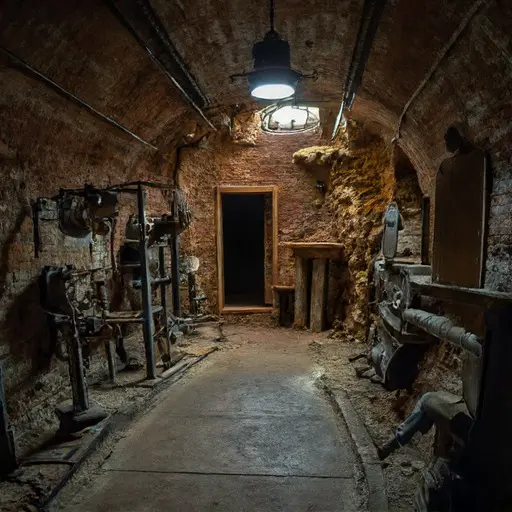
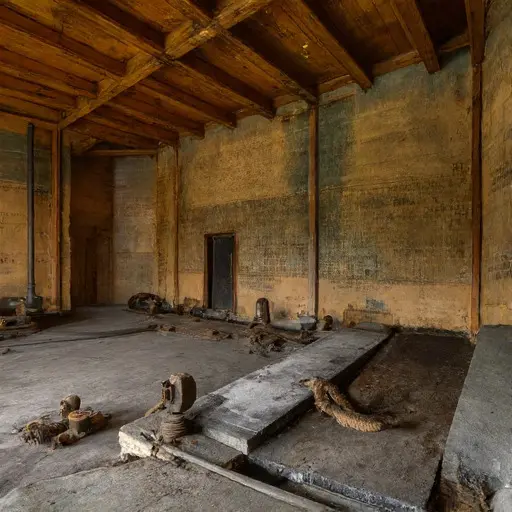
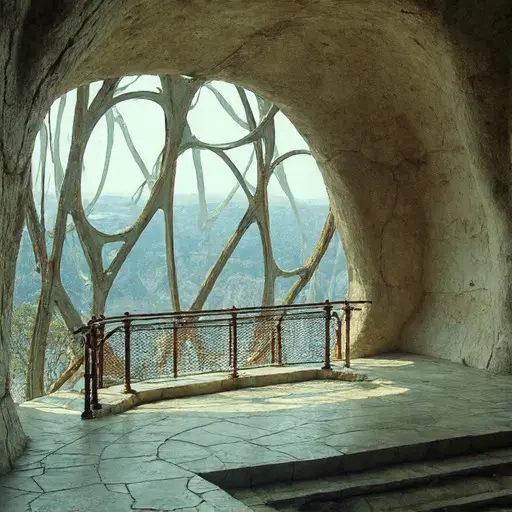
Abandoned Victorian house, opaline-graphite brick, marigold-cerulean timber, jade-rust steel, a compact Victorian observatory-keeper house built as a small angular residence attached to the base of a low astronomical dome structure, where the home occupies service rooms beneath the observatory and extends outward as a sharply geometric footprint aligned with tracking instruments and foundation piers. The silhouette is compact but mechanically precise, with a rectangular main dwelling, a slightly offset instrument annex, and a short external stair leading to a viewing platform that once supported telescope calibration. Rooflines are faceted and functional, formed from segmented slate planes, copper alignment rails, and reinforced metal edges designed to minimize vibration rather than ornament.
The façade is fully exterior and instrumentally weathered: opaline-graphite brickwork forming the observatory base with mineral staining from dew and frost cycles, marigold-cerulean timber panels cladding the residential sections with sun-faded calibration markings still faintly visible, and jade-rust steel brackets, mounts, and tracking supports embedded into the structure for celestial equipment, all oxidized from long exposure to night humidity and wind. Trim contrast appears in blackened iron calibration rings, riveted steel plates, and brass alignment fixtures dulled into patina.
The sky is a soft highland astronomical overcast, pale blue-gray with thin atmospheric haze, producing even natural daylight that renders materials with documentary realism and no dramatic emphasis.
The house sits in a highland meadow biome where grass grows in thin wind-swept layers across stone foundations and instrument pads, and wild alpine flowers—small white star blossoms, yellow meadow buttercups, and pale violet ground blooms—cluster around structural supports. A broken brass telescope gear assembly lies near the base of the dome, frozen and half-buried in moss, while a collapsed wooden instrument shelter leans against a calibration pillar, its roof warped and partially open to the sky. A shallow drainage groove carved into stone channels rainwater away from the observatory base, reflecting fragments of sky in narrow linear pools. Every surface feels exterior, scientific, and physically grounded, like a real Victorian observatory residence built to support measurement of the sky rather than domestic display. The entire scene reads like a documentary architectural photograph of a forgotten scientific dwelling, naturally weathered, structurally precise, and quietly integrated with its celestial purpose.