Arcade of Quiet Commerce
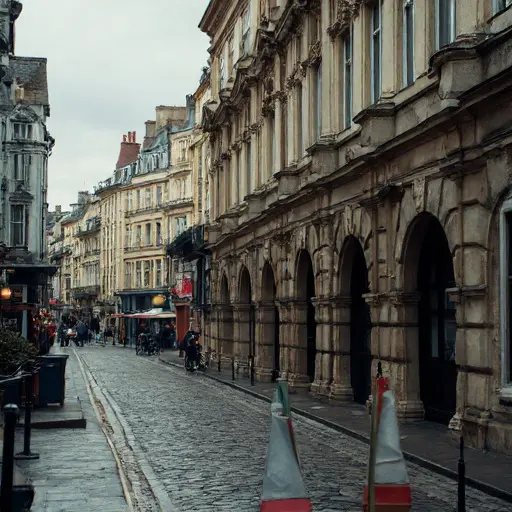
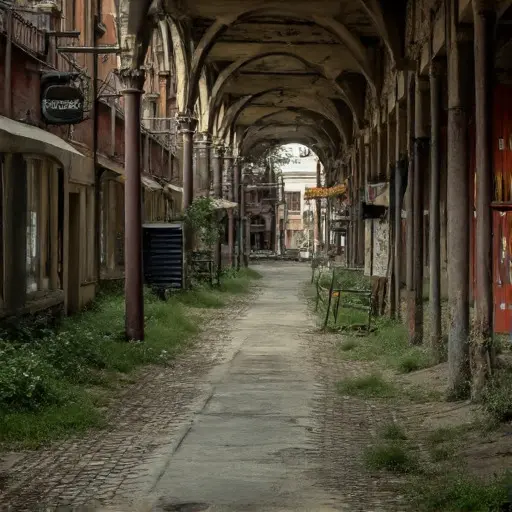
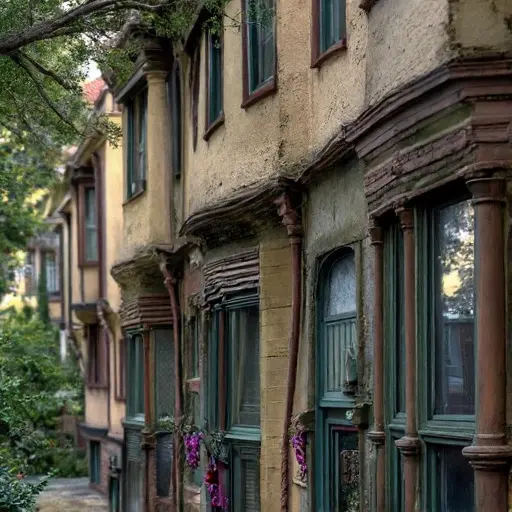
Abandoned Victorian mansion, aurora-coral, sapphire-reed, ember-graphite, a compact street-arcade manor built as a tightly woven Victorian civic façade where residential quarters rise above a continuous ground-level market colonnade, forming a hybrid architecture of dwelling and trade rather than a singular private residence. The silhouette is linear and densely composed, with a repeating sequence of stone arches at street level supporting a calm upper band of evenly spaced sash windows and shallow bay projections that stretch the building along the street like an architectural procession.
Rooflines are disciplined and continuous, formed from narrow slate ribbons, copper gutter seams, and modest chimney stacks placed at measured intervals to reinforce the rhythm of the façade. The structure reads as one unified frontage rather than segmented buildings, its Victorian order preserved even through abandonment.
The façade is fully exterior and richly structured: aurora-coral plaster and stucco at upper levels softened by time, sapphire-reed carved stone forming the arcade’s repeating arch system, and ember-graphite wrought iron brackets that once held market signage, lanterns, and trade markers now bent and empty but still aligned with civic intent.
Every surface feels like part of a public-facing architectural system rather than private ornament.
The sky hangs in a muted soft river-gray overcast, naturally lit and even, casting diffuse daylight into the arcade so that stone grain, iron corrosion, and plaster wear remain legible without contrast harshness or shadow drama. The environment is a quiet former market street biome where grass grows in thin seams between cobblestones beneath the arches and spreads into the spaces where stalls once stood.
At the central colonnade bay rests a broken iron merchant placard frame, fractured and tilted inward, still anchored into the masonry as a remnant of commerce now dissolved into silence.