Gate of the forgotten orchard manor
Abandoned Victorian mansion, aurora-lemon, sapphire-rosewood, mint-obsidian
A compact orchard-gate manor designed as a tightly framed Victorian entrance residence, centered on a monumental exterior archway that pierces through the building mass like a ceremonial threshold rather than a decorative feature. The silhouette is symmetrical and controlled, with a dominant central gateway volume anchoring the composition and two low residential wings extending outward in balanced restraint, emphasizing arrival and passage over domestic sprawl.
Rooflines are clean and disciplined, composed of steep slate planes, fine copper ridge lines, and evenly spaced chimney stacks that reinforce the building’s formal symmetry. The façade is fully exterior and richly articulated: aurora-lemon plaster walls with soft mineral texture, sapphire-rosewood timber framing defining structural rhythm around windows and edges, and mint-obsidian wrought iron detailing that wraps around the central archway, balcony edges, and window frames in continuous Victorian ornamentation.
The sky hangs in a bright orchard-blue overcast, naturally lit and crisp, casting even daylight that enhances surface color, material clarity, and architectural definition without heavy shadows or atmospheric gloom.
The estate sits within a lush orchard biome where grass grows in soft uneven carpets between fruit trees and spreads across worn cobblestone paths leading directly toward the central gateway, reinforcing the idea of movement through landscape toward architecture.
At the threshold of the arch rests a broken stone nameplate slab, weathered smooth and partially buried in grass, once marking the estate’s identity before time erased its inscription.
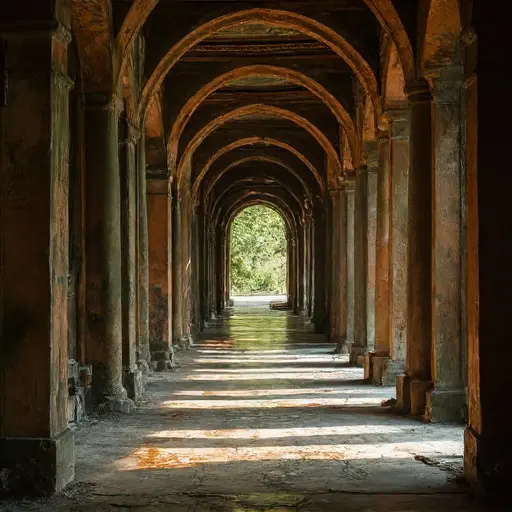
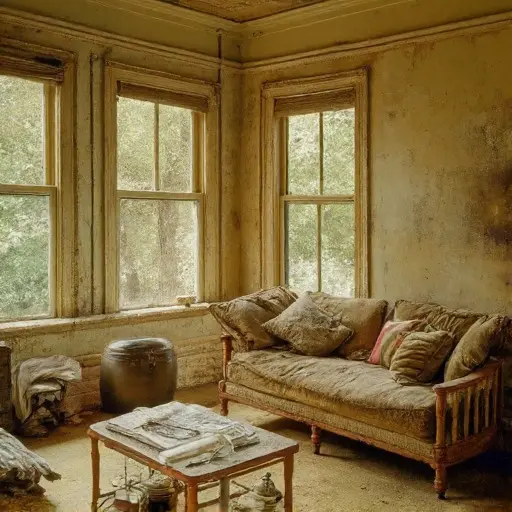
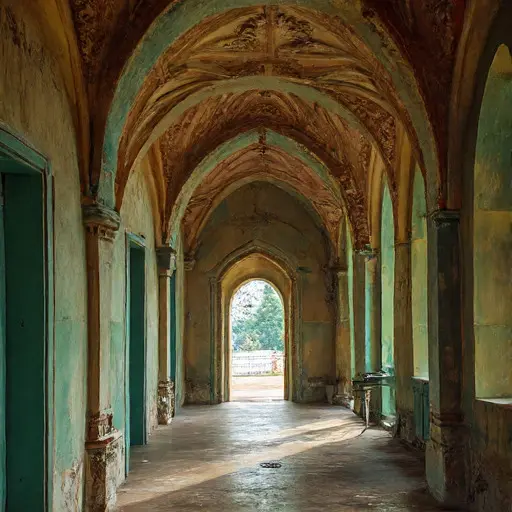
Inside, the manor remains abandoned yet structurally intact, with interiors organized around the idea of passage, symmetry, and controlled architectural procession.