Aurora-Basil Conservatory Manor
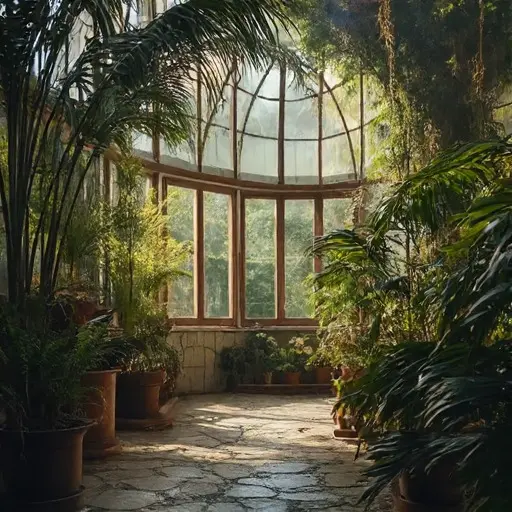
Abandoned Victorian mansion, aurora-basil, ember-ivory, nocturne-citrine, a compact greenhouse-front manor designed as a tightly framed conservatory façade attached to a solid stone residential core, merging domestic Victorian architecture with botanical exhibition structure in a single controlled frontage system. The silhouette is compact and balanced, anchored by a rectangular main body while the front elevation is dominated by a wide transparent glass plane that functions as a continuous conservatory wall, presenting the house as both dwelling and cultivated display enclosure.
Rooflines are restrained and utilitarian, composed of shallow slate slopes, slender ridge vents, and evenly spaced chimney stacks positioned behind the glass façade line so that the conservatory face remains uninterrupted in visual rhythm. The geometry prioritizes stability and enclosure, allowing the glass system to define the identity of the structure while the masonry core remains recessed and structurally grounded.
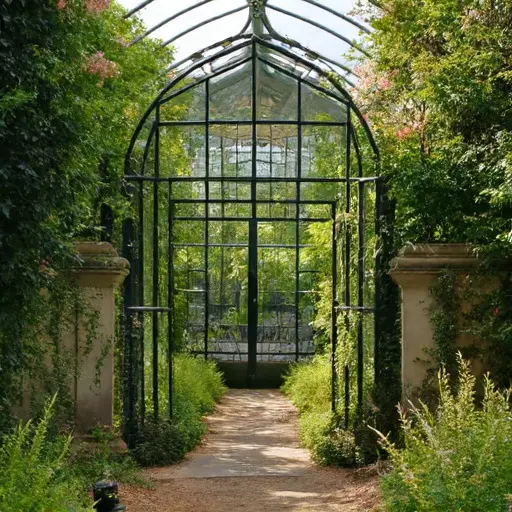
The façade is fully exterior and horticulturally Victorian in discipline: aurora-basil painted timber framing forms the conservatory grid, ember-ivory stone basework anchors the lower structure, and nocturne-citrine iron latticework supports large arched glass panels that span the entire front elevation.
The glass surface reads as a continuous botanical membrane, subtly reflecting the surrounding garden while still allowing interior visibility through softened, weathered transparency.
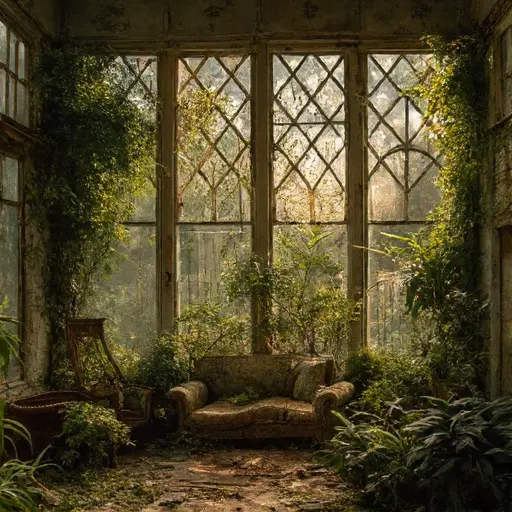
The sky hangs in a pale sea-mist blue overcast, naturally lit and matte, producing even diffused illumination that passes gently through the conservatory glass. Reflections remain subdued, and interior surfaces are visible without glare, emphasizing material realism—dust on panes, streaks from long-absent rainfall, and faint mineral buildup along iron joints.
The estate sits in an overgrown botanical garden biome where grass grows thick between fractured stone paths and wild vines climb the conservatory framing in irregular, uncontrolled patterns. The glass façade is partially overtaken by climbing vegetation, yet the structure remains intact and legible as a designed horticultural system.
At the front garden threshold rests a broken brass irrigation valve wheel, half-buried in soil and surrounded by creeping vegetation, once responsible for regulating water distribution across the greenhouse gardens now long abandoned.