Aurora-Fig Cranehouse Dock Manor
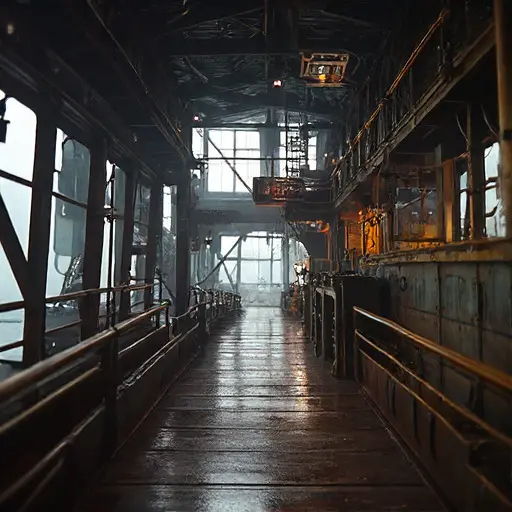
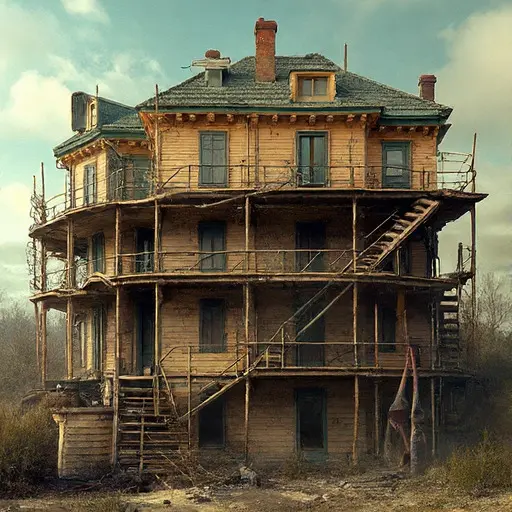
Abandoned Victorian mansion, aurora-fig, ember-slate, sea-glass gold, a compact dockside crane-house manor integrated directly into a working harbor scaffold system, where Victorian residential architecture is fused with exposed industrial infrastructure and pressed into a tight stacked-block composition anchored on tidal stone foundations. The silhouette is compact, mechanical, and deliberately engineered, formed from interlocking rectangular volumes with a single reinforced harbor-view bay projecting outward like a calibrated instrument rather than a decorative balcony.
Roof architecture is flat-leaning and segmented, composed of corrugated slate plates, narrow ventilation ridges, and iron-framed skylight strips aligned to the harbor’s structural grid. Every roof segment reads as part of a larger operational system, prioritizing drainage, wind resistance, and functional alignment with dock machinery over ornamental expression, while still retaining subtle Victorian detailing in its edges and junctions.
The façade is fully exterior and utilitarian-Victorian in character: aurora-fig weatherboard panels define the primary surfaces, ember-slate reinforced masonry anchors the corners and load-bearing transitions, and sea-glass gold iron crane rails and balcony braces run continuously across the structure like integrated mechanical anatomy.
The result is a building that feels both inhabited and operational, as if residence and harbor machinery were designed as a single unified system.
The sky hangs in a muted storm-cyan maritime overcast, naturally lit and matte, casting even diffuse illumination across wet stone, oxidized iron, and salt-darkened timber without glare or reflective intensity. Light reveals texture rather than spectacle: rust blooms on steel joints, softened wood grain swelling from moisture, and salt crust forming along exposed beam edges.
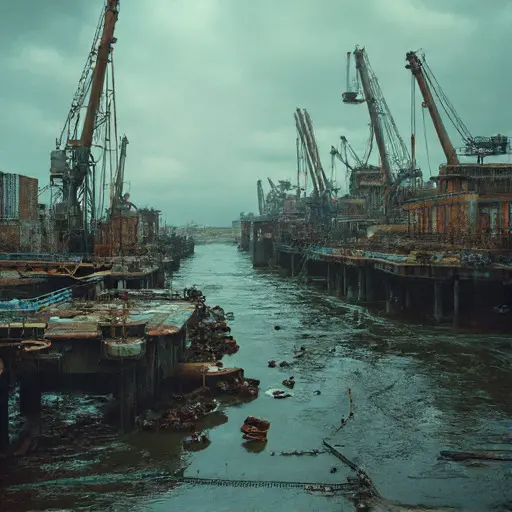
The estate sits in a working harbor biome where thin grass grows between cobblestone loading docks and salt wind threads through lower scaffolding levels. The boundary between architecture and infrastructure dissolves at ground level, where tidal mechanics and residential space share the same structural language.
At the quay edge rests a broken cargo winch drum, frozen mid-collapse, its chain half-submerged in shallow tidewater beside the manor’s foundation pilings—an artifact of stalled maritime labor embedded in the building’s industrial identity.