The Canopy-Root Estate of the Inverted Arbor Manor
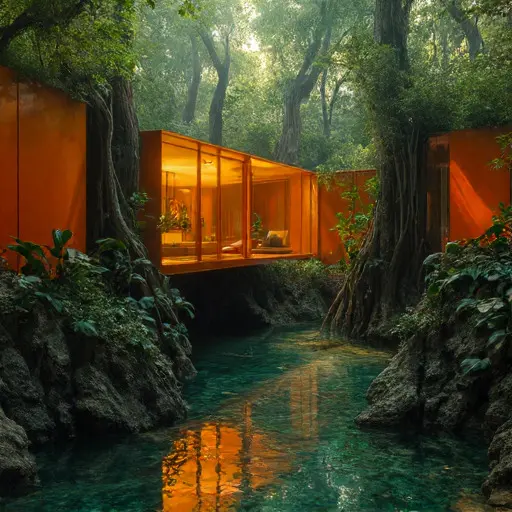
An abandoned Victorian mansion is suspended high within a rainforest canopy under a deep cyan-green haze, where light filters through dense foliage in soft layered gradients. The atmosphere is naturally lit and matte, with no artificial glow—only filtered forest illumination shifting through humidity and leaf-shadow. The structure appears less built than entangled, as if architecture and ecosystem agreed to occupy the same breath.
The manor is composed of offset cubic rooms clipped into a living lattice of ancient tree roots. Each volume is suspended at a slightly different height, forming an irregular stacked silhouette that defies stable orientation.
Some rooms jut outward, others recede into the canopy, creating a sense of continuous architectural hesitation, like the building is trying to rearrange itself while remaining ceremonially composed.
Roof structures flatten into overlapping plate terraces threaded with fine brass veinwork. Narrow skylight slits cut through the canopy shadow in disciplined geometric lines, allowing controlled shafts of light to descend into the suspended interior layers. The effect is precise yet organic, as if the forest itself had learned aristocratic order.
The façade is coated in glossy enamel panels of sunset-tangerine lacquer, arctic-emerald trims, and midnight-fuchsia glass inlays. These colors do not glow but press visually against the green environment, like inherited luxury compressed by jungle density. The entire structure feels sealed yet alive, its surfaces reflecting moisture, leaflight, and slow-moving canopy wind.
The estate is anchored into massive aerial root systems. Thick roots pass through and around rooms, binding the architecture into the canopy like structural memory grown over centuries. Below, suspended grass pockets and moss platforms connect fragmented walkways, forming a secondary ground that exists entirely above the earth.
At a lower junction, a broken porcelain canopy elevator cage hangs between roots. Its fractured lattice frame dangles midair, suggesting a ceremonial vertical transport system that was abandoned mid-ascent. It no longer moves, but remains perfectly positioned within the forest’s vertical logic.
Interior glimpses
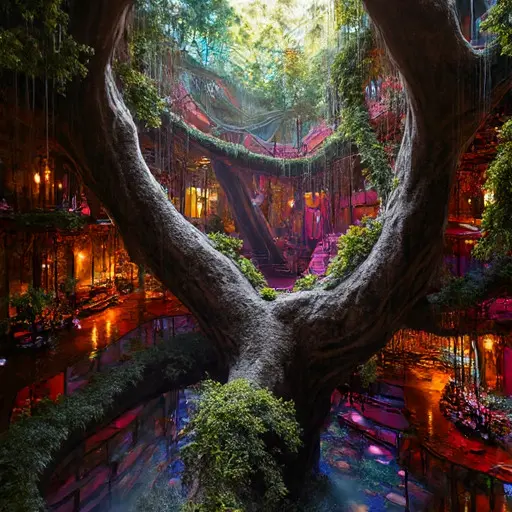
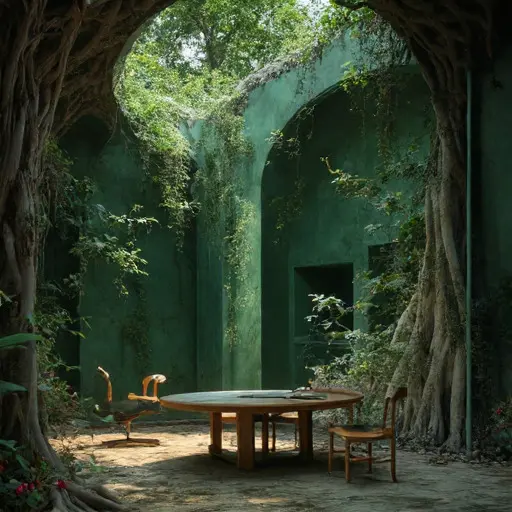
Inside, the mansion feels like a controlled suspension of domestic space. Rooms do not sit on floors so much as attach themselves to living structure, forming layered habitation pockets woven into the canopy’s vascular system. Movement between rooms feels vertical, lateral, and organic at once.
There is no decay beyond natural humidity and age-softened surfaces. No collapse, no supernatural presence—only a tightly integrated Victorian canopy manor preserved inside living architecture, as if aristocratic space chose to become part of the forest rather than resist it, whispering quiet grandeur through roots, leaves, and suspended light.