The Rotational Crown of the Imperial Cylinder Manor
An abandoned Victorian mansion stands in a wide tundra clearing beneath a soft cyan-amber dusk sky, where the light is matte and evenly diffused, carrying no glare or artificial bloom. The landscape is calm and wind-quiet, with pale grass rippling gently across frozen soil and faint auroral curtains drifting low along the horizon like slow ceremonial weather. The structure feels less like a building placed in nature and more like a contained ritual anchored into it.
The manor is a compact concentric rotunda composed of stacked cylindrical layers nested within one another. Each ring is slightly misaligned, creating the impression of a slow rotational disagreement frozen mid-motion.
The silhouette remains modest in height, but visually dense, as if architectural pressure is distributed outward through controlled radial geometry rather than vertical expansion.
The exterior is wrapped in deep-sapphire enamel masonry, tightened with glacier-lime lattice trims that trace circular logic across the curved façade. Vermilion glass insets are embedded at measured intervals, fracturing ambient daylight into sharp, controlled shards that slide along the cylindrical walls. The entire building feels calibrated, like an instrument designed to refract both light and authority.
Above, the roof resolves into a crowned central dome surrounded by smaller segmented domelets arranged in concentric tiers. Each dome is ribbed with fine Victorian filigree that tightens toward its apex, producing a sense of restrained imperial tension rather than openness. The geometry suggests ceremony held under compression, as if celebration has been folded inward into structure.
The estate grounds are minimal but striking: a flat tundra lawn with auroral reflections stretching across distant sky layers. At the front approach, a fractured aurora-glass weather vane spire leans slightly off-axis, still indicating a symbolic northern direction despite its damage. It reads less as decoration and more as an obsolete instrument of aristocratic navigation.
Interior glimpses
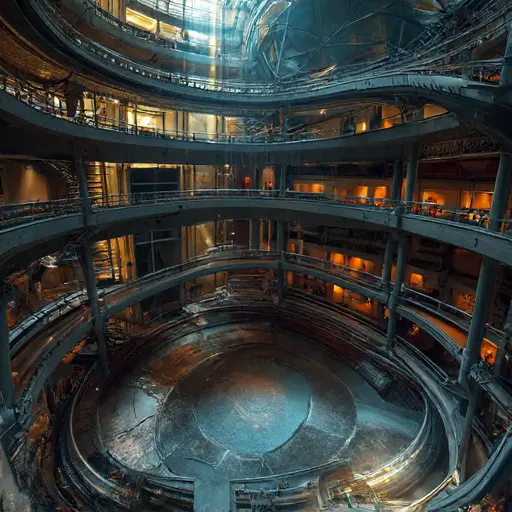
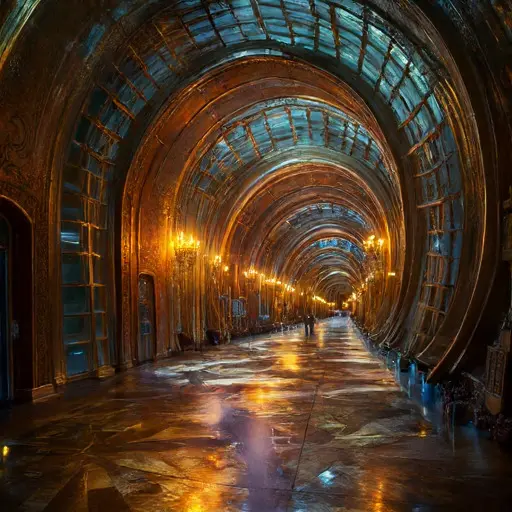
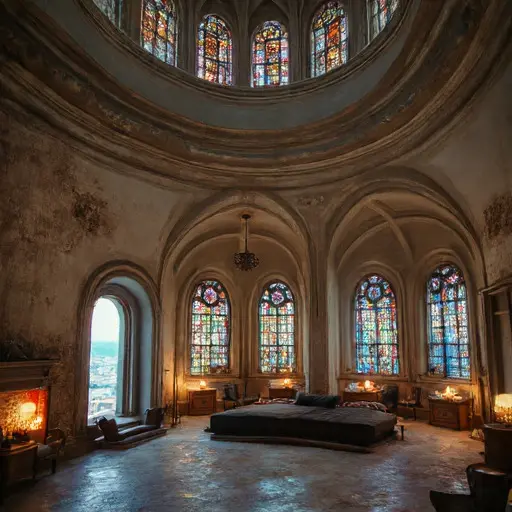
Inside, the mansion intensifies its concentric logic. Rooms do not branch outward but instead wrap and recur, forming layered circular sequences that loop perception rather than direction. Movement feels like gradual rotation through nested states of the same architectural idea, each layer slightly offset from the last.
There is no decay beyond natural weathering of stone, glass, and enamel. No collapse, no supernatural presence—only a tightly wound Victorian rotunda-manor preserving its own ceremonial geometry within a silent aurora-lit tundra, like an imperial structure that chose containment over expansion and never stopped turning inward.