The Folded Manor of the Poison Delta
An abandoned Victorian mansion sits in a quiet river-delta mangrove, where shallow water channels thread through floating islands of tall grass under a dusk-turquoise sky. The atmosphere is naturally lit and matte, with no artificial glow—only soft, humid daylight diffused through the heavy air. The structure feels compact yet unstable in geometry, as if its architecture is perpetually mid-adjustment.
The manor is built as an accordion-like shell of stacked bay-window cubes, each slightly offset from the next so the building appears to shift when viewed from different angles. Its silhouette remains low and boxy, but internally complex, with rooms folding into one another like hidden aristocratic machinery compressed into an intentionally modest footprint.
Nothing extends outward freely; everything is contained, layered, and folded inward.
Roof geometry forms a dense lattice of interlocked gables and lantern-box dormers, each tilted in a different direction as though the house refused any single alignment with the world. The façade is covered in glazed enamel panels, fine brass lattice trims, and vertical strips of rose-opaline stained glass that fracture daylight into controlled shards of color—chartreuse, violet-blue, and soft coral reflections sliding across the surfaces.
The surrounding environment is a tropical mangrove delta. Water channels flow slowly around stilts and stone footings, reflecting broken fragments of architecture. Roots coil beneath the structure like structural memory, reinforcing the sense that the house is both built and grown into the wetland at once. On a side veranda, a cracked moonstone greenhouse hinge sculpture rests half-buried in moss, its articulated joints frozen in an impossible suggestion of once-mobile botanical chambers.
Interior glimpses
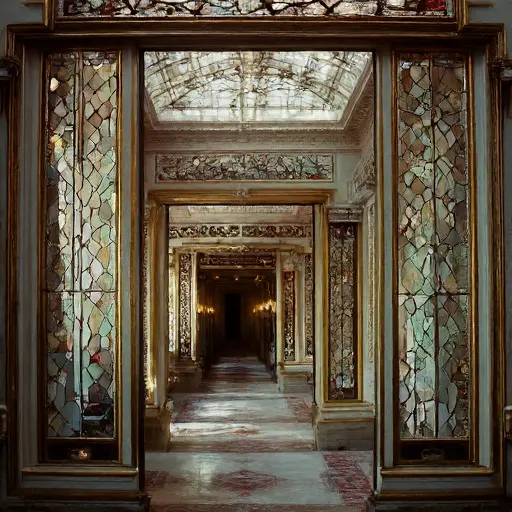
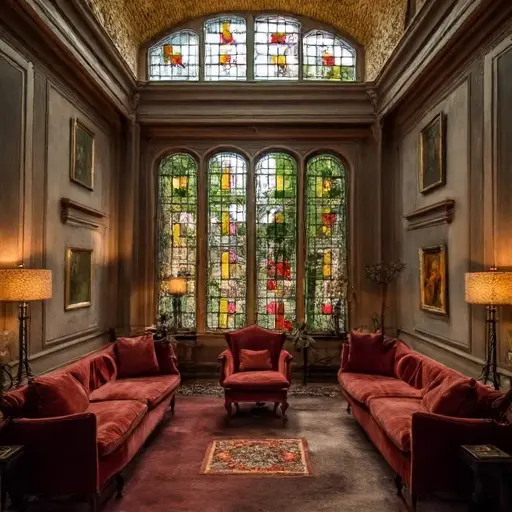
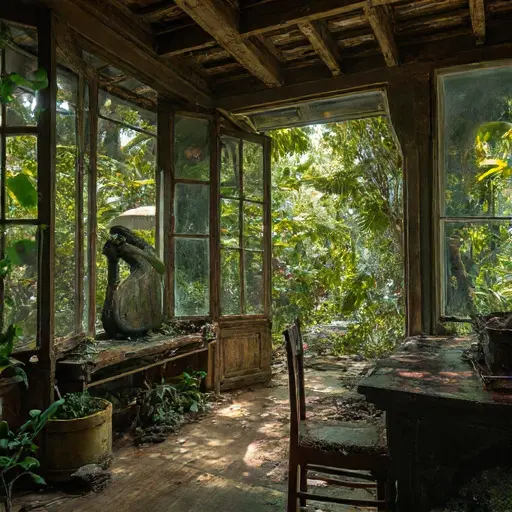
Inside, the house behaves like a controlled compression of space rather than a traditional residence. Rooms overlap at slight offsets, creating layered sightlines where one space is partially visible through another. Materials remain pristine but subdued—enameled surfaces, polished brass, and softly aged glass—giving the impression of preserved density rather than abandonment.
There is no decay beyond natural humidity and time. No collapse, no supernatural presence—only a meticulously folded Victorian structure quietly dissolving into its mangrove surroundings, like a dynasty preserved inside an architectural puzzle that never stopped tightening.