Reservoir of Quiet Measures
An abandoned Victorian rainwater reservoir house sits hidden deep in a forest basin under soft overcast daylight, where a uniform pale gray sky flattens all contrast into calm, even illumination. The structure is fully intact and quietly imposing, built from pale stone blocks reinforced with white-painted timber detailing. It does not present itself as a home at first glance, but as a controlled architectural system that happens to include living space.
The building occupies a subtle rise above a vast circular underground cistern network. Its presence is hinted at through stone inspection grates, drainage seams, and shallow water channels that trace precise arcs around the foundation.
The entire structure feels organized around water storage and regulation, as if habitation was secondary to a larger hydraulic purpose that has since gone silent.
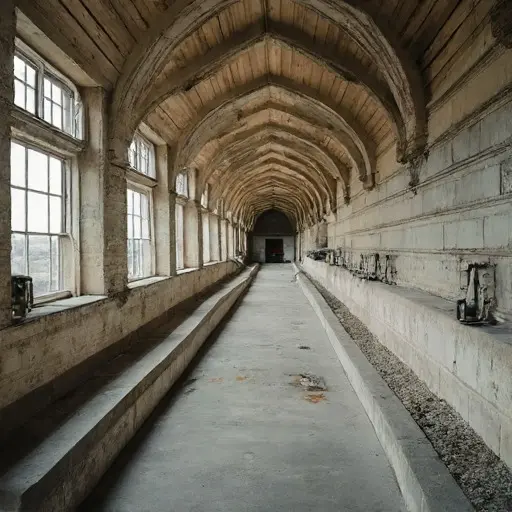
There is no electricity anywhere in the house—no wiring, no lamps, no modern fittings. All illumination comes from tall arched windows and a central skylight, both filtered through overcast sky. The result is a completely natural lighting system: soft, diffuse, and slightly damp in tone, with no shadows strong enough to define edges sharply.
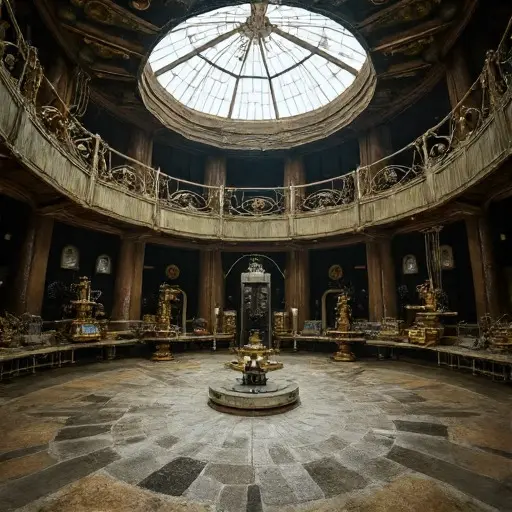
The architecture is gently radial. Rooms curve around a central control hall that once monitored reservoir levels and distribution flow. From above, the plan reads as a soft circular geometry embedded into the forest clearing, like a mechanical diagram turned into inhabitable space. The symmetry is not rigid; it is functional, slightly relaxed by time and construction phases.
The roof is slate gray and evenly weathered, forming a continuous surface interrupted only by a low central skylight dome made of thick glass panes. The glass is lightly clouded by age but remains intact, diffusing daylight into a muted vertical glow that falls into the heart of the structure.
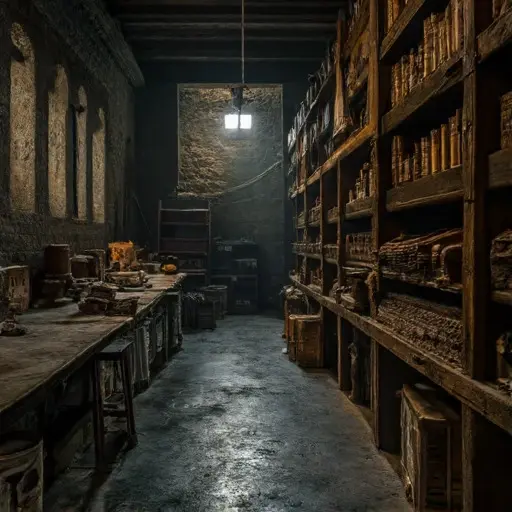
Tall, narrow windows wrap the outer perimeter in consistent spacing. Their faded white frames carry faint hints of pale blue-green paint beneath the aging surface. Through them, interior rooms are visible in stillness: stone floors, wooden tables, brass mechanisms, and wall engravings marking levels, pressure readings, and water thresholds.
Interior glimpses
Outside, a ring of shallow water channels encircles the structure, perfectly still and reflective. They connect to drainage seams in the forest floor and disappear beneath moss-covered stone outlets. The system is inactive, but preserved with unusual clarity, as if maintenance simply stopped rather than failed.
The surrounding forest forms a loose boundary around the basin. Trees stand at respectful distance, their reflections faintly trembling in the water channels. Moss grows along edges and joints, but does not obscure the geometry of the system. Everything remains legible, deliberate, and quietly maintained by time rather than intervention.
No decay beyond natural aging, no collapse, no supernatural presence. The house feels like an abandoned Victorian water management residence—an exploration-game environment defined by circular engineering, silent infrastructure, and the calm persistence of a system that still remembers how it once controlled the flow of an entire landscape.