Quarrylight Overseer House
An abandoned Victorian hillside quarry overseer’s house sits hidden in a dense forest under soft overcast daylight, where a pale gray sky flattens the world into calm, even illumination. The structure is fully intact and firmly practical, built from pale quarried stone with simple white timber framing, designed for supervision rather than comfort or display. It feels like a place made to watch the land, then quietly forgotten once the watching ended.
The house occupies a carved terrace cut directly into the hillside, overlooking a silent quarry basin below. The quarry is long inactive, filled with still rainwater that reflects the sky in dull silver sheets broken by scattered stone ridges and submerged geometry.
The forest climbs to the edge of the excavation but does not reclaim it, forming a natural boundary between wild growth and engineered void.
Architecturally, the building is compact and rectilinear, with a strong horizontal emphasis that contrasts the vertical drop of the quarry. The lower level is embedded into the terrace stone, while the upper level opens outward through evenly spaced sash windows aligned like measurement marks. There is no ornamentation—only repetition, proportion, and utility preserved through time.
No electricity exists anywhere in the structure. There are no wires, no fixtures, no lamps—only daylight and shadow. The entire interior is designed around visibility during working hours, with rooms opening toward quarry light or side-lit by forest reflections. Even now, the house feels like it is waiting for inspection that will never resume.
The roof is steep and simple, clad in dark slate tiles that remain evenly seated despite decades of weather. A single brick chimney rises from the rear corner, slightly soot-darkened at the top but structurally unchanged. The overall silhouette is stable, heavy, and grounded in the hillside like a carved instrument of observation.
Interior glimpses
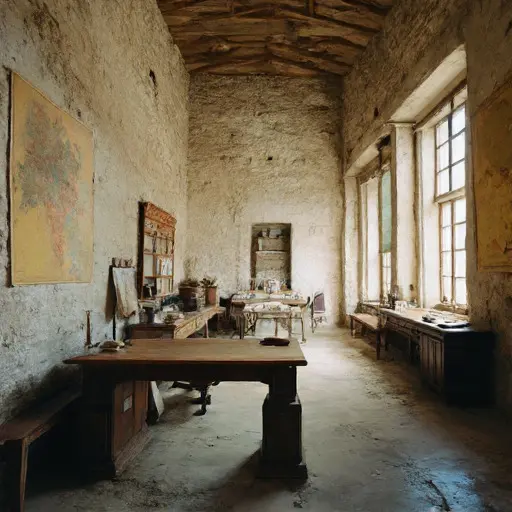
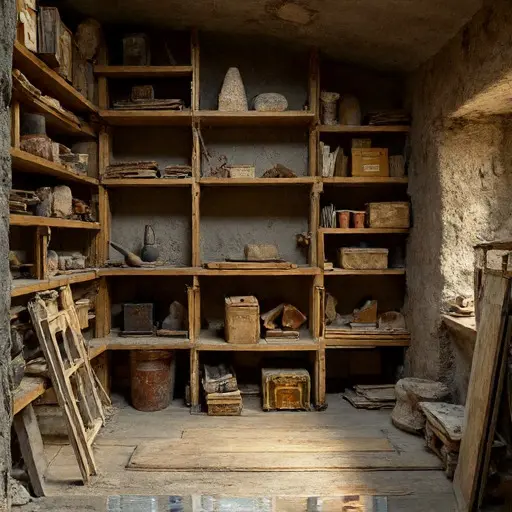
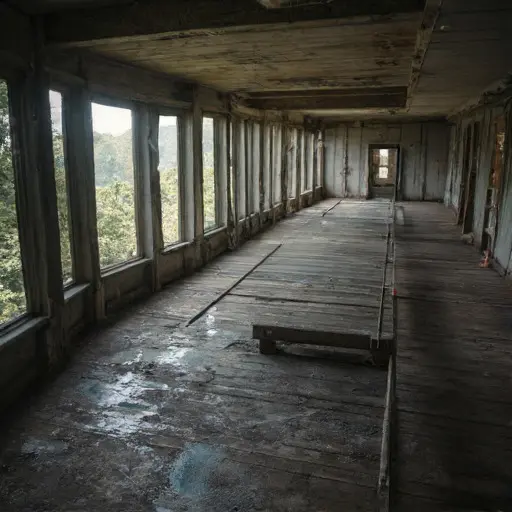
Outside, a stone observation platform extends from the front of the house, projecting toward the quarry edge like a deliberate point of measurement. It is unadorned, functional, and slightly worn, with a low railing and steps descending toward the basin. It feels designed for charting, not contemplation.
The surrounding forest presses close to the quarry rim but respects its engineered geometry. Moss and grasses gather along terrace seams and drainage lines, yet the stonework remains legible and intact. Nothing overwhelms the structure; nature only edits its edges.
No decay beyond natural aging, no collapse, no supernatural presence. The house feels like an abandoned Victorian quarry control residence—an exploration-game environment defined by geology, silence, and observation, where human order once mapped the land and then stopped answering it.