The Octagonal House of Forgotten Summers
Hidden deep within a bright forest clearing, far beyond the last maintained path, stands an abandoned Victorian amusement-house unlike any ordinary family residence. Time has not ruined it. Instead, the years have softened it into something quieter—an architectural curiosity preserved beneath silver skies and vibrant woodland growth. Surrounded by bright green foliage, colorful fallen leaves, and diffuse daylight filtering through the canopy, the structure feels less like a lost mansion and more like a forgotten destination waiting to be rediscovered.
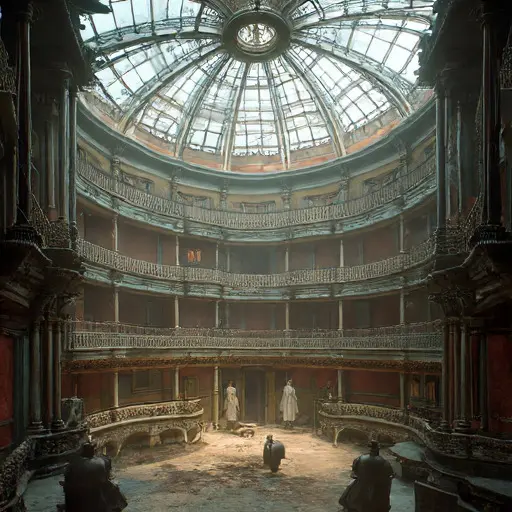
At the heart of the estate rises a massive octagonal central hall crowned by an elegant glass lantern roof.
The lantern remains intact, its many panes reflecting pale clouds and fragments of surrounding treetops. From this central space, six separate wings radiate outward in a symmetrical yet playful arrangement, creating the impression of a grand Victorian complex designed for gathering, exploration, and leisure rather than formal living.
Each wing carries its own distinct identity. One is painted in faded powder blue and cream, another in soft cherry red and white, while others feature combinations of sage green, muted gold, pale coral, and weathered ivory. The colors have faded gently through decades of seasons, blending into a harmonious palette that feels layered by generations rather than designed all at once. Every addition appears to tell its own story while remaining connected to the whole.
Wide wraparound verandas encircle nearly every section of the building, linked together by covered walkways lined with decorative Victorian railings. The railings alternate between faded blue, red, and white paint, creating subtle rhythms of color that guide visitors around the structure. Despite years of abandonment, the woodwork remains remarkably intact, carrying only the soft patina of age.
The roofscape is one of the manor’s most distinctive features. Small towers rise from unexpected corners, colorful gables overlap at varying heights, and decorative dormers emerge between glass roof sections that illuminate interior spaces below. Nothing feels excessive or chaotic. Instead, the architecture possesses the accumulated charm of a place that expanded whenever its owners imagined a new room, a new viewpoint, or a new experience worth building.
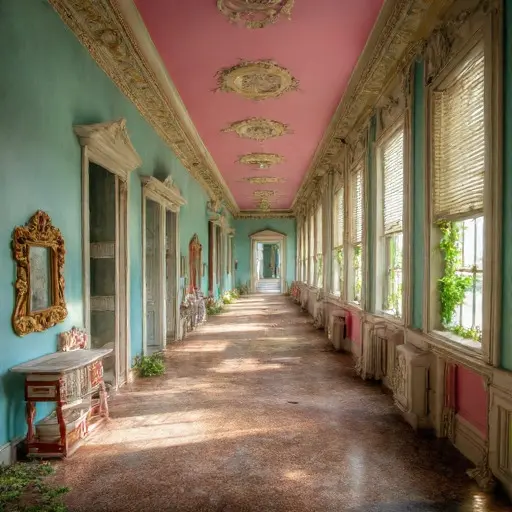
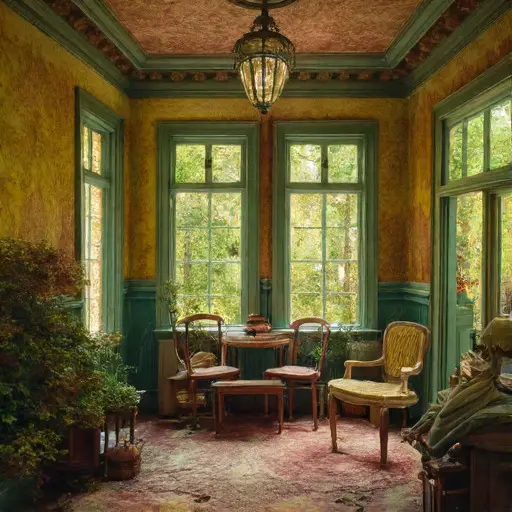
Tall Victorian windows line every façade. Their glass remains clear enough to reflect forest greenery and pale skies while allowing glimpses into rooms preserved in quiet stillness. Some chambers reveal faded yellow wallpaper illuminated by diffuse daylight. Others contain pale turquoise walls, soft rose-colored ceilings, or carefully painted decorative trim that still retains traces of its original color.
Inside, the house unfolds like a collection of separate memories. Every wing feels distinct. Corridors branch unexpectedly into sunlit sitting rooms, enclosed galleries, and intimate reading spaces. Decorative details vary from room to room, suggesting generations of changing tastes and personal projects. Yet despite these differences, a consistent atmosphere of warmth and creativity ties everything together.
One wing contains a sequence of bright reception rooms painted in soft creams and pale blues, their large windows overlooking gardens and woodland. Another appears devoted to leisure and gathering, with expansive open spaces connected by decorative archways and surrounded by broad verandas that blur the boundary between indoors and outdoors.
The central octagonal hall remains the emotional core of the structure. Looking upward through the lantern roof, visitors can see drifting clouds and swaying treetops framed by intricate ironwork. Surrounding balconies overlook the open volume, creating layered sightlines between floors and reinforcing the sense that the house was designed as much for wandering as for living.
Outside, the grounds remain equally remarkable. A circular stone courtyard sits near the main entrance, its geometry still clearly visible beneath patches of grass and scattered leaves. Colorful tiled pathways branch outward into the forest, occasionally disappearing beneath roots before reemerging farther along the clearing. Small painted gazebos stand among the trees, their bright colors softened but still visible through the greenery.
Former flower gardens survive as geometric patterns woven into the landscape. Though no longer maintained, they remain readable beneath wild growth, preserving the outlines of pathways, borders, and gathering spaces. The forest has embraced these features without erasing them, creating a balance between human design and natural succession.
The surrounding woodland contributes greatly to the atmosphere. Unlike darker forests associated with abandoned estates, this environment feels vibrant and welcoming. Bright leaves catch soft daylight, silver-gray skies diffuse illumination evenly across the clearing, and gentle breezes move through tall grasses surrounding the property. Every surface is visible, every path inviting.
There is no sense of tragedy here. No collapse, no menace, no mystery demanding resolution. Instead, the house feels preserved within a pocket of time—a place built for joy, creativity, and exploration that simply continued existing after its visitors departed.
Today, the Victorian amusement-house remains hidden among the trees, a colorful architectural dream resting quietly beneath the forest canopy. Every wing, veranda, courtyard, and tower contributes to the impression of a beloved destination waiting patiently to be explored once more, as though somewhere beyond the trees the sounds of laughter and summer gatherings have only just faded from memory.