The Hillside House of Quiet Music
An abandoned Victorian hillside music house sits embedded into a dense forest slope under soft overcast daylight, where evenly diffused gray-blue light removes harsh contrast and turns the entire landscape into a calm, tonal composition. The structure is fully intact and lightly weathered, built from pale stone, white timber, and restrained accents of deep burgundy and muted forest green that soften into the surrounding woodland palette.
The house is arranged in a stepped formation across the hillside, with each level slightly offset yet cleanly connected. From a distance, it reads like a layered architectural melody—stacked rooms descending the terrain in a measured, rhythmic sequence. The structure does not impose on the slope but follows it, as if the building itself were composed to match the land’s natural cadence.
Color is expressive but aged. Burgundy-painted window frames have softened into dusty wine tones, balcony rails carry muted forest green, and pale cream walls reflect the cool sky light with gentle uniformity. These colors blend into the forest rather than contrast against it, creating a visual harmony that feels intentional and composed rather than decorative.
Large sash windows repeat across each level in structured patterns. Some are paired, others arranged in triplets, forming visual rhythms across the façade that resemble musical notation. Curtains in faded gold, soft blue, and muted rose hang still behind the glass, visible but subdued.
The roof is dark slate with a subtle bluish cast, carefully segmented to follow the stepped geometry of the house. Small chimneys rise at varying heights along the slope, each aligned with a different tier, reinforcing the sense of layered tonal structure across the building.
A long covered wooden gallery connects the tiers externally. Painted in alternating muted green and cream panels, it runs steadily along the hillside. While structurally sound, one section shows slightly altered beam spacing, introducing a subtle visual variation that reads like syncopation rather than damage.
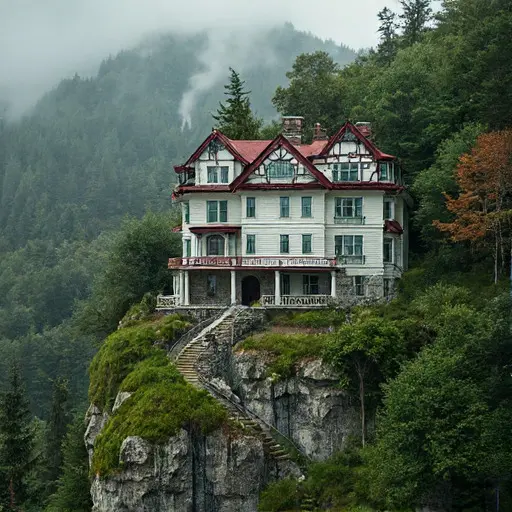
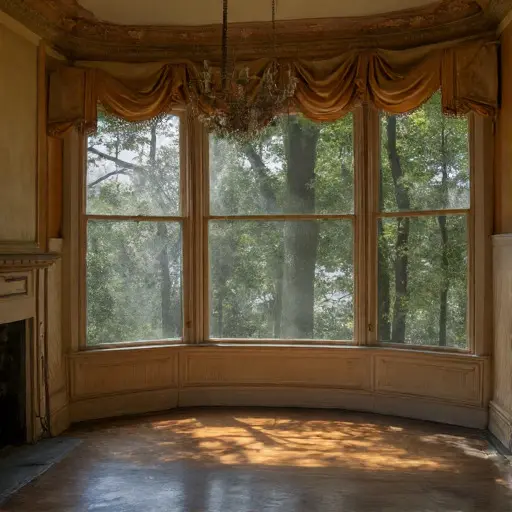
Inside, visible through tall sash windows, rooms remain empty yet warm. Polished wooden floors reflect soft overcast light, cream walls hold faint decorative molding with burgundy trim, and simple staircases connect each level in smooth, predictable transitions. Each landing is lit slightly differently depending on angle and elevation, reinforcing the layered rhythm of the structure.
The surrounding forest climbs the hillside naturally, wrapping the house in greens and muted grays. Moss and grass gather lightly around stone foundations, but the structure remains clearly defined and unobstructed. Trees frame the building like a quiet amphitheater, enhancing its sense of vertical rhythm.
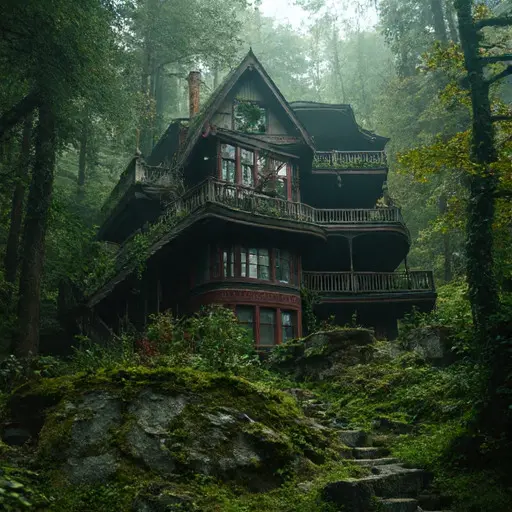
No decay, no collapse, no horror. The house feels like a Victorian music residence designed around rhythm, elevation, and visual harmony—an architectural composition suspended in quiet, cinematic stillness, as if the building itself were a piece of music left gently paused in time.