The Long Arc of Crescent House
Deep within a basin of towering beech trees, where damp earth remains perpetually dark beneath layers of fallen leaves, The Crescent House curves through the forest like a forgotten fragment of a Victorian city. Hidden from any direct approach, the structure reveals itself gradually between trunks and mist, its immense arc emerging section by section until its unusual geometry becomes impossible to ignore.
Unlike traditional Victorian residences organized around symmetry and straight lines, Crescent House was conceived around a sweeping crescent-shaped footprint. The building extends in a broad curve around a neglected inner garden, creating the impression of an architectural embrace that never fully closes. What may once have been an ambitious experiment in residential design has become something stranger with time—a structure whose form dominates every experience of it.
Constructed from pale gray brick accented by dark sandstone trim, the exterior presents an orderly Victorian appearance despite its unconventional layout. Tall sash windows repeat along the outer wall with disciplined regularity, framed by decorative lintels and weathered cornices. Multiple chimneys rise above the roofline at uneven intervals, creating a skyline that appears improvised across decades of expansion. The forest-facing façade remains remarkably intact, though years of exposure have bleached portions of the masonry and etched subtle mineral stains beneath iron fixtures.
The most striking aspect of the house is its sheer continuity. Walking alongside the exterior, the building never seems to end. The curve is so gradual that perspective constantly shifts, causing windows, chimneys, and projecting bays to rotate slowly through view. No two sections appear entirely parallel. Reflections of beech trunks slide across the glass at changing angles, creating an illusion of movement even in complete stillness.
The roof reflects the same compromise between Victorian convention and unusual geometry. Rather than following a true curve, it consists of dozens of straight slate sections joined at shallow angles. From a distance these facets merge into a continuous arc, but closer inspection reveals subtle transitions where one roof plane yields to another. Decades of rain have exploited these junctions differently, producing localized sagging and irregular drainage patterns. Gutters occasionally terminate slightly above neighboring sections, evidence of generations of repairs adapting to a form never entirely suited to standard construction methods.
The neglected courtyard enclosed by the crescent has become its own ecosystem. Once a formal garden, it now supports dense growth of saplings, ferns, ivy, and thorn-covered shrubs. Remnants of Victorian conservatories survive among the vegetation. Their rusted iron frameworks remain standing despite the collapse of most glass panels, forming skeletal arches that emerge from greenery like forgotten greenhouse ruins. The courtyard traps moisture and cool air, creating a pocket of lingering mist that often remains after the surrounding forest has cleared.
Stepping inside reveals the true consequences of the building’s design. Because every room occupies a segment of the arc, conventional geometry gradually dissolves. Walls converge and diverge almost imperceptibly. Corners rarely meet at perfect right angles. Hallways that initially appear straight reveal themselves as subtle curves when viewed from a distance.
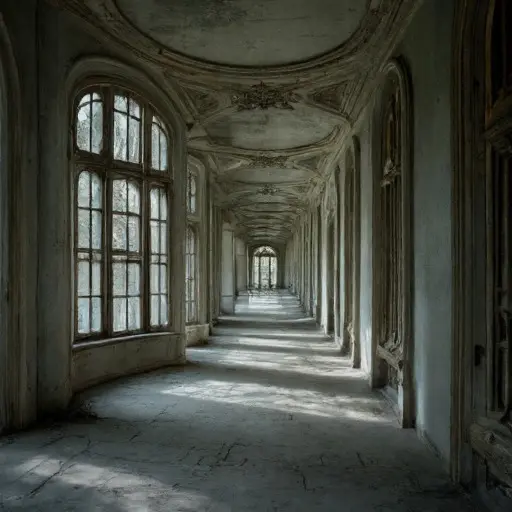
The central corridor extends through much of the house, tracing the crescent continuously. Its curvature is so gradual that occupants can never see its full length. The passage disappears behind itself, limiting visibility and subtly distorting one’s sense of scale. Rows of doors line both sides, many swollen by decades of moisture. Some remain closed permanently, while others reveal wedge-shaped rooms whose dimensions shift depending on perspective.
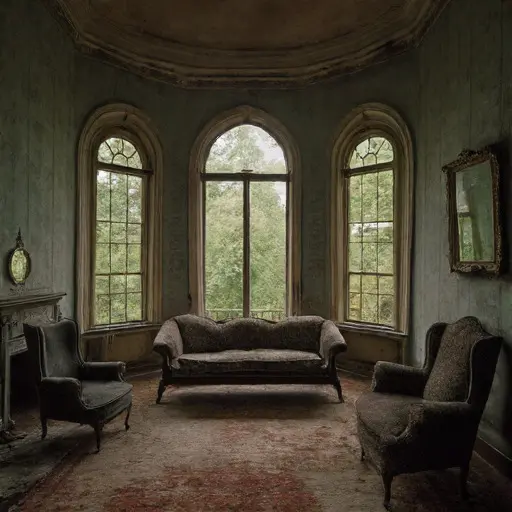
The interiors retain fragments of Victorian refinement beneath extensive decay. Decorative moldings still frame ceilings. Wallpaper survives in sheltered areas, faded into muted tones of cream, green, and gray. Light enters through tall windows at constantly changing angles due to the building’s curvature, producing uneven illumination that moves across rooms in ways difficult to predict.
Multiple staircases were introduced during different renovation periods. Their orientations rarely agree. One staircase rises perpendicular to the arc while another follows the curve itself. Though they often arrive near one another vertically, they seldom connect directly. Moving between floors requires passing through intermediary rooms and corridors, creating circulation routes that feel layered rather than planned.
The upper levels emphasize the building’s unusual proportions even further. Long sightlines become impossible. Rooms overlap visually without aligning structurally. Bay windows project outward at subtly different angles, offering unique views of the surrounding forest from every chamber.
Outside, the forest continues to reshape the property. Trees fill the open side of the crescent while vegetation thickens within the enclosed garden. Moss blankets shaded brickwork along the courtyard-facing walls, while exposed exterior sections weather under wind and rain. The differing conditions have created two distinct faces of the same structure—one damp, enclosed, and overgrown, the other faded and exposed to the elements.
Today, Crescent House remains less memorable for its abandonment than for its geometry. The building feels like an entire Victorian streetscape bent into a single continuous arc and deposited deep within the forest. Its rooms remain physically plausible, its construction structurally sound, yet every space contains a slight deviation from expectation. Nothing is impossible. Nothing collapses. Instead, the house quietly demonstrates how small architectural irregularities, repeated over great distance, can transform an ordinary residence into something profoundly difficult to comprehend.
In the silence beneath the beech canopy, Crescent House persists as a monument to accumulated geometry—a Victorian experiment in curvature slowly dissolving into forest, mist, and memory.