Mourningfold House
Mourningfold House rests deep within a rain-soaked forest where the canopy is so dense that daylight arrives only in broken, diluted shafts. The air is saturated and still, carrying the weight of constant moisture through black-green trunks and tangled undergrowth. At first glance, the structure reads as a traditional Victorian timber house—dark oak framing, steep chimneys, ornate bargeboards—but closer inspection reveals a building assembled in overlapping phases that were never fully reconciled.
The house is divided into three vertically offset levels that do not align cleanly with one another. The ground level is partially submerged into a sloped embankment, its windows pressed directly against compacted soil and root systems.
The middle level sits at a slight diagonal shift, as if the entire floor plane was nudged sideways after completion. Above it, the upper level appears visually stable but subtly overhangs the forest-facing side without visible external support, held in place by internal structures that vanish too cleanly into the walls to be fully legible.
The exterior timber is deeply weathered, stripped of paint and darkened to near-black by years of moisture. Victorian ornamentation still clings to the eaves—lace-like wooden fretwork, carved brackets, and repeating decorative motifs—but the rhythm is inconsistent. Some patterns repeat twice in immediate succession while others stretch apart unnaturally, as if the design process lost synchronization mid-execution.
Windows are tall, narrow, and fitted with leaded glass, yet many are rotated by slight degrees within their frames. This is not enough to break the façade’s cohesion, but it is sufficient to misalign interior reflections with exterior geometry. In several cases, identical stained-glass motifs appear in different windows but inverted or mirrored, suggesting panels were reused without regard for orientation consistency.
A central staircase runs through the interior, but its path does not behave as a simple vertical connector. It rises halfway, transitions into a lateral corridor parallel to the outer walls, then re-enters a different section of the building at a shifted elevation. From outside, this circulation is partially visible through mismatched window placements, hinting at internal pathways that do not correspond cleanly to the building’s external massing.
The roof is steep and heavily pitched, layered in slate that has slipped in slow, uneven sheets. Entire sections appear to have drifted downward by small increments without collapsing, creating overlapping roof planes that suggest frozen motion rather than failure. Two opposing gables are internally connected through an attic space that feels disproportionately large for the footprint it occupies.
Behind the structure, the forest presses close, yet the immediate perimeter around the house is unnaturally flattened, as if repeatedly pressed down over time. Moss forms dense, uniform carpets along lower timbers, while higher sections remain comparatively bare, producing a vertical gradient of growth that does not correspond to light or rainfall patterns.
Inside, the house is empty and acoustically muted, as if sound is absorbed rather than reflected.
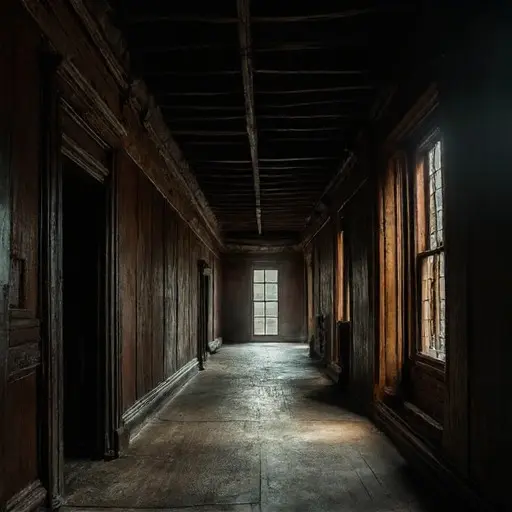
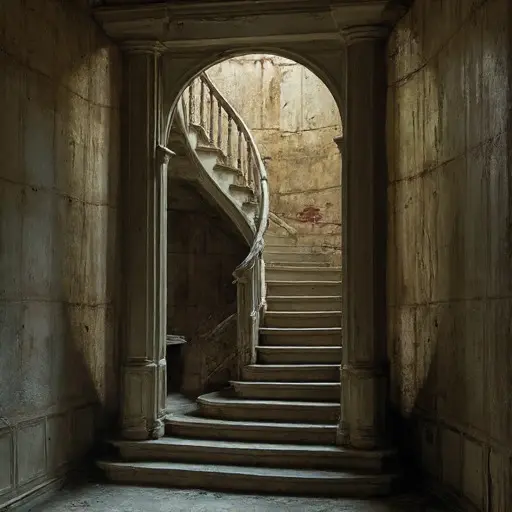
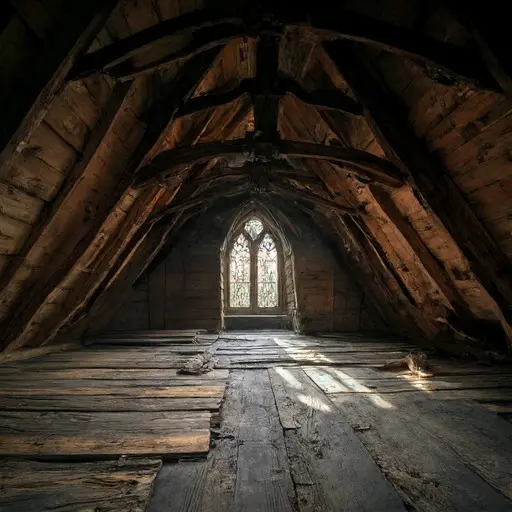
Doorways often fail to correspond with the rooms they appear to serve. Some open into shallow transitional voids that resolve into solid walls when viewed from another angle, while others seem to imply corridors that cannot be fully traced from any single perspective. Despite this, there is no structural collapse—only a sustained contradiction between perceived layout and physical continuity.
Mourningfold House does not read as neglected. It reads as unresolved. Its final configuration was never agreed upon, and the structure continues to preserve every version of itself simultaneously, held together not by stability, but by persistence.