Bramblewyck Parsonage
Bramblewyck Parsonage sits deep within a forest basin where the ground remains permanently damp, as though the soil itself never fully settles into dryness. Mist clings low between bramble thickets and blackened tree trunks, softening the edges of the building so it appears partly absorbed into the landscape. At first glance it reads as a restrained Victorian rectory—orderly, brick-built, ecclesiastical in tone—but prolonged viewing reveals a subtle refusal of stable proportion.
The lower structure is compact and grounded, built from tightly fired red brick with sparse stone detailing. Above it, the upper floor extends slightly beyond the base footprint, not uniformly, but in uneven increments that shift around the perimeter like delayed corrections in construction logic.
This creates a faint overhang that never resolves into a clear pattern. The roof rises steeply in traditional Victorian fashion, yet its ridge line bends into a shallow S-curve that is visually undeniable while structurally unmotivated. Slate tiles remain perfectly gridded across this distortion, refusing to acknowledge the curvature beneath them.
A corner bell tower interrupts the silhouette, placed off-center in a way that feels like a late-stage relocation rather than an original design decision. Each level of its louvered openings is fractionally misaligned from the one below, producing a stacked rhythm that still reads as stable masonry despite its incremental drift.
Windows across the façade are tall and narrow, reminiscent of chapel architecture, but their spacing occasionally compresses beyond comfortable logic. Stone frames overlap in places where separation should exist, yet the material does not fracture; instead, it appears to redistribute itself, maintaining continuity while subtly defying spacing constraints. The main entrance sits beneath a clean stone arch, its geometry precise and calm, contrasting with the irregular rhythm of the steps leading up to it, where risers vary in depth while maintaining consistent overall height.
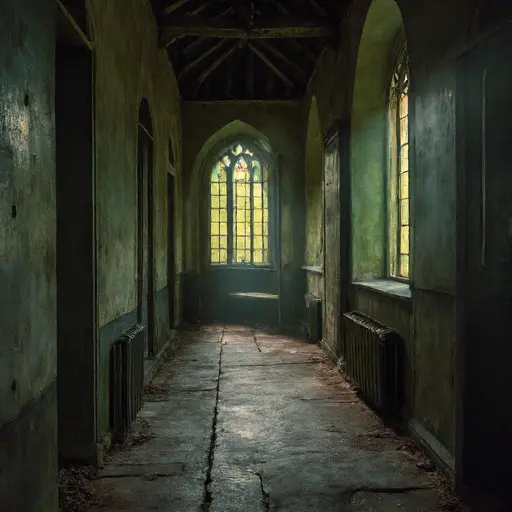
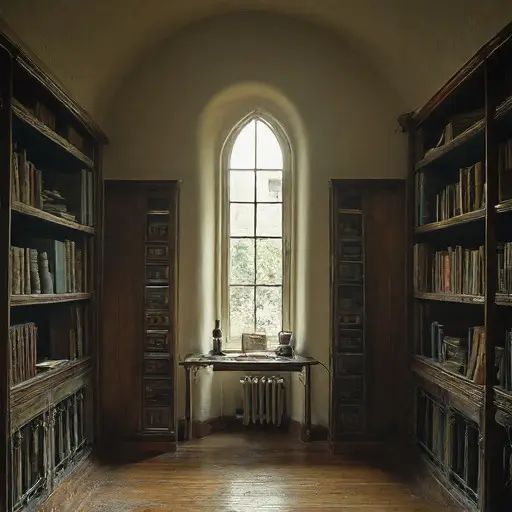
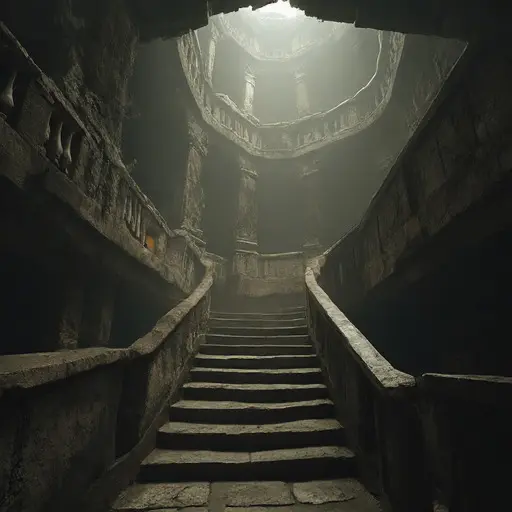
Inside, the parsonage is empty but not derelict. Wooden beams run across ceilings in regular intervals that fail to correspond with window placements below. Rooms feel slightly elongated compared to their exterior walls, as if interior partitions were adjusted after the outer shell had already been finalized. The effect is not collapse or decay, but a quiet persistence of structural disagreement.
The surrounding forest presses close without fully consuming the building. Brambles gather at the foundation stones, ivy threads through mortar lines, and moss spreads in soft gradients along shaded walls. Yet the bell tower remains unusually clear of growth, as if exempt from the forest’s slow reclamation.
Nothing here fails outright. Instead, the parsonage exists in a state of continuous, patient misalignment—an architecture that still behaves correctly in isolation, while quietly refusing to agree with itself as a whole.