Eastmere Observatory House
Deep in a fog-heavy forest valley, Eastmere Observatory House sits as a quiet anomaly in the landscape—half Victorian residence, half vertical observatory, rising from the ground like a structure extended beyond its original intent. Mist collects in dense, unmoving layers between the trees, softening the entire scene into muted greens and grays, where the house appears both grounded and subtly misaligned with its surroundings.
The base structure is a weathered red-brick Victorian home, its edges softened by time and moisture. Above it, the architecture transitions into dark timber and slate-clad forms, culminating in a cylindrical observatory tower that does not align perfectly with the center of the building. The tower rises slightly off-axis, its stacked masonry bands each rotated by a fraction of a degree, creating a slow twisting illusion that feels mathematically precise yet visually disorienting.
Despite this, every joint remains tightly sealed, reinforcing the impression of impossible structural accuracy rather than decay.
The main house expands in a U-shaped layout, though the symmetry breaks immediately in scale. One wing extends deeper into the forest, filled with larger windows and more open interiors, while the opposite wing compresses into narrow corridors and lower ceilings, as if the building adjusted itself to uneven spatial logic rather than uniform design. Across the façade, Victorian bay windows project outward at subtly different heights, preventing any clean horizontal alignment. Iron grilles repeat decorative patterns that occasionally overlap themselves, suggesting a design language that folds back into earlier versions of its own geometry.
The slate roof above undulates in gentle waves rather than forming a consistent ridge. Dormer windows interrupt its surface at irregular intervals, including two that face one another across an impossible internal gap, implying spatial relationships that do not resolve cleanly from the exterior.
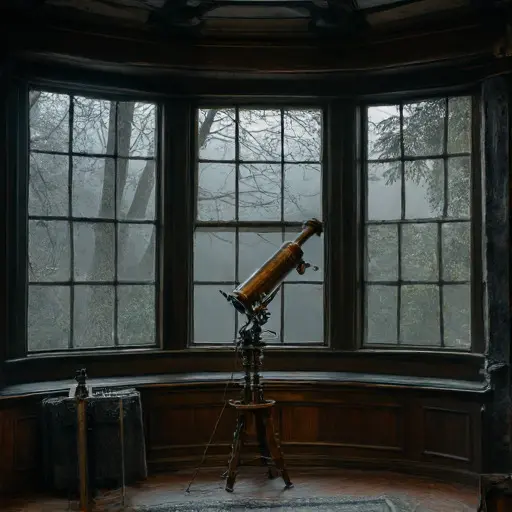
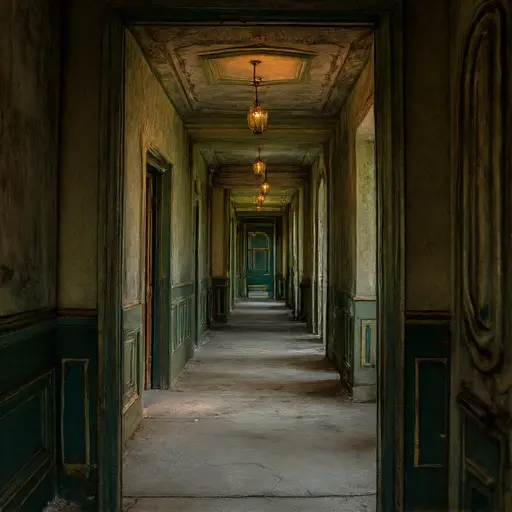
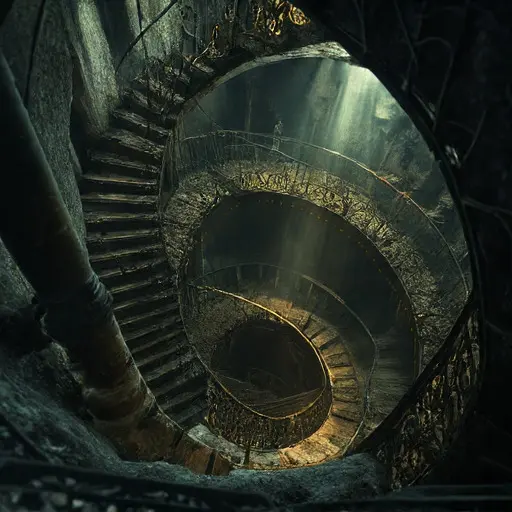
Inside, the structure feels meticulously maintained yet strangely uninhabited. Staircases spiral upward into the tower but occasionally meet landings that do not fully correspond to visible floors. Corridors widen or contract in ways that are not reflected externally, reinforcing the sense that the house’s internal logic is only partially readable from its façade.
Outside, the forest remains patient and close, but not invasive. Moss traces only specific mortar lines, avoiding certain seams as if respecting unseen boundaries. Fog fills every gap between trunks and branches, diffusing all edges into soft gradients. The house does not appear broken—it appears exact, but slightly out of agreement with itself, as if its geometry has drifted a few degrees away from the world it occupies.