The Star-Arm Manor of the River Meadow
An abandoned Victorian family manor sits in a wide, gently sloping river meadow where bright deciduous forest opens into long grasses, scattered willow trees, and shallow reflective water channels that thread through the landscape like quiet natural pathways. The lighting is soft and overcast, a steady natural daylight with no direct sun—just even sky illumination that reveals true color across stone, wood, and foliage with calm precision.
The manor is unusually multi-directional in its design, expanded over time into a star-like footprint rather than a single coherent block. The original Victorian core is a compact three-story structure of pale limestone with soft peach-toned brick inlays. From this center radiate four distinct architectural wings, each built in a slightly different Victorian sub-style, giving the building a layered, generational complexity that feels organic rather than planned.
One wing rises tall and narrow like a secondary tower, lined with vertical sash windows framed in faded cobalt blue woodwork. Another stretches long and low toward the river channels, defined by wide bay windows and pale mint-green paneling. A third wing cascades gently in stepped levels, painted in soft lavender plaster with cream trim, its proportions shifting subtly as it follows the terrain. The fourth wing is partially glass-fronted, a hybrid gallery and conservatory framed in oxidized turquoise ironwork with pale gold accents, allowing light to pass through its structure even on overcast days.
The roofscape is equally varied and intricate: intersecting slate planes in blue-gray, soft green slate, and faint rose-tinted tiles, each section marking a different era of expansion. Chimneys appear irregularly spaced—some tall and ornate with carved stone detailing, others simple and squat—yet all softened by time while remaining structurally sound.
Inside, the manor feels like a network of distinct households stitched into a single evolving residence. Each wing carries its own interior identity, shaped by its era of construction and use.
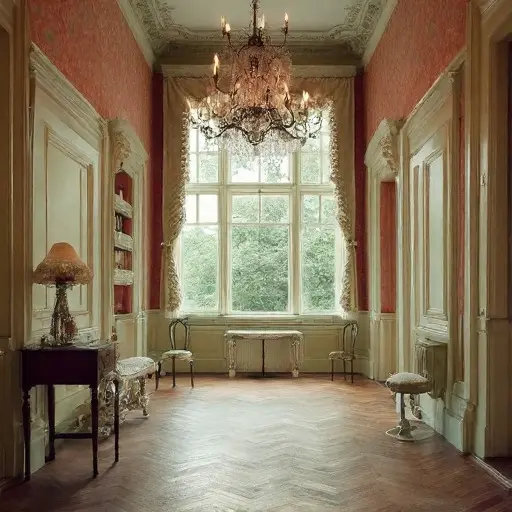
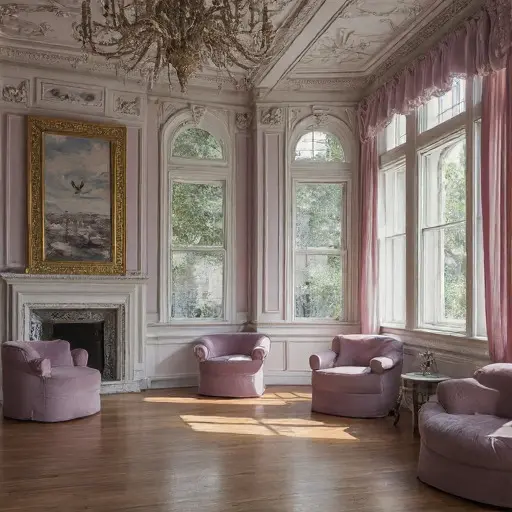
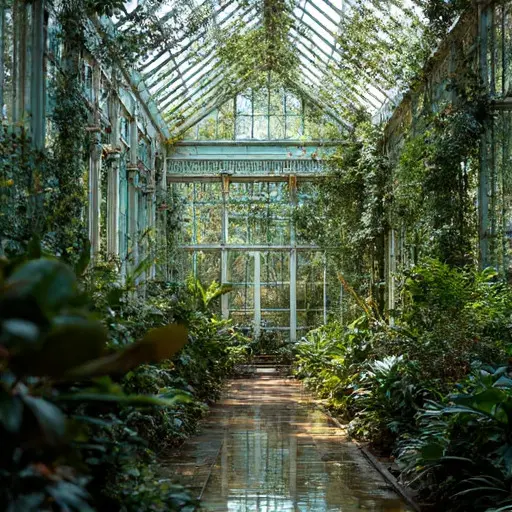
Furniture varies across sections: dark walnut Victorian pieces dominate older rooms, pastel-painted furniture appears in later expansions, and lighter, more open woodwork defines the glass wing. Despite this variation, everything remains orderly, as if the household simply expanded instead of ever stopping.
The surrounding river meadow is bright and open, with calm water reflecting muted sky tones, reeds swaying gently in the breeze, and grasslands blending smoothly into the forest edge. Trees are healthy and naturally spaced, allowing long sightlines through the landscape without density or darkness.
The atmosphere is quiet, balanced, and realistically lit—no storms, no decay-driven drama—just a complex Victorian estate that grew outward over generations, now resting in a calm river valley where forest and meadow slowly reclaim it with patience rather than force.