A coastal manor in gentle daylight
An abandoned Victorian family manor sits within a wide, sunlit coastal meadow forest where open grasslands blend naturally into scattered groves of birch and flowering hawthorn. The environment is bright and fully ordinary—soft blue sky, even daylight, and a steady breeze that moves through tall grasses and leaves without haze or atmospheric distortion. Everything feels calm, clear, and grounded in a stable, living landscape.
The manor is an elegant Victorian estate constructed from pale limestone and pearl-white brick, accented with refined trim in faded seafoam green and muted coral-red. Its architecture is tall and balanced, defined by symmetrical proportions and large sash windows that reflect sky, meadow, and trees with soft clarity.
Over time, tasteful additions were integrated seamlessly: a glass sunroom extending toward the meadow, a music salon wing with taller windows, and a modest central tower crowned with narrow arched openings framed in pale teal-painted wood.
The roof is steep and slate-covered, shifting between cool gray and soft blue tones depending on sunlight. A decorative iron cresting runs along the ridgeline, painted in weathered turquoise that still catches bright highlights. The structure feels cohesive despite its evolution, as if each addition respected the original Victorian language.
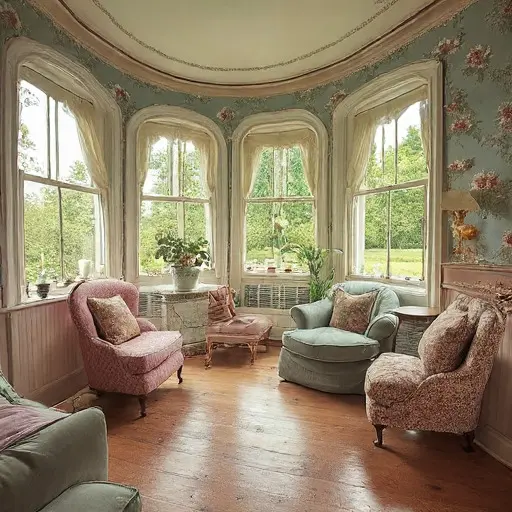
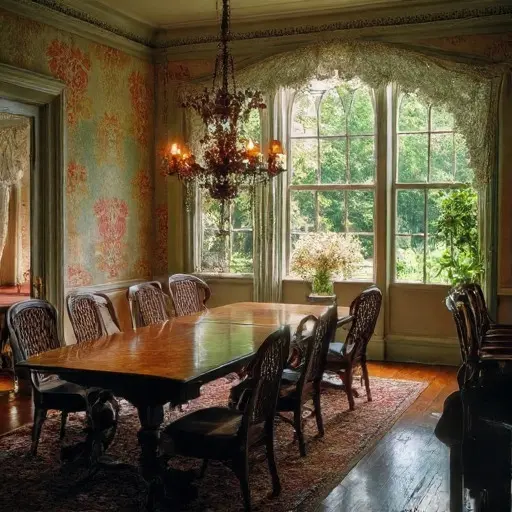
Inside, the manor remains orderly and preserved, filled with warm daylight that moves slowly across polished wood and patterned walls. Rooms are spacious and carefully maintained in appearance, with floral Victorian wallpaper in cream, blush pink, pale lavender, and soft sky-blue tones. Furniture is arranged with quiet precision—armchairs in muted sage, dusty rose, and pale aquamarine fabrics, carved wooden tables, and shelves of neatly aligned books that suggest an interrupted but not abandoned domestic rhythm.
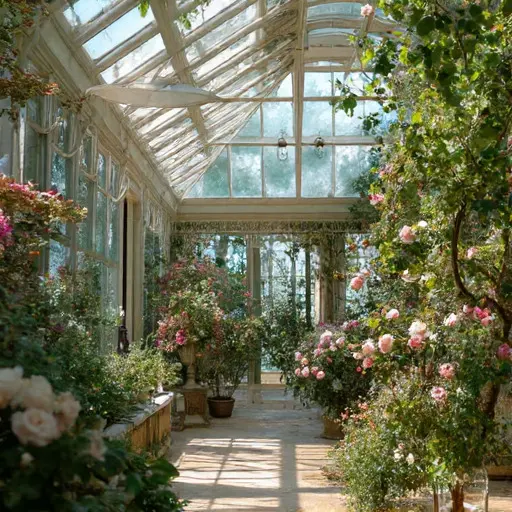
At the rear, the conservatory opens fully toward the meadow, framed in painted ironwork of mint green and softened gold. Inside, plant life thrives in controlled abundance—roses, ferns, and climbing vines arranged in balanced, well-tended growth that suggests continuity rather than neglect.
Outside, the coastal meadow forest remains open and vibrant. Wildflowers scatter across grasslands, bees drift between blossoms, and evenly spaced trees form a soft natural boundary where forest meets meadow. The air is bright and clear, carrying gentle movement rather than stillness.
The atmosphere is luminous, warm, and realistically grounded—an abandoned Victorian family manor resting peacefully in a bright coastal meadow forest, preserved in light, color, and architectural harmony rather than decay or silence.