Riverside Light at the Victorian Manor
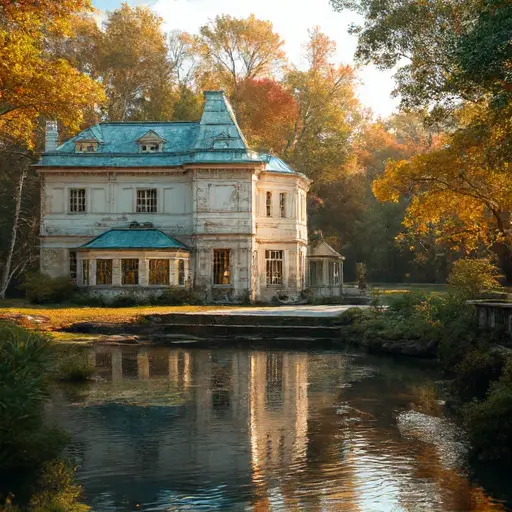
An abandoned Victorian family manor sits beside a wide, sunlit bend in a slow river, surrounded by a bright deciduous forest where poplar, maple, and birch trees form an open canopy that allows generous daylight to fill the landscape. The setting is calm and completely ordinary in tone—soft blue sky overhead, warm sunlight, and gentle leaf movement casting crisp, natural shadows across grass, stone, and flowing water.
The manor itself is a refined Victorian estate built from pale cream limestone, accented with soft seafoam green and muted periwinkle trim. Its architecture is balanced and carefully proportioned, featuring tall sash windows, delicate carved stone details, and a central façade topped with a modest decorative pediment. The steep slate roof shifts subtly in tone from cool blue-gray to faint lavender depending on the angle of sunlight, giving the structure a quiet, elegant variability.
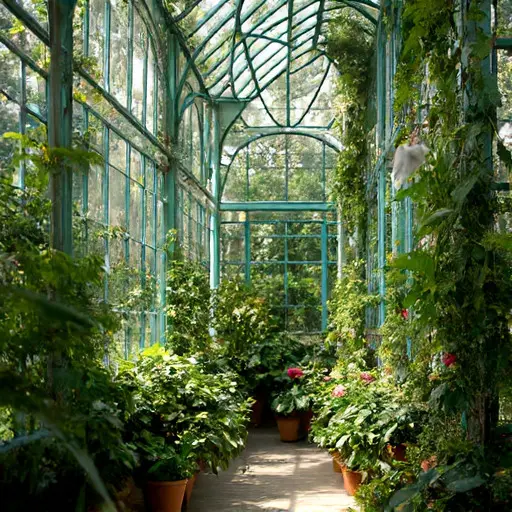
A glass conservatory extends along the riverside wing, framed in fine ironwork painted in faded turquoise and soft gold. The glass remains largely clear, allowing daylight to pour directly into the space and reflect off interior foliage. Inside, the conservatory is still alive—lush ferns, flowering plants in coral and pale yellow, and climbing vines that trace the geometry of the structure without overwhelming it.
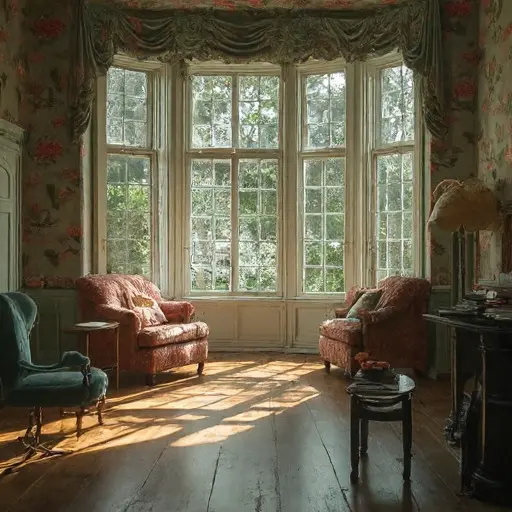
Inside the manor, rooms remain orderly and filled with natural light. High ceilings with restrained Victorian plasterwork create a sense of openness, while sunlight moves slowly across polished wooden floors. The interior palette is soft and harmonious: powder blue walls, warm ivory accents, pale sage tones, and blush pink floral wallpaper that remains crisp and intact. Furniture is carefully arranged and undisturbed—upholstered chairs in muted teal and dusty rose, smooth wooden tables, and bookshelves filled with neatly aligned volumes.
At the rear of the estate, the conservatory opens directly toward the river, where light reflects through glass and iron framing in shifting patterns. The space is filled with thriving plant life—bright green ferns, flowering vines, and carefully arranged shrubs that appear maintained by natural growth rather than neglect. The glass panels are clear enough to reveal both interior greenery and the shimmering river beyond.
The surrounding forest remains open and healthy, with evenly spaced trees, sunlit grass, and wildflowers along the riverbank. Water flows gently, reflecting fragments of sky and branches without distortion or turbulence. Everything feels balanced and naturally sustained.
The atmosphere is warm, peaceful, and grounded in realism—an elegant Victorian manor resting quietly beside a bright river, preserved by light, time, and a living forest rather than decay or abandonment.