The Hillside Greenhouse Family House
An abandoned family hillside greenhouse house stretches along a dense cool-temperate forest slope where tall firs and pale birch trees rise through drifting ground mist. The structure is a long, horizontally extended residence fused with a continuous greenhouse spine, built from pale structural steel and large glass panels framed in a faded powder-blue finish that has weathered into subdued gray-blue and desaturated mint tones. The entire building follows the natural incline of the hill in a gentle, deliberate arc, appearing placed upon the terrain rather than constructed against it.
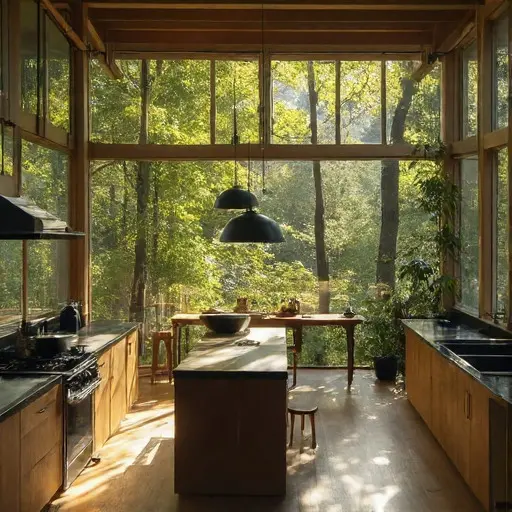
The home is organized into two parallel and interconnected systems. On one side, a linear domestic corridor contains the family living spaces—kitchen, dining area, bedrooms, and small transitional rooms arranged in a calm sequence along the slope.
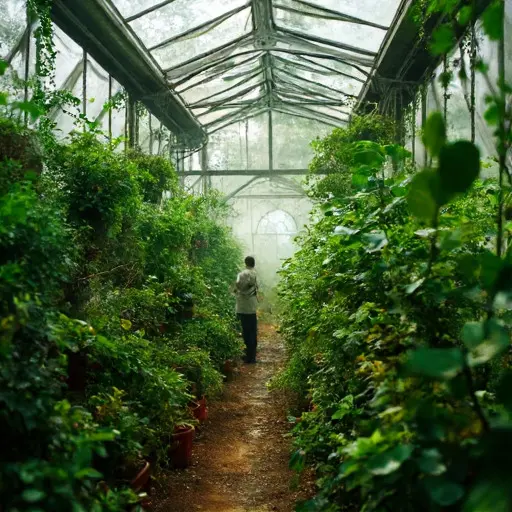
On the opposite side, a mirrored greenhouse corridor runs the full length of the structure, filled with layered plant beds, suspended planters, and climbing vines that have slowly adapted to the controlled glass environment. Large glass panes separate both systems, mostly intact but softened by condensation trails, mineral deposits, and fine forest dust that diffuses the outside world into muted green-blue tones.
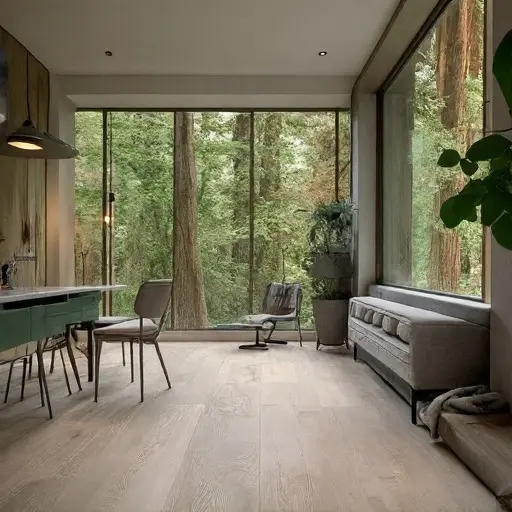
Inside the domestic side, the home remains quietly preserved. A pale wooden dining table sits undisturbed, surrounded by fabric chairs in muted gray-green upholstery. Shelving units hold everyday objects in their original arrangement, untouched since abandonment. Light enters from both the forest-facing windows and the greenhouse side, creating overlapping illumination patterns that shift gently across floors, walls, and furniture surfaces.
The surrounding forest is dense yet calm, shaped by long ecological continuity rather than disruption. Moss spreads across stones and fallen logs, while faint animal paths weave through undergrowth. Roots press gently against the greenhouse foundation without breaking it, and branches rest lightly against glass surfaces, forming a soft dialogue between architecture and forest. The stillness feels natural rather than frozen.
The atmosphere is overcast and softly luminous, with diffused light filtering through canopy layers and glass surfaces alike. Shadows are minimal and smooth, reinforcing a sense of quiet equilibrium. The entire scene conveys a believable merging of domestic life and botanical growth, where a family home has gradually become an extended greenhouse embedded in forest time.