The Courtyard Loop Family House
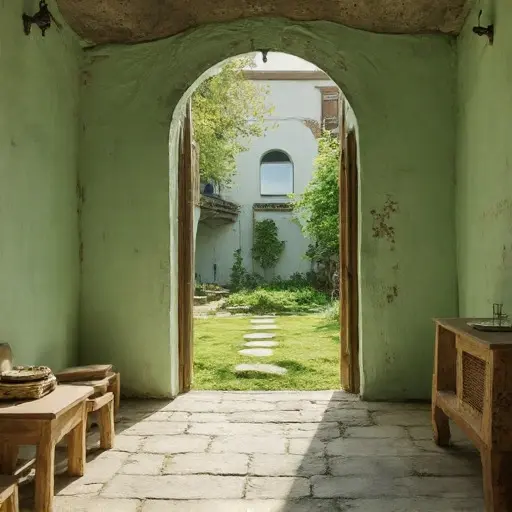
An abandoned family courtyard house sits quietly within a dense temperate forest that has slowly grown around an older rural settlement, leaving the structure partially concealed yet still fully intact. The architecture forms a low, inward-facing rectangular loop organized around a central open courtyard. Pale limestone walls anchor the structure, while upper levels of wood-framed rooms are clad in faded desaturated mint-green paint that has softened into muted gray-green tones through decades of weather and humidity. The house feels gradually assembled rather than formally designed, as if each wing was added in response to family needs over time.
At the center, the courtyard remains the defining space of the home.
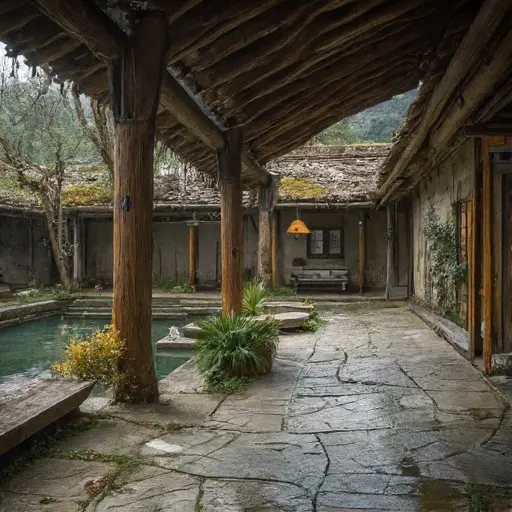
Once a shared daily gathering area, it is now a quiet, open void filled with soft moss, wild grasses, and scattered ferns growing between weathered stone paving. A shallow reflecting basin sits at its center, cracked along its edges yet still holding rainwater that mirrors fragmented patches of sky and canopy above. Covered walkways line all four sides of the courtyard, supported by slender wooden columns that have aged into pale, silvery tones, forming a continuous shaded perimeter around the open space.
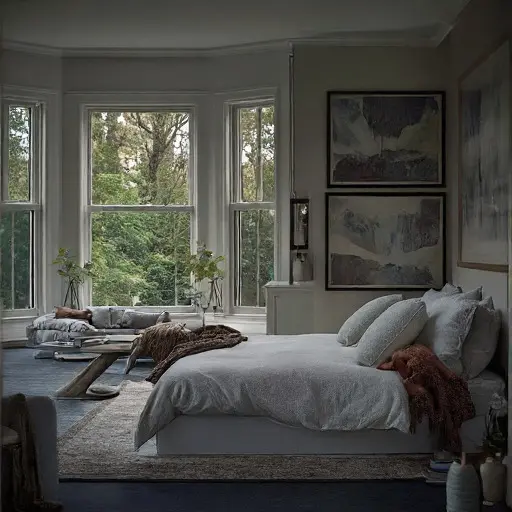
Inside, rooms are oriented inward toward the courtyard, creating a constant visual relationship with the central garden. Tall arched doorways and shuttered windows connect interior spaces to the open air. The interiors themselves remain orderly and domestic in character: simple wooden furniture, fabric seating in faded blues and soft grays, and built-in shelving that follows the geometry of the inner walls. Rooms facing the courtyard are bright with diffused natural light, while exterior-facing rooms are more enclosed and subdued.
The surrounding forest approaches the structure with quiet restraint. Trees stand just beyond the outer walls, their branches occasionally extending over rooflines, while roots trace along the base of limestone foundations without breaking or displacing them. Vines appear selectively, following mortar seams and architectural lines rather than overtaking surfaces, preserving the clarity of the original design.
The atmosphere is overcast and evenly illuminated, with soft forest haze diffusing light throughout the courtyard and interior corridors. The scene feels calm, balanced, and realistic—an ordinary multi-generational home organized around shared space, now gently reclaimed by a patient forest that respects its geometry rather than erasing it.