The Station-Edge Family Home
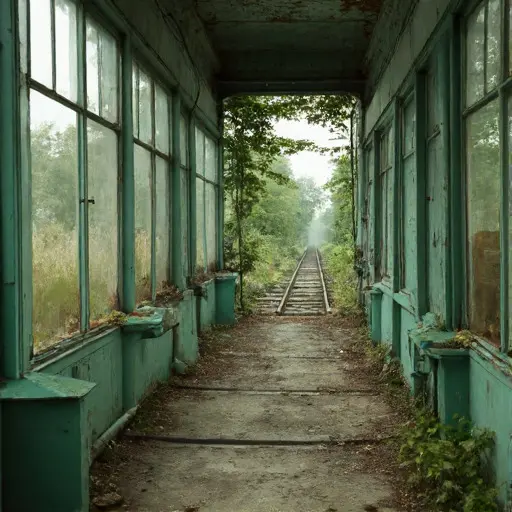
An abandoned family railway-adjacent home sits quietly beside a forest corridor where a single-track railway fades into dense green distance. The structure runs parallel to the old line like a companion to it—once a station master’s residence, later expanded into a modest family home through decades of practical additions. Its form is long and narrow, built from pale desaturated mint-green siding, off-white trim, and a gently pitched roof interrupted by small extensions that shift slightly in angle, reflecting incremental, necessity-driven construction over time.
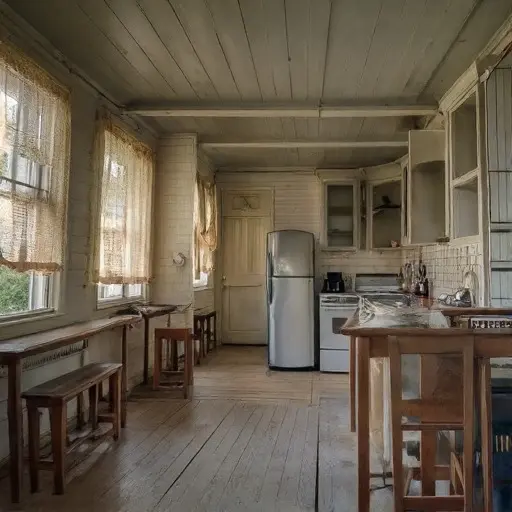
The house is clearly organized into layered functional sections. The original core contains the essential domestic rooms—kitchen, living area, and a central staircase leading to compact upper bedrooms.
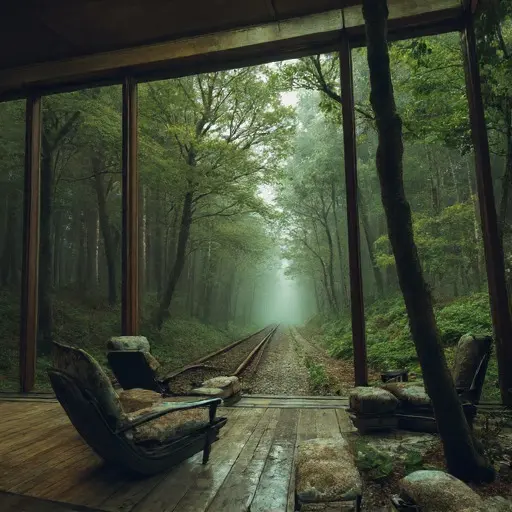
From this core, later additions extend toward the railway: a sunroom positioned directly beside the tracks, a narrow office with wide observation windows for monitoring train movement, and a glass-walled sitting room that now faces a quiet, overgrown corridor of rails. The railway itself remains intact but softened—its gravel ballast partially buried beneath moss, grasses, and scattered wildflowers that follow the line into the forest.
Inside, the abandonment is gentle rather than chaotic. Curtains in faded gray-blue hang motionless in open windows, and wooden furniture remains precisely where it was last used, edges softened by humidity and time. Surfaces carry a uniform layer of dust rather than disruption, suggesting a slow departure rather than sudden loss. In the hallway, a stopped clock anchors the interior in stillness, reinforcing the sense of suspended domestic life.
The surrounding forest has grown in with quiet persistence. Tall birch and pine trees form a natural tunnel around the railway corridor, while vines wrap lightly around old fence posts and signal poles without breaking them. The environment feels neither destructive nor invasive—only steadily reclaiming unused geometry.
The atmosphere is overcast, cool, and evenly diffused. Soft light filters through mist and canopy, flattening harsh contrast and emphasizing material honesty: painted wood weathered by moisture, glass dulled by age, and metal softened by oxidation. Everything feels grounded, realistic, and unhurried—an ordinary family home shaped by railway life and gradually absorbed into the forest’s long, patient timeline.