id=”l5p8qa”
The House of Converging Streams
In a secluded forest clearing where multiple narrow streams braid together into a shallow network of reflective channels, an abandoned family home spreads across the landscape as a scattered constellation of interconnected structures. Rather than forming a single unified building, the residence is composed of many small domestic volumes—each one added over decades—linked by enclosed glass corridors, covered walkways, and slender bridges that cross both water and woodland floor.
The result is an architectural composition that feels both whimsical and entirely plausible, as though each generation extended the home only as far as necessity or imagination required.
Each section of the house carries the visual memory of a different era. Soft duck-egg blue panels sit beside pale lavender siding.
Muted sage walls transition into weathered ivory timber. These pastel tones have softened further with age, dulled by constant humidity and filtered forest light until they appear like faded watercolor impressions resting quietly in the trees.
The roofscape is equally varied and complex. Steep gables overlap at irregular intervals, forming a layered skyline of dormers, attic rooms, sunlit glass additions, and narrow observation nooks. Some rooflines extend low toward the streams, while others rise above the canopy, allowing the structure to step gently with the terrain rather than resist it.
Between these volumes, covered walkways and glass corridors weave through the clearing. Beneath them, small wooden bridges cross slow-moving water channels that reflect fragments of the architecture above. Ripples distort pastel reflections into soft abstractions, merging building and landscape in constant subtle motion.
The surrounding forest feels intimate and alive without being overwhelming. Mature beech trees rise among thick ferns and moss-covered stones. The streams curve naturally around roots and fallen logs before converging beneath the structures. Nothing appears forced; the home seems to have grown within an already established ecosystem rather than imposed upon it.
Inside each wing, domestic life reveals itself in quiet, varied ways.
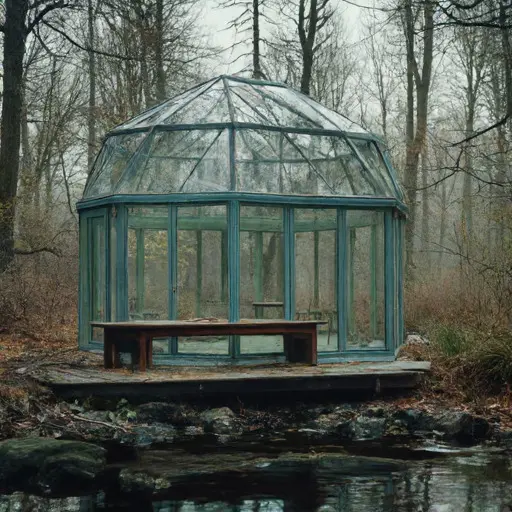
A glass breakfast room extends over one of the channels, its floor-to-ceiling windows revealing slow-moving water beneath. The interior is simple—light wooden furniture, faded textiles, and ceramic dishware left in place—but the presence of flowing water beneath the structure gives the room a suspended, almost weightless quality.
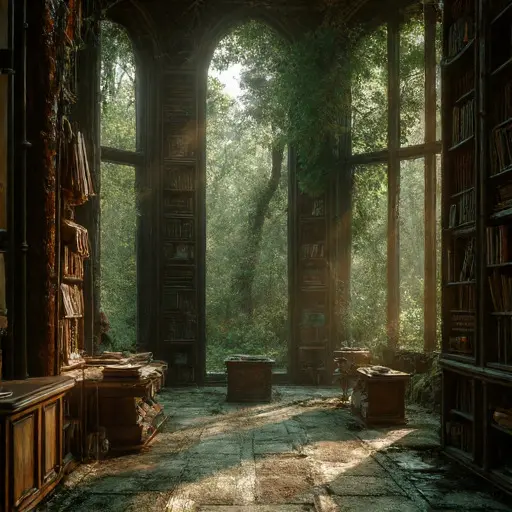
Elsewhere, a narrow tower-like addition houses a small library. Shelves line the vertical space from floor to ceiling, following the shape of the structure rather than a standard room layout. Books remain undisturbed, softened by dust and humidity. A single reading chair sits angled toward a window that overlooks dense ferns and winding water channels.
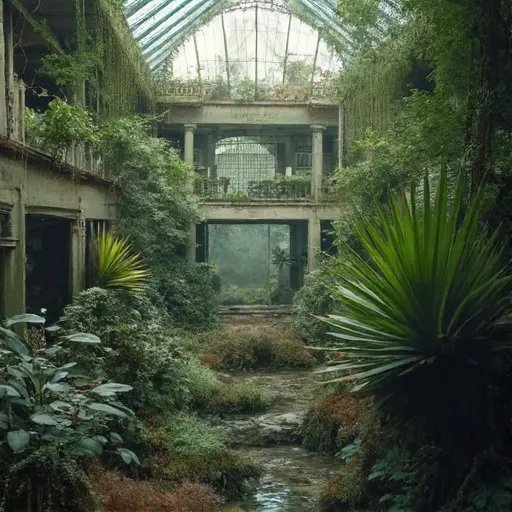
A third space—a greenhouse lounge—connects two major wings of the house. Here, overgrown ferns and climbing plants have slowly filled the room, thriving in the humid forest climate. Sunlight filters through aged glass, casting soft green-tinted shadows across pale walls and worn flooring. The boundary between interior and exterior feels gently blurred but still intact.
Throughout the property, furniture remains precisely where it was left. Dust settles evenly across surfaces, untouched by wind or disturbance. Curtains hang still in open windows. Chairs remain pushed slightly away from tables, as if someone simply stepped out and never returned.
Outside, water continues its slow movement through the clearing. Streams reflect fragments of pastel architecture broken by ripples and drifting leaves. Mist gathers in low pockets between tree trunks, softening edges and blending reflections into the surrounding forest.
The atmosphere remains calm, overcast, and gently luminous. There is no dramatic decay, no collapse, no sense of catastrophe—only the quiet persistence of time acting upon a home designed to grow, adapt, and coexist with its environment.
In this secluded clearing, architecture, water, and forest exist in delicate equilibrium. The house feels neither fully abandoned nor fully alive, but instead suspended in a long, quiet pause where nature and human design continue to share the same breathing space.