id=”l7w2fn”
The House Across the Drowned Bridge
In the center of a dark freshwater lake lies a small forested island, almost entirely concealed beneath a canopy of mature pines, maples, and moss-covered understory. From the mainland, only fragments of a faded lavender roofline can be glimpsed through the trees. Reaching the island requires crossing a long wooden footbridge that stretches silently over the still water, its weathered planks sagging in places where decades of neglect have allowed sections to sink slowly toward the lake below.
At the end of the bridge stands an abandoned family home unlike any single architectural style. It began as a modest lakeside cottage generations ago, but over time each new owner left a physical mark upon it.
Additional rooms appeared where they were needed. Porches were enclosed. Attics became bedrooms. Sunrooms were attached to capture better views of the lake. Reading nooks emerged beneath rooflines that had once been simple gables.
The result is a house that feels deeply personal rather than formally designed.
Its exterior remains painted in faded dusty lavender, softened by years of moisture into muted pastel tones that blend beautifully with pale cream trim and weathered woodwork. Against the dark greens of the surrounding island forest, the color palette feels almost dreamlike while remaining entirely believable. Every surface shows age: peeling paint, softened edges, slight warping in timber railings, and moss gathering in protected corners.
The roofscape is particularly distinctive. Multiple generations of additions have created a complex arrangement of intersecting rooflines that overlap and fold into one another. Dormer windows emerge unexpectedly between steep slopes. Small balconies hide beneath projecting eaves. Glass-walled reading rooms occupy elevated corners where former attics once stood. Yet despite the complexity, every addition feels practical and grounded, reflecting a century of gradual adaptation rather than a single grand design.
Large windows wrap around much of the house, reflecting the dark lake and surrounding forest. During overcast afternoons, the glass mirrors the silver-gray sky so perfectly that portions of the structure seem to dissolve into the landscape. Reflections of trees drift across the panes as subtle ripples move through the water below.
The island itself has become an extension of the home.
Narrow footpaths wind through dense vegetation, disappearing between moss-covered boulders and exposed roots before reappearing near forgotten garden terraces. Ivy threads gently along porch railings and stone steps. Ferns emerge between foundation stones. Low branches hang over sections of the roof without damaging them, creating the impression that forest and architecture have reached a quiet agreement after decades of coexistence.
Inside, the home remains remarkably intact.
Rooms connect in unexpected ways as additions from different decades merge into a labyrinth of domestic spaces. A narrow hallway might lead into an enlarged family room before opening unexpectedly into a glass conservatory overlooking the water. Small staircases connect half-levels created during various expansions, producing subtle shifts in elevation throughout the structure.
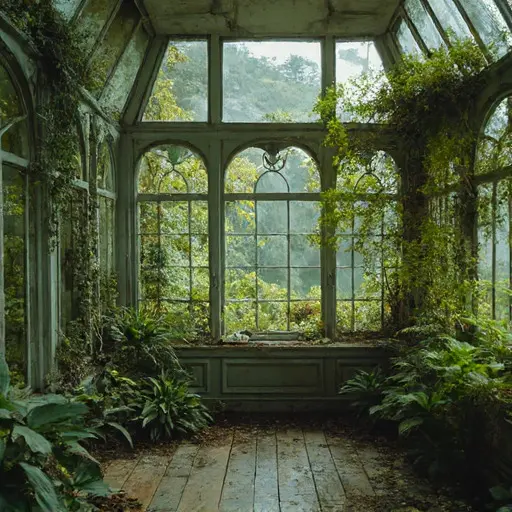
The conservatory remains one of the most striking spaces. Beneath a glass roof softened by age and condensation, ferns have flourished in the humid environment. They grow among abandoned planters and weathered wicker furniture, transforming the room into a gentle indoor garden suspended between house and forest.
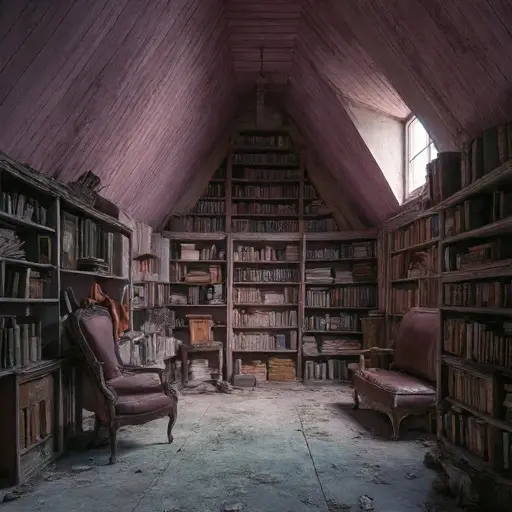
Further inside lies a library tucked beneath steep roof slopes. Built-in shelves follow the angles of the walls, filled with books left untouched for years. Dust settles evenly across wooden surfaces while muted daylight filters through narrow dormer windows.
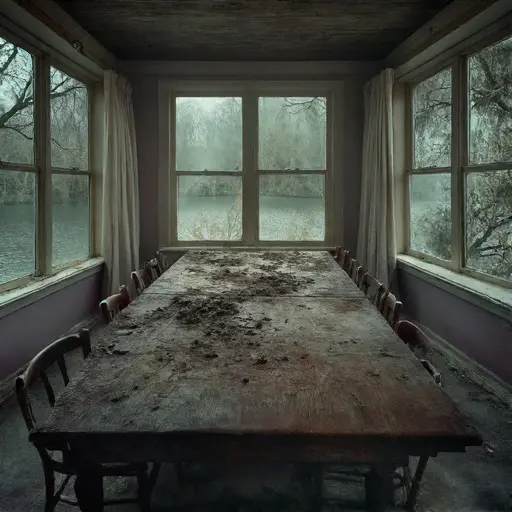
The dining room occupies one of the later additions and extends outward toward the shoreline. Windows surround the space on three sides, offering uninterrupted views of the lake through every season. A long wooden table remains centered beneath the ceiling, chairs still pushed into place as though waiting for a gathering that never returned.
Throughout the house, furniture remains where it was left. Dust covers surfaces but little has been disturbed. Faded fabrics in pale blue, cream, and muted lavender tones soften the interiors. The atmosphere feels preserved rather than ruined, as though time slowed upon reaching the island.
Outside, the lake reflects everything with quiet precision.
Birches and pines along the shoreline appear doubled in the water. The partially submerged bridge forms a broken line stretching toward the mainland. Soft ripples drift across the surface, gently distorting reflections without ever fully breaking them. Mist occasionally gathers above the water during cool mornings, blurring the boundary between forest, lake, and sky.
The atmosphere remains calm and overcast. High cloud cover filters sunlight into a silvery glow that settles evenly across the scene. There is no dramatic weather, no violent decay, and no sense of catastrophe. Instead, the house exists within a state of gradual integration—a family home quietly aging alongside the forest island that shelters it.
Today it stands as a secluded monument to ordinary generations of life. Every porch, stairway, window seat, and attic room tells the story of additions made when new space was needed, when children grew older, or when someone simply wanted a better view of the lake. Abandoned yet intact, isolated yet deeply connected to its surroundings, the house has become inseparable from the small island world that has protected it for so many years.