The Riverside Mill House Left Abandoned by Trade Decline
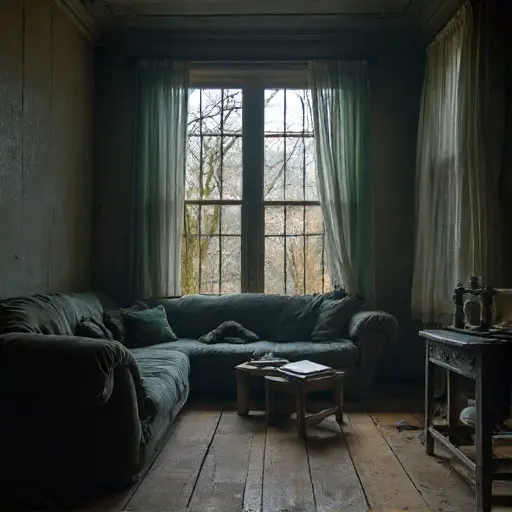
The living room of the mill house once served as the emotional center of a small milling family who lived here during the early decades of the 20th century, when the river still powered steady local trade and the surrounding forest road connected several working settlements. The space is modest but carefully arranged, shaped by necessity rather than decoration: a low sofa, a narrow bookshelf built into the wall, and a central table positioned to face the river window as if watching both weather and work cycles.
By the late 1930s, however, the mill’s productivity had already begun to decline.
Larger industrial facilities downstream absorbed much of the grain processing that once sustained homes like this one. The living room reflects the early stage of abandonment rather than collapse—objects remain in place, but their purpose has quietly dissolved. Dust gathers in thin layers along fabric seams, and the river outside continues its slow, indifferent movement, reflecting a life that no longer interacts with the house. The family did not leave suddenly; instead, each year brought fewer reasons to stay, fewer repairs made, and longer gaps between occupation and absence.
The Silent Machinery Floor Below
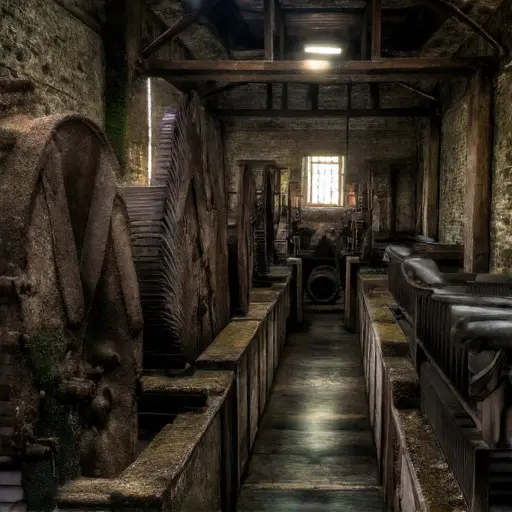
The lower level of the house tells a different part of the decline—one tied directly to the mill’s economic failure. The machinery room, once alive with motion and constant vibration, now rests in complete stillness. Massive wooden gears remain bolted in place, their edges softened by moisture and time, while iron components show uneven corrosion patterns where water once flowed regularly but now arrives only seasonally.
After the regional milling route was redirected in the early 1940s, maintenance became sporadic and expensive. The river itself changed subtly as well, its flow no longer strong enough during dry months to justify continuous operation. What remains is not destruction, but functional suspension: belts hang without tension, channels are dry but structurally intact, and the entire space feels paused rather than ruined. The silence here is heavier than in the rooms above, as if the building’s working memory still lingers in the stone.
The Upstairs Bedroom Overlooking the River
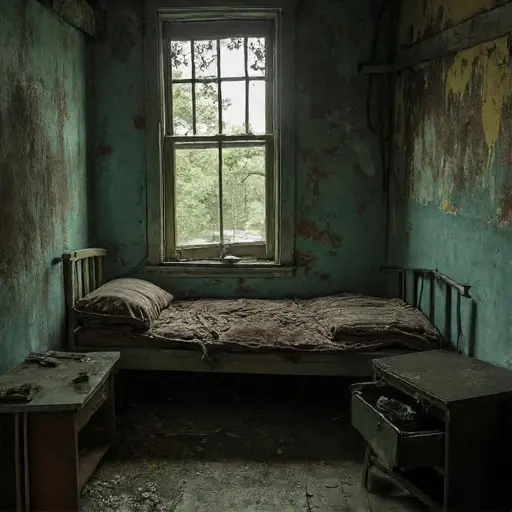
The upper bedroom marks the final stage of abandonment, where the human presence has retreated completely but not violently. It is a quiet withdrawal, recorded in subtle environmental changes rather than dramatic damage. The bed remains made, though the fabric has lost its color identity, and the window frame has begun to shift imperceptibly under long-term humidity from the river below.
By the late 1940s, the family had ceased living here full-time. Seasonal visits stopped entirely after a particularly wet year weakened the surrounding access paths, and the mill was officially decommissioned soon after. No sale or renovation followed. Instead, the house simply remained—legally present, physically intact, and functionally forgotten.
The forest and river have not reclaimed it aggressively. Ivy touches the lower stonework, and moisture slowly ages the timber, but the structure still stands in full coherence with its original intent. What defines its abandonment is not ruin, but absence of return. The mill house continues to face the river each day, unchanged in position, while everything around it moves forward without acknowledgment. No restoration ever came, no heirs returned to restart its machinery, and the building remains exactly where its working life ended—quietly suspended between function and disappearance.