The Leaning Turret Manor Left Within Forest Silence
The Victorian manor was constructed in the late 19th century as the primary residence of a rural family estate that once controlled a modest but prosperous tract of temperate woodland and surrounding cultivated land Built with ornate attention to vertical proportion and decorative detailing, the structure featured steep gabled roofs, carved wooden trim, and a central turret designed as both a visual focal point and observational space overlooking the estate grounds The original builders selected a site slightly elevated above the surrounding forest floor, relying on stone foundation blocks to stabilize the structure against seasonal soil moisture and root expansion At the time of construction, the surrounding forest was managed and selectively cleared, creating a clear separation between architectural space and natural growth
Over the course of the early 20th century, however, the estate began to decline as agricultural activity diminished and maintenance of surrounding grounds was gradually reduced The forest responded slowly but persistently, with deciduous trees expanding back into former garden spaces and root systems beginning to exert subtle pressure on the manor’s foundation Ivy and climbing vines spread across the exterior façade in controlled but continuous growth patterns, softening the sharp architectural lines without compromising structural integrity The central turret began to exhibit a slight lean over decades of uneven soil settlement, not enough to threaten stability but sufficient to mark the passage of long-term environmental change Garden paths that once connected formal landscape features became faintly visible beneath layers of moss and fallen leaves, preserving the geometry of the estate in a subdued, partially erased form
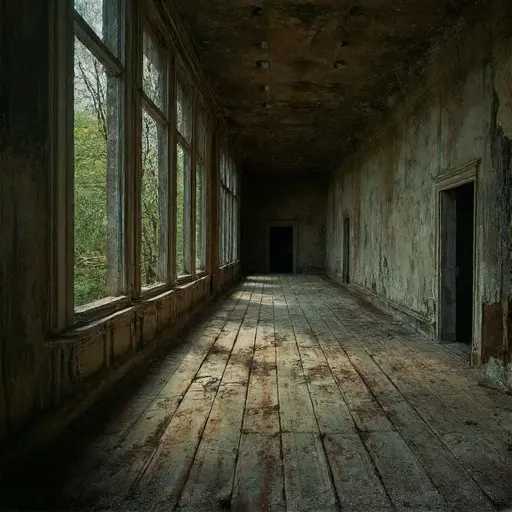
Despite abandonment, the interior of the manor remained structurally intact Rooms retained their original proportions, though time and humidity altered surface materials significantly Wallpaper in long corridors faded into layered abstractions where floral and geometric patterns dissolved into softened tonal gradients Wooden staircases remained functional but aged, their surfaces darkened by oxidation and repeated seasonal humidity cycles Tall windows along upper floors framed dense forest growth pressing close against the glass, creating a visual compression between interior and exterior spaces Rather than collapsing into ruin, the manor preserved its architectural coherence while gradually integrating the surrounding forest into its perceptual environment
Gradual Abandonment and Forest Reclamation
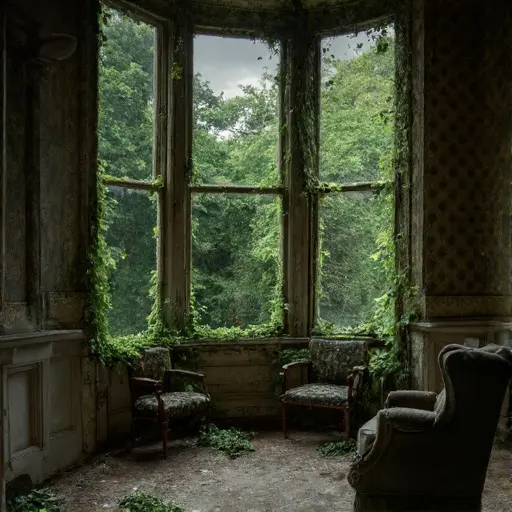
By the mid-20th century the estate had transitioned fully into a state of functional abandonment as the remaining family lineage dispersed and formal upkeep of the property ceased entirely Without active maintenance, the surrounding forest continued its slow encroachment into former estate boundaries, though in a gradual and non-destructive manner The wrought-iron gate at the property entrance eventually rusted into a fixed open position, while the ornamental fountain in the courtyard became filled with ferns and saplings that grew in concentric patterns aligned with its original basin geometry This subtle preservation of spatial order within natural reclamation created a unique condition where the geometry of the estate remained legible despite ecological transformation
Final State of Victorian Forest Integration
<img src=”https://beyondvisit.
com/wp-content/imagecontent/uploads/abandoned victorian house 54447437.webp” alt=”” />
By the late 20th century the manor was no longer listed as an active residence and was instead classified as a historical forest-edge structure under passive ecological observation No restoration efforts were undertaken due to its stable integration with surrounding vegetation and lack of structural urgency Ownership remained technically recorded but functionally inactive, with no maintenance or habitation activity documented for decades The manor remains in place as a quiet architectural presence within the forest, slowly shared between built form and natural growth
The Victorian manor persists as a silent structure within the temperate woodland Its leaning turret and vine-softened façade remain intact despite long abandonment No return has occurred, and no reconstruction has been attempted The house endures as a quiet convergence of architecture and forest, resting in stillness beneath diffuse light filtering through the canopy