The Blackwell Manor Left Vacant After Structural Drift
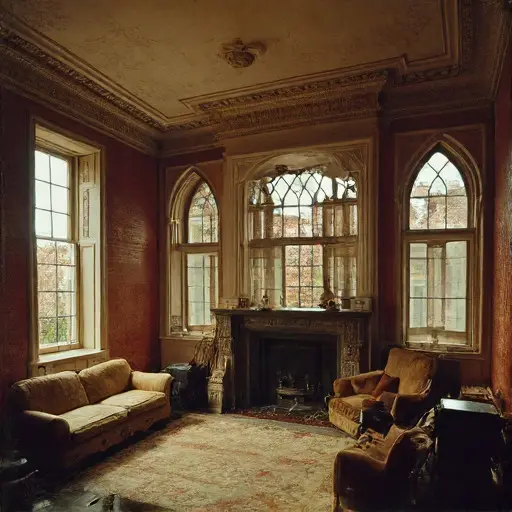
Blackwell Manor was constructed in 1894 by the Harrington-Blackwell estate family, who commissioned the residence as a permanent rural retreat deep within an untouched forest basin The intention was to build a single unified Victorian Gothic structure, but early construction records already note minor blueprint drift between phases, where successive wings were measured and laid out independently rather than from a fixed master grid As a result, the manor developed subtle but cumulative geometric inconsistencies from its earliest years The household initially consisted of three generations living under one roof, supported by income derived from textile trade holdings in nearby industrial towns For a time, the estate functioned without issue despite its unusual architecture, as servants and family members adapted naturally to the shifting interior proportions However, by the first decade of the 20th century, financial dependencies on external markets began to weaken the family’s ability to maintain the increasingly complex structure, and early signs of neglect appeared in areas where maintenance required specialized masonry and carpentry beyond local capability
Early Structural Drift and Domestic Strain
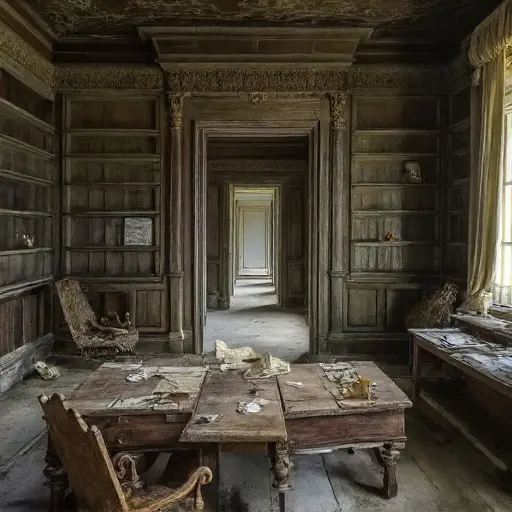
By the late 1920s the Harrington-Blackwell household had begun to fragment under combined financial pressure and structural complexity The manor’s maintenance requirements had grown disproportionately due to its drifting geometry, where no two wings shared perfectly aligned load paths or consistent measurements across floors and façades External contractors refused large-scale repairs after repeated structural surveys revealed that sections of the building had rotated slightly relative to each other while remaining physically stable This created a situation in which even routine repairs required custom fabrication of materials to match non-standard angles and offsets Family members began to relocate gradually, first the younger generation moving to urban centers for employment, followed by elder occupants who could no longer sustain the environmental isolation By 1931 only a small portion of the central residence remained actively inhabited, while outer wings were left sealed off and slowly overtaken by moisture and vegetation infiltration The house continued to function, but its internal coherence weakened as corridors, staircases, and doorframes increasingly failed to align across different sections of the structure
Final Evacuation and Structural Abandonment
<img src=”https://beyondvisit.
com/wp-content/imagecontent/uploads/abandoned victorian house 79374729.webp” alt=”” />
By the early 1930s Blackwell Manor had entered irreversible abandonment following legal dissolution of the Harrington-Blackwell estate after the final heir died without a direct successor Probate delays prevented immediate sale or restoration, and by the time ownership was clarified, the cost of stabilizing the structure exceeded any viable economic justification County inspectors documented widespread but non-catastrophic structural drift, noting that while no section had collapsed, the building’s global alignment had shifted beyond standard architectural tolerances Entire wings were declared uninhabitable due to incompatible floor heights and corridor misalignment rather than material failure, making restoration effectively equivalent to rebuilding the entire estate The surrounding forest further accelerated decay as moss, ivy, and moisture penetrated joints and weakened timber supports across multiple levels By 1942 the manor was formally removed from residential registries and left without maintenance or oversight
Blackwell Manor remains standing deep within the forest as an abandoned and unresolved architectural relic Its structure continues to exhibit slow, subtle geometric drift, with rooms and façades maintaining physical plausibility while deviating in alignment across time No restoration has ever been attempted, and no surviving family members have returned to reclaim the estate The building persists in a silent state of gradual decay, fully abandoned, structurally intact yet increasingly misaligned, left to the forest without resolution or return