The Canal House That Waited Beside Still Water
An abandoned surreal Victorian canal-side townhouse stands along a calm urban waterway under bright, peaceful afternoon daylight. The atmosphere is quiet and nostalgic, with soft warm sun reflecting off the canal’s surface and onto the surrounding brick and plaster facades. There are no storms, no wind disturbances, and no activity along the walkway—only a still, suspended moment in a city edge that feels gently forgotten rather than decayed.
The architecture belongs to a narrow Victorian rowhouse, part of a continuous canal-side street, yet this single residence shows subtle signs of long-term individualized transformation. The structure has been slightly expanded backward over time through layered rear additions, forming a modest but complex extension system that remains coherent in proportion. Floors exhibit a faint vertical misalignment caused by gradual settling, though the building remains stable and structurally believable.
A small bay window faces the canal, its framing slightly shifted but intact, catching soft reflections of water and sky. Toward the rear, a glass-roofed kitchen extension brings in diffuse daylight, while the attic has been converted into a living space with asymmetrical dormer windows placed irregularly along the roofline. The overall geometry remains dense and urban, yet softened by incremental personal modifications accumulated over decades.
Materials across the townhouse reflect long exposure to damp canal air. The exterior paint is faded cream and pale mint, worn thin in places where exposed red brick shows through earlier repairs. The slate roof contains irregular tile replacements in light gray tones, subtly mismatched but functional. Wooden sash windows are slightly warped yet fully intact, and iron balcony railings carry a soft rust patina. Brass door fixtures are dulled but still present, catching faint highlights from the sun. Along the canal edge, pale limestone stonework shows water staining that marks years of rising and falling levels.
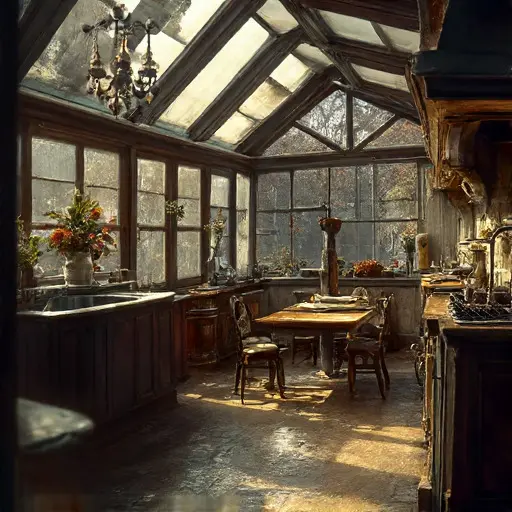
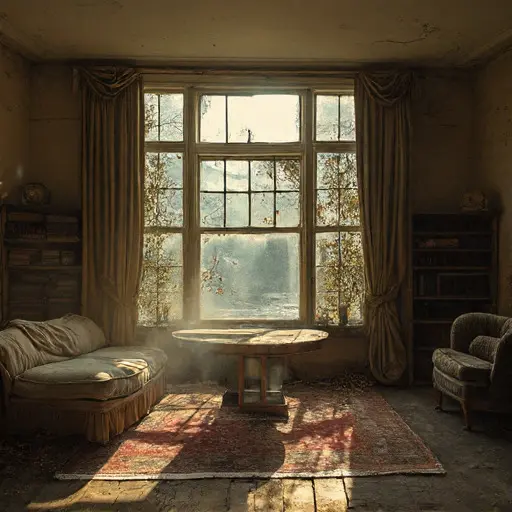
The state of abandonment is long-term but peaceful. The interior remains fully furnished throughout: dining tables are set in quiet order, beds are made but dusted with time, and curtains hang naturally without disturbance. Dust is visible in sunbeams entering from canal-facing rooms, creating a soft atmospheric layer that emphasizes stillness rather than decay. Wallpaper peels lightly in select areas, and wood in damp zones shows subtle warping, but there is no collapse, no vandalism, and no structural failure.
Outside, the canal runs slowly through the urban landscape, its reflective surface mirroring facades in soft distortion. A stone walkway lines the water’s edge, slightly cracked with grass growing in the seams. Small overgrown potted plants remain on balconies above, suggesting forgotten maintenance rather than sudden abandonment. Rows of similar townhouses extend into the distance, gradually fading into perspective and atmospheric haze. Sunlight reflects off the water, scattering warm highlights across brick and plaster surfaces.
The camera perspective is a cinematic wide shot at eye level from the canal walkway, using a 35mm lens that emphasizes linear perspective and depth along the water’s vanishing point. The composition draws the eye through repeating architectural rhythms while maintaining focus on the central townhouse. Soft depth of field gently blurs distant buildings, reinforcing the intimacy of the immediate structure.
The overall impression is one of quiet urban suspension. The canal house has not collapsed or decayed—it has simply remained, fully furnished and softly illuminated, holding its place beside still water as if the city itself briefly paused and never resumed.