The Seabright Victorian House That Waited in Still Light
An abandoned surreal Victorian seaside family house sits facing a calm, bright shoreline under soft afternoon daylight. The atmosphere is quiet and stable, with no storms or dramatic weather—only a gentle coastal breeze moving through tall grass and the distant rhythm of slow ocean waves. The house feels less like a ruin and more like a paused domestic memory preserved in salt air and sunlight.
The architecture is the result of generations of careful expansion. What began as a modest Victorian coastal home has gradually extended into a slightly asymmetrical but still believable family residence. A steep gabled roof defines the original structure, while a later sunroom projects toward the sea with larger glass panels, and a smaller kitchen extension settles lower on one side. These additions are not chaotic; instead, they form a subtle architectural drift, as if each generation adjusted the house slightly without ever rebuilding it from scratch.
Materials throughout the structure carry the quiet imprint of coastal time. Sun-faded white clapboard siding dominates the exterior, softened by pale seafoam green and washed-out blue trim. The slate roof is light gray with salt-weathered edges that have dulled over years of exposure. An aged oak porch stretches across the front, its boards worn smooth but intact, supported by iron railings lightly rusted yet still structurally sound. Brass lantern fixtures hang at intervals, their surfaces dulled into a soft patina that catches daylight without glare.
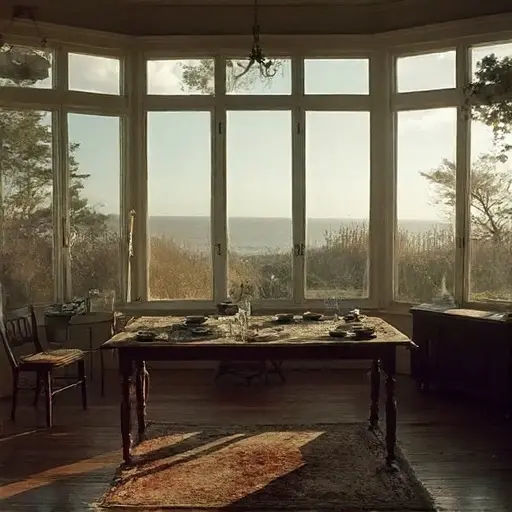
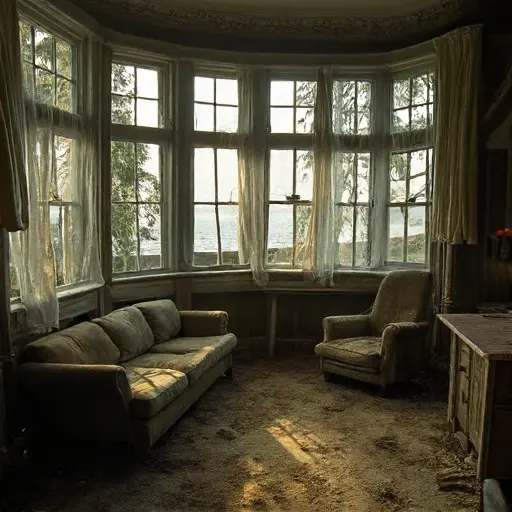
The house shows long-term abandonment without collapse or destruction. Inside, furniture remains exactly where it was last used. Sofas, dining tables, bookshelves, and beds are still arranged in coherent domestic order, only softened by dust and time. Curtains hang loosely in still air, and sunlight reveals fine particles drifting through beams of light. Paint on the walls peels gently in coastal patterns, while wood surfaces show slight warping from humidity rather than decay. Everything feels intact, as if life simply stopped continuing rather than leaving in haste.
The surrounding environment reinforces this quiet suspension. A narrow garden path leads toward the house, partially overgrown but still traceable through the grass. Tall beach vegetation sways gently in the breeze, and scattered driftwood rests near the shoreline. The ocean beyond is calm and slow, reflecting a pale blue sky with soft white clouds. Light is even and warm, without harsh shadows or dramatic contrast, emphasizing clarity over tension.
A final interior view through the upper bay windows reveals a bedroom left undisturbed. A made bed sits beneath soft curtains, slightly dusted but carefully arranged. A wooden dresser stands against the wall with small objects still aligned on its surface. The glass panes here subtly distort the horizon, bending the sea into faint curves that do not match the outside world’s geometry.
The house remains abandoned in the most complete sense. No inhabitants, no recent activity, no sign of return. Yet nothing has collapsed or been destroyed. It persists in quiet architectural continuity—sunlit, weathered, and gently preserved—holding its place above the sea like a memory that refused to fade.