The Ashfall Highland House Left in Heat-Set Silence
The Ashfall Highland House stands in a volcanic valley where the ground itself feels older than the idea of settlement. It was once a modest rural residence, built for stability rather than spectacle, but the landscape beneath it never remained still. Over decades, subtle geothermal warmth rose through basalt fractures below, not enough to damage the structure outright, but sufficient to coax it into a slow, irreversible deformation.
The result is not ruin, but a house that has learned to sag with the earth rather than resist it.
The architecture remains fully legible: pale stone walls, faded plaster surfaces, and dark timber framing still define its silhouette against the highland mist. Yet nothing holds a strict line anymore. Each section of the building has settled at its own pace, producing a quiet vertical inconsistency where corners lean independently, and wall planes no longer agree on what “straight” means. It feels less like a collapse and more like a long negotiation between gravity and heat.
The roof is the most expressive record of this slow transformation. Its low-pitched layers no longer form a precise ridge but instead undulate in long, shallow curves that dip and rise across the house like cooled lava that never fully solidified. Tiles have shifted into subtle wave patterns, not sliding off, but reorganizing themselves into thermally influenced bands. Some sections press downward into the walls beneath, while others lift slightly, as if the structure is breathing at a geological pace.
Windows throughout the house are uniformly dark. There is no interior glow, no reflection of life, only matte voids that absorb the muted light of the valley. Their shapes remain recognizably rectangular, yet even they are not immune to the long influence of heat and settlement—frames stretch or compress just enough to suggest that geometry here is no longer fixed, only persistent.
The stone porch at the entrance wraps gently around the front of the house, partially embedded into uneven volcanic soil. Its steps are not broken but irregularly spaced, as though the ground beneath them has shifted in slow motion over generations. Wooden supports lean into the terrain at different angles, still bearing weight without complaint, as if they adapted rather than resisted the slow instability of the earth.
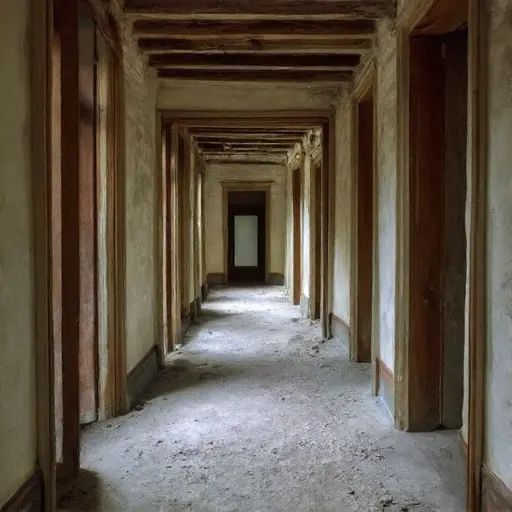
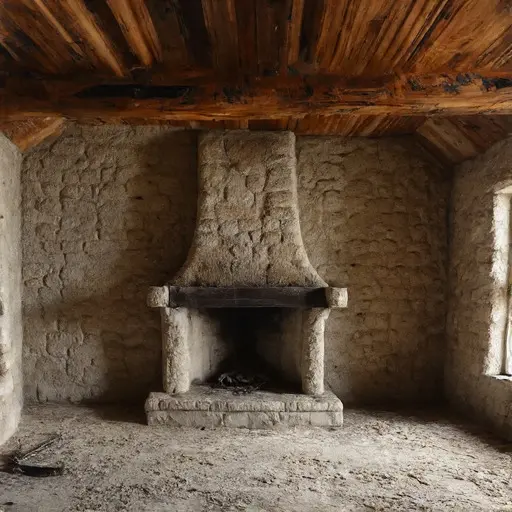
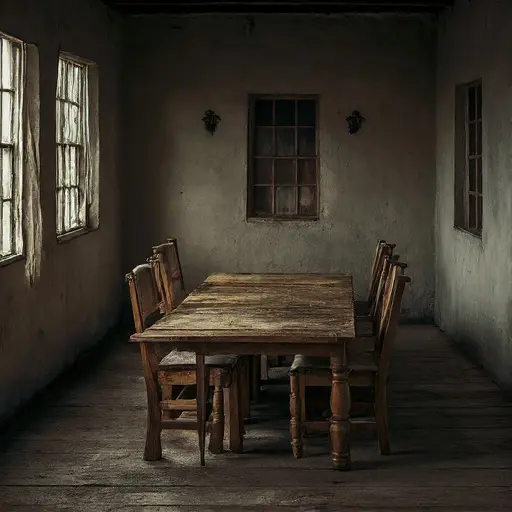
Inside, the house remains fully intact in function and layout. Rooms are still recognizable—kitchen, parlor, sleeping quarters—but transitions between them feel subtly inconsistent, like walking across surfaces that cannot decide on a single horizontal plane. Doorways do not fail; they simply feel slightly misaligned with expectation, as if the building remembers earlier versions of itself.
Outside, the volcanic highland valley remains still. Basalt fields stretch outward in fractured darkness, interrupted by dry grass and sparse pine clusters. Occasional pale steam vents rise in the distance, drifting through the overcast air without urgency. The house stands alone in this mineral silence, neither collapsing nor thriving, but slowly conforming to the heat of the ground beneath it.
It remains abandoned in the most definitive sense: no lights, no movement, no return. No restoration has occurred, no intervention has altered its condition, and no presence has re-entered its rooms. The Ashfall Highland House endures as it is—quiet, unlit, and gradually reshaped by the slow pressure of geothermal time, holding its softened form in permanent abandonment.