The Bramblewick Orchard House Left After Glass Corridor Closure
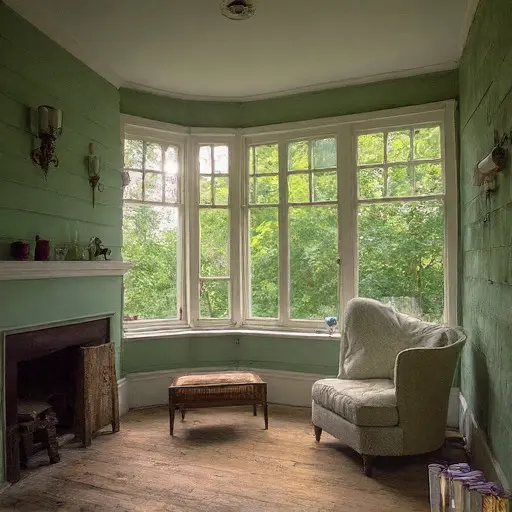
The Bramblewick House was constructed in 1882 on the gradual boundary where cultivated farmland transitioned into an older, semi-wild orchard that had been planted several generations earlier by a now-dispersed agricultural estate The house was built for the Linton family, who specialized in orchard management and small-scale botanical experimentation, using the property as both a residence and a seasonal research site for fruit cultivation and preservation techniques
The defining architectural feature of the property was the glass corridor greenhouse connecting the main residence to a small detached reading pavilion This corridor was designed as a controlled climate passageway for studying plant growth across seasonal variation while maintaining direct domestic access between living and study spaces The structure was slightly bowed along its length due to thermal expansion over decades but remained structurally stable through iron framing reinforcement
The reading pavilion itself was rotated a few degrees relative to the main house, a deliberate design choice intended to optimize sunlight exposure from the orchard edge rather than align with the main building’s geometry This created a subtle angular tension across the property that became more pronounced as later additions and repairs accumulated
Gradual Decline of Orchard Management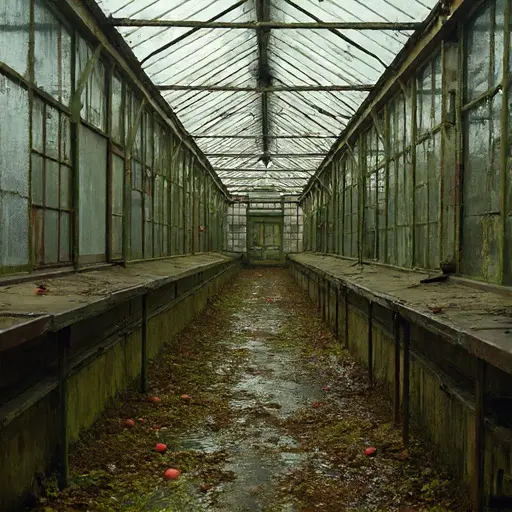
By the early 1930s the Linton family began reducing their time at Bramblewick as commercial orchard operations declined and larger agricultural producers began to dominate regional fruit distribution Markets for experimental orchard varieties contracted significantly leading to reduced staffing and eventual abandonment of seasonal research activities
The greenhouse corridor remained in partial use for several years but gradually lost its function as plant cultivation ceased entirely Wooden shutters on orchard-facing doors began to warp slightly under constant moisture exposure and the glass surfaces developed faint clouding from long-term humidity accumulation The structure itself remained stable but increasingly disconnected from its original purpose
The surrounding orchard began to shift from cultivated rows into a more naturalized environment Fallen fruit accumulated seasonally and pathways became less maintained allowing vegetation to slowly reclaim structural order without disrupting the core layout
Final Abandonment of the Orchard Corridor House
<img src=”https://beyondvisit.
com/wp-content/imagecontent/uploads/abandoned victorian house 58672493.webp” alt=”” />
By 1949 the Bramblewick Orchard House was fully vacated following the closure of the Linton agricultural operations and the relocation of remaining family members to urban residences where agricultural research facilities had become centralized No redevelopment or demolition was carried out and the property was left in its existing condition
In the years that followed the structure remained unchanged in form while gradually responding to environmental exposure The greenhouse corridor retained its structural integrity despite humidity and seasonal temperature variation while the orchard continued its slow transition toward natural rewilding without human intervention
By 1950 the Bramblewick Orchard House remained standing at the edge of the orchard fully abandoned and structurally intact No collapse occurred no restoration was attempted and no return was recorded The glass corridor still connected house and pavilion in quiet suspension between cultivated memory and returning wilderness