The Hollowmere Forest House Left Quiet After Bathhouse Closure
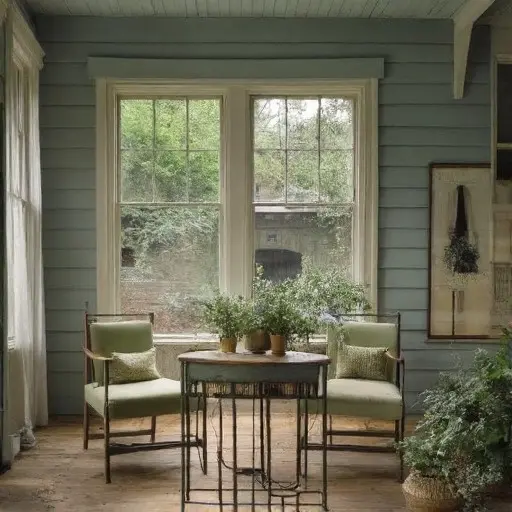
The Hollowmere House was constructed in 1886 at the edge of a dense woodland region where small settlements gradually gave way to unmanaged forest growth The original structure was a compact Victorian family home built for the Larkin family, who chose the location for its proximity to a natural spring-fed water source emerging near the tree line Unlike many rural homes of the period, the property was designed with a secondary architectural feature from its earliest phase: a stone bathhouse annex constructed behind the main residence in a partially recessed courtyard space
The bathhouse was built using carved limestone and faced inward toward a sheltered stone basin supplied by diverted spring water The design reflected a Victorian emphasis on hygiene and therapeutic bathing practices, with ceramic tiles in muted teal and off-white lining the interior surfaces The annex became an important part of daily domestic life, functioning not only as a bathing space but also as a seasonal retreat during colder months when the forest edge grew damp and quiet
Over time, the main house evolved gradually, with small additions reflecting the needs of successive generations A slightly enlarged bay window was added to the front façade, roof sections were repaired and replaced in uneven intervals, and interior spaces were subtly reconfigured to improve circulation between the house and bathhouse courtyard Despite these changes, the structure remained coherent and stable, its irregularities emerging from lived adaptation rather than formal redesign
Gradual Decline at the Forest Edge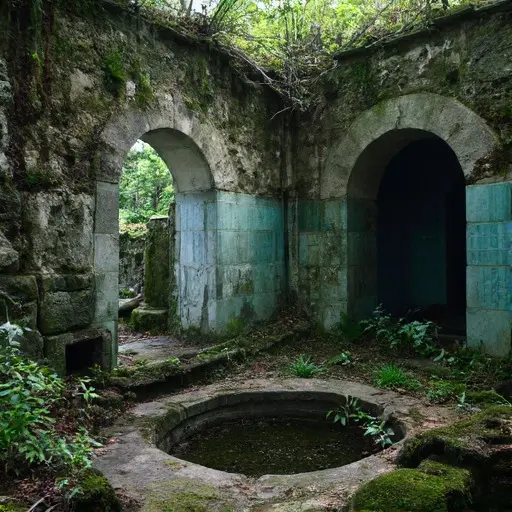
By the early 1930s, the Larkin family began to reduce their permanent residence at the Hollowmere property as younger members relocated to nearby towns for employment and education opportunities The bathhouse, once central to daily routines, saw reduced use first, followed by gradual closure of seasonal living spaces within the annex and rear-facing rooms
The forest surrounding the property began to encroach slowly, with damp soil and fallen branches accumulating along garden paths leading to the bathhouse courtyard Maintenance of the stone basin became irregular, and minor water stagnation appeared in low areas of the structure The carved limestone remained structurally stable, but moisture penetration into shaded joints led to subtle staining and moss accumulation
Inside the main house, paint began to peel in thin layered sheets, revealing older tones beneath the faded pale blue-gray exterior Wooden porch supports sagged slightly, and window frames developed minor warping from prolonged humidity exposure Despite these changes, no structural failure occurred, and the house remained intact throughout this period of gradual decline
Final Stillness in the Courtyard
<img src=”https://beyondvisit.
com/wp-content/imagecontent/uploads/abandoned victorian house 71514673.webp” alt=”” />
By 1947 the Hollowmere House had been fully vacated following the departure of the remaining Larkin descendants No subsequent occupation was recorded, and no formal restoration effort was initiated despite the structural integrity of both house and bathhouse annex The property remained legally unchanged but physically unused, gradually transitioning into a state of quiet environmental absorption
Over the following years, the bathhouse courtyard became increasingly integrated with surrounding forest conditions Moss thickened along stone edges, and vegetation slowly reclaimed pathways leading between the two structures Water in the basin remained largely undisturbed, collecting rain under uniform overcast skies while reflecting the empty courtyard above
By 1950 the Hollowmere Forest House and its stone bathhouse annex remained standing in silent abandonment No collapse occurred, no demolition was undertaken, and no return by former occupants took place The structure persisted at the forest edge, softened by mist and time, preserving the quiet imprint of its former domestic and ritual life