The Orchard House Left Empty After Family Dispersal
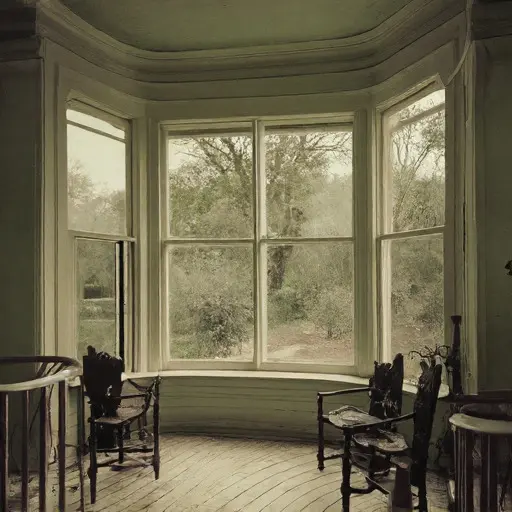
The orchard house was built in 1887 on the edge of a productive family fruit farm, surrounded by orderly rows of apple and pear trees that stretched across gently rolling land. Unlike larger rural estates, it was designed as a compact Victorian family residence. Over time, additions were made according to need rather than symmetry.
A reading room was attached to one side, a bay window was expanded beyond its original dimensions, and a small octagonal corner room was integrated into the structure at an unusual angle.
For nearly forty years, the house belonged to the Whitlock family. Three generations lived there, managing the orchard while maintaining a quiet household centered on seasonal agricultural work. The reading room became a favorite gathering space during winter months, while the orchard itself provided the family’s primary income. The house aged naturally but remained carefully maintained through the early decades of the twentieth century.
The first signs of decline appeared after the death of the family patriarch in 1931. Responsibility for the orchard passed to multiple heirs, none of whom wished to remain permanently on the property. Income from fruit sales began to decline as larger commercial operations gained market advantage. Sections of the orchard were left unattended, and maintenance of the house gradually became less consistent.
A House Growing Quieter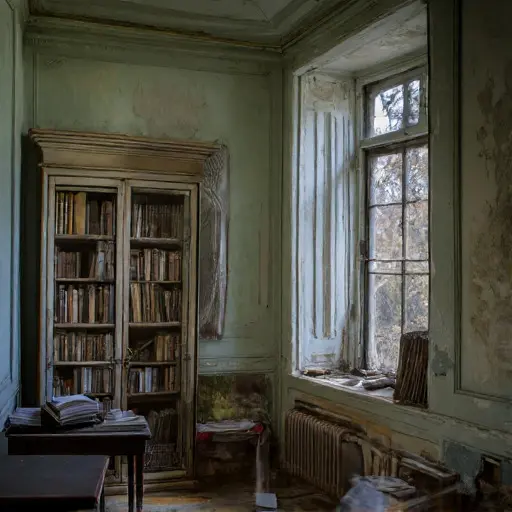
By 1936, only two members of the Whitlock family still occupied the house year-round. Several upstairs rooms were closed to reduce heating expenses. Repairs to the slate roof were postponed, and routine painting ceased altogether. The orchard continued producing fruit, but at significantly lower levels than before.
Financial records preserved among family papers reveal increasing difficulty paying property taxes and maintaining equipment. As revenues declined, portions of the orchard were leased temporarily to neighboring farmers. The arrangement provided short-term relief but failed to reverse the property’s gradual deterioration.
The reading room reflected these changes particularly well. Ledgers remained unfinished on desks. Letters discussing inheritance arrangements accumulated in drawers. Dust settled across surfaces that had once been used daily. Nothing catastrophic occurred; instead, the house entered a prolonged period of slow retreat from active life.
Following the outbreak of the Second World War, younger family members relocated to towns and cities for employment and military service. The remaining occupants struggled to maintain both the house and the orchard. By the mid-1940s, only a small section of the original fruit-growing operation remained productive.
The Final Years of Vacancy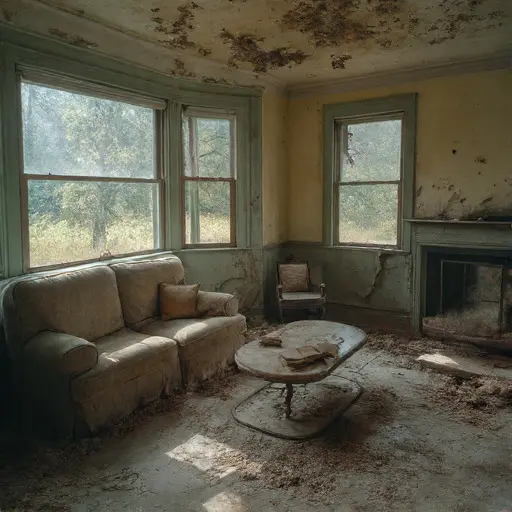
The final occupants departed in 1948 after settling inheritance disputes that ultimately left ownership fragmented among distant relatives. None chose to return. The orchard ceased commercial operation entirely, and maintenance of the house stopped soon afterward.
Over the following years, the building remained structurally sound despite increasing signs of neglect. Paint peeled slowly from siding. Porch supports sagged slightly under age. Moss gathered around shaded foundation stones. Inside, rooms remained largely untouched, preserving evidence of the family’s gradual withdrawal rather than sudden abandonment.
No restoration project was undertaken. No heir reclaimed permanent residence. Ownership remained unresolved through successive transfers and legal complications. The orchard house still stands among aging rows of fruit trees, abandoned yet intact, quietly deteriorating beneath the overcast sky while the orchard slowly erases the last visible traces of the family that once lived there.