The Ashcombe Canal House Left Quiet After Workshop Closure
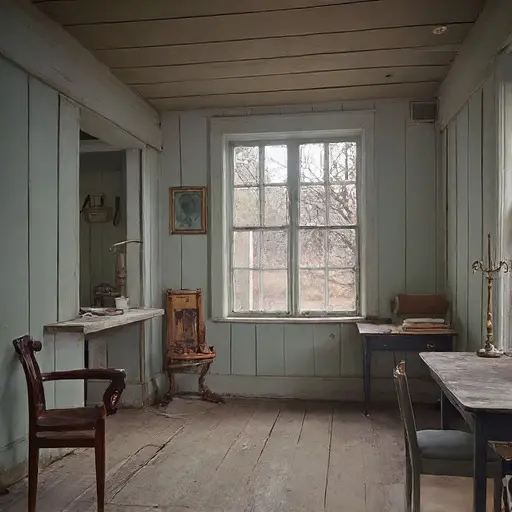
The Ashcombe Canal House was constructed in 1881 along a narrow rural canal as a compact family residence designed to support both domestic life and small-scale waterside labor The original structure consisted of a two-story Victorian house aligned parallel to the canal’s edge, ensuring direct access to water transport and maintenance routes A modest workshop annex was added shortly after construction, extending toward the canal on a slightly different structural rhythm but maintaining coherent Victorian detailing The house evolved gradually through incremental repairs and expansions, resulting in subtle asymmetry in window spacing, a slightly off-center attic dormer, and a gently uneven roofline formed through decades of patchwork maintenance rather than sudden redesign
For most of its active life, the house was occupied by the Haversham family, who used the workshop for repairing boats, handling cargo tools, and maintaining canal trade equipment The canal itself provided steady economic activity, and the home functioned as both a domestic residence and a working interface between land and water The brick chimney showed early signs of water staining near its base due to persistent canal humidity, but the structure remained stable and well cared for The surrounding environment was quiet and consistent, with reeds along the canal edge, a cobblestone path running parallel to the water, and distant village silhouettes softened by mist
Early Decline of Canal Activity and Reduced Workshop Use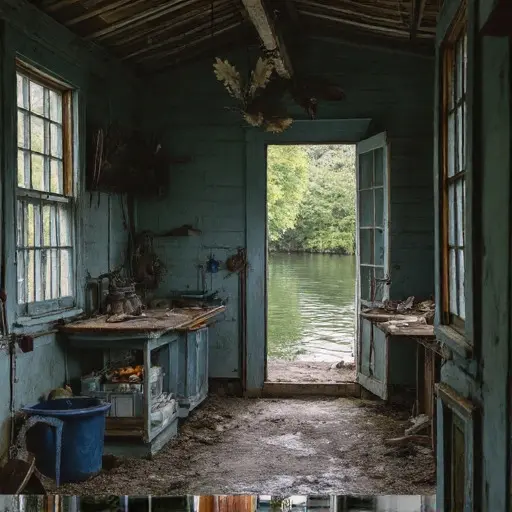
By the early 1930s, the Haversham family began to reduce their reliance on canal trade as rail and road transport shifted regional commerce away from waterways The workshop annex, once the most active part of the property, saw increasingly intermittent use, while the main house remained occupied but gradually less central to daily operations Maintenance of canal-facing structures became less frequent, resulting in slow accumulation of moisture damage along lower timber sections and gradual fading of painted surfaces Despite this, the house remained structurally sound, and no abrupt changes occurred in occupancy patterns
As canal traffic declined further, portions of the workshop were left unused for extended periods, and minor repairs were deferred The dock planks along the canal edge began to soften in tone, weathering into a uniform gray as they absorbed constant humidity without replacement The structure retained its integrity, but its functional purpose steadily diminished until it no longer served as an active working hub
Final Silence Along the Canal Edge
<img src=”https://beyondvisit.
com/wp-content/imagecontent/uploads/abandoned victorian house 68791179.webp” alt=”” />
By 1940 the Haversham descendants had fully vacated the Ashcombe Canal House as canal-based commerce effectively collapsed in the region and maintenance costs exceeded practical use No replacement occupants were ever assigned, and the property entered a state of passive abandonment without formal demolition or redevelopment The workshop annex ceased all activity, and the main residence remained empty except for occasional inspection visits that gradually stopped over time
In the following decade the house aged slowly in place, affected primarily by moisture exposure and environmental stillness rather than structural failure The canal remained calm and unchanged, preserving the reflective symmetry of the abandoned structure while subtly reinforcing its isolation No collapse occurred, and no restoration was initiated
By 1950 the Ashcombe Canal House remained standing along the quiet waterway, fully abandoned but structurally intact No return was recorded, no demolition occurred, and no new use was established The house persisted in soft overcast light beside the still canal, its workshop and residence frozen in calm abandonment, held in silence between water, stone, and weather