The Holloway Ridge Manor Left Quiet After Lineage Drift
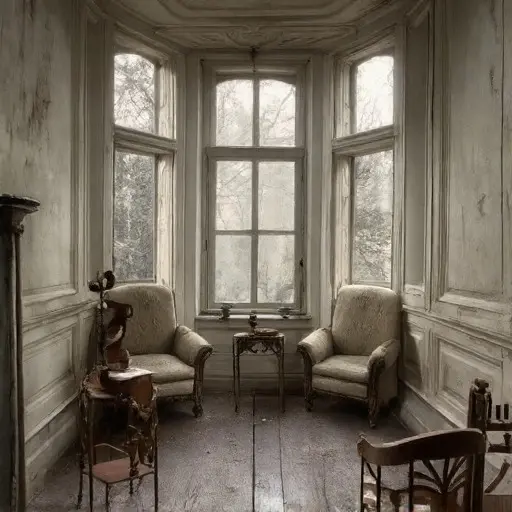
The Holloway Ridge Manor was built in 1874 as a modest rural family residence on the edge of a quiet forest clearing, originally intended to support a small agricultural household rather than function as a large estate The structure began as a simple two-story Victorian house, later expanded through incremental additions that reflected changing family needs rather than any unified architectural plan A modest wing extension was added in the late 1880s, followed by the integration of a small turret-like corner room that served as a private study and weather-watching space The result was a compact but slightly asymmetrical manor, shaped gradually over decades of use and repair rather than formal design intent
For most of its history, the manor was continuously inhabited by successive generations of the Holloway family, who maintained the property with practical repairs and minimal decorative alteration The roofline slowly shifted due to repeated patchwork replacements, with one side becoming subtly higher than the other, though the structure remained stable and functional The front bay window, slightly offset from the centerline, became a familiar feature of the façade, marking the layered evolution of the building rather than any flaw The surrounding clearing remained quiet and unchanged, with low grass, scattered shrubs, and a stable tree line framing the house in evenly diffused light throughout the seasons
Early Absence and Gradual Reduction of Occupancy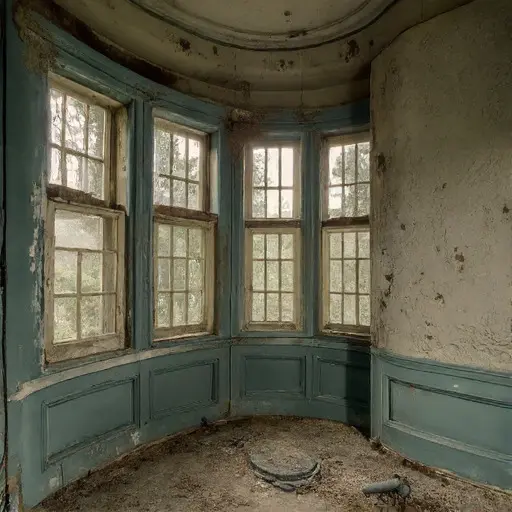
By the early 1930s, the Holloway family began to gradually withdraw from full-time residence as younger members relocated to nearby towns for employment and education The manor transitioned from a continuously occupied home into a partially used rural dwelling, with extended periods of vacancy during colder seasons Certain rooms were closed off to reduce maintenance demands, particularly within the upper floor sections where minor structural irregularities required more frequent repair The wing extension remained usable for a time but was eventually left dormant as household activity concentrated into the central core of the building
Although the manor never experienced abrupt abandonment, subtle signs of long-term decline became increasingly visible Paint on interior and exterior surfaces began peeling in thin layers, and light warping appeared along wooden porch edges exposed to seasonal moisture Window panes remained intact but showed fine cracking and distortion from age, while moss growth appeared only at the base of exterior walls where damp soil met brick foundation The house remained structurally sound, but its use steadily diminished until daily life no longer defined its spaces
Final Quiet Vacancy in the Forest Clearing
<img src=”https://beyondvisit.
com/wp-content/imagecontent/uploads/abandoned victorian house 42050824.webp” alt=”” />
By 1940 the remaining Holloway descendants had fully dispersed, leaving the manor without permanent occupation for the first time in its existence Wartime disruptions and changing rural economies made continued maintenance impractical, and no coordinated effort was made to restore full habitation Despite this, the structure remained stable, requiring only minimal upkeep to prevent weather-related deterioration
In the following decade, the manor continued to exist in a state of quiet suspension The surrounding forest edge remained unchanged, and the clearing retained its open, stable character without encroaching on the structure itself The house aged slowly and evenly, with no collapse or dramatic ruin, only the gradual softening of materials under consistent overcast light
By 1950 the Holloway Ridge Manor stood entirely empty, structurally sound and gently weathered No restoration was undertaken, no demolition occurred, and no return was recorded The house remained in place under a neutral gray sky, quietly preserved in rural stillness, a small Victorian family manor left behind without rupture or spectacle