The Ellery House and Its Abandonment
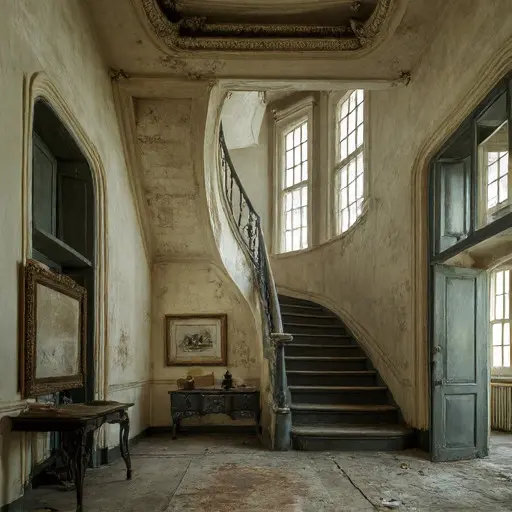
Ellery House was completed in 1896 for Thomas Edwin Harrow, born 1846 in Norwich, a civil land surveyor employed by regional planning offices during the expansion of rural estate mapping and early infrastructure alignment projects. His work involved measuring boundaries, correcting cadastral records, and resolving disputes where property lines overlapped uncertain terrain near forests and meadowland. Over time, his professional correspondence reveals increasing preoccupation with alignment errors in older surveys, especially in regions near the birch forest valley.
He moved into the house with his wife Margaret Lorne Harrow and their daughter Edith, intending it as a long-term residence near the districts he surveyed. Early household records show careful organization, with ledgers, maps, and correspondence stored in the study and maintained with precision.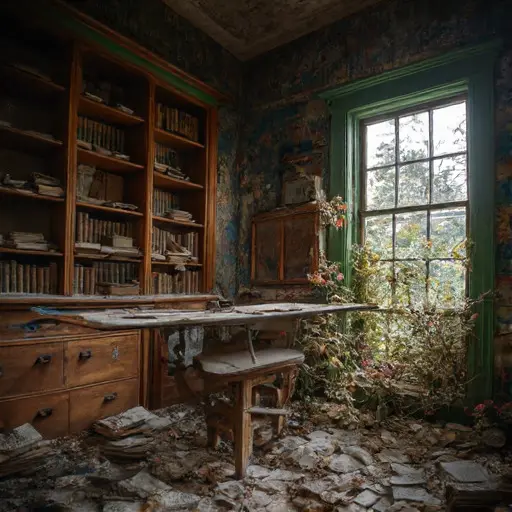
The decline begins in 1907 when Harrow’s survey corrections for several hillside developments were challenged by conflicting municipal records. Boundary discrepancies, initially dismissed as clerical error, began repeating across multiple independent sites. His revised maps increasingly failed to align with older documents, and his professional reputation suffered as agencies questioned the reliability of his measurements.
By 1911, he had withdrawn from active surveying work. Letters preserved in the house show his growing fixation on “progressive misalignment” in regional geography, though contemporaries attributed this to exhaustion. Financial strain followed as contracts were revoked or reassigned. Edith’s correspondence ceases abruptly in the same period.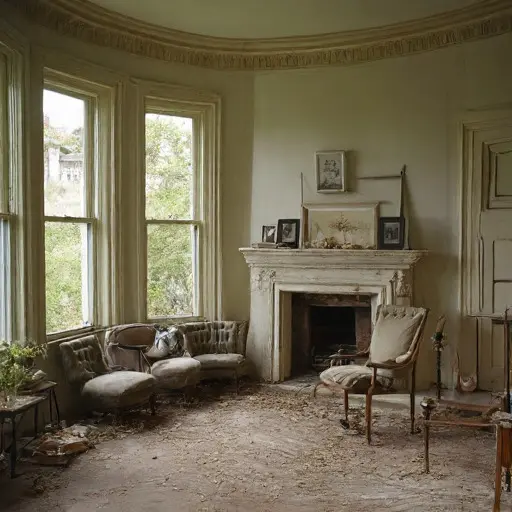
By 1913, Thomas Harrow had relocated to temporary municipal offices, continuing private attempts to reconcile conflicting survey systems. Margaret’s correspondence ends shortly afterward, and Edith appears only once more in a legal document concerning unresolved property boundaries tied to the estate.
The Ellery House remained fully furnished but unattended. Survey maps stayed pinned in the study. Drafting tools were never collected. No sale was completed, no return was recorded, and the property was left standing in the meadow, abandoned without resolution, as if the geometry of the house itself had quietly decided to stop agreeing with the world around it.