The Blackwater Crest House and the Dispersal of a Mining Estate
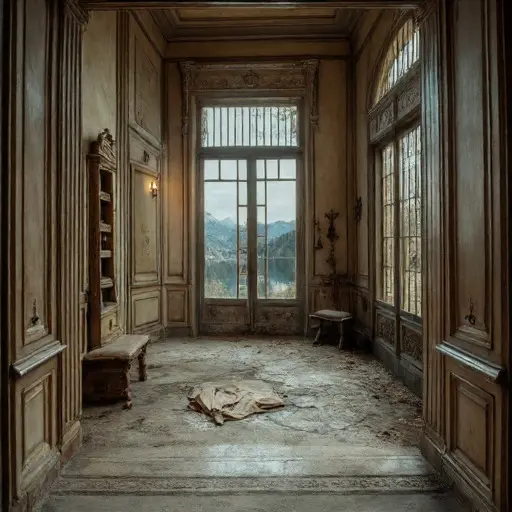
Blackwater Crest House was established in 1888 by Jonas Calder Whitmore, born 1841 in Pennsylvania, a mining investor and logistics financier whose wealth originated in the expansion of silver and iron extraction operations across high-altitude regions. Whitmore consolidated mining claims, funded transport routes through mountain passes, and developed supply contracts that connected remote extraction sites to industrial processing centers in lower valleys.
He lived in the house with his wife Amelia Whitmore and their son Daniel.
The estate functioned as both residence and coordination center for mining operations, with correspondence and geological assessments managed from rooms overlooking the alpine lake that served as the region’s primary transport reference point.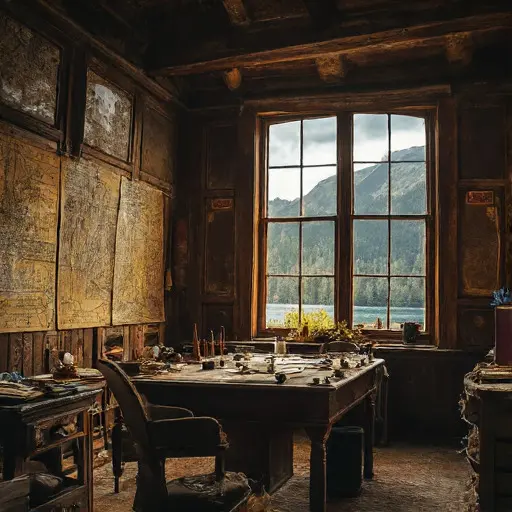
The decline began after a series of unstable yield reports in 1901, when several major mining sites produced significantly less ore than projected. Whitmore expanded operations in response, financing deeper excavation projects and extending supply infrastructure further into unstable terrain. The additional extraction costs were absorbed through heavy borrowing against future output.
By 1906, multiple mines had become structurally unsafe, and production delays accumulated across transport routes. Legal disputes emerged with labor contractors, landholders, and equipment suppliers. Insurance claims increased rapidly following several tunnel collapses, further straining financial stability. Internal records show increasingly fragmented accounting practices as revenues failed to align with operational expenditures.
Household documentation reflects a parallel contraction of life within the estate. Servant quarters were gradually closed. Maintenance of the upper floors was reduced. Furnishings were sold in stages to cover outstanding obligations. Despite this, the study and office remained largely untouched, preserving the administrative core of the estate’s operations long after its practical collapse.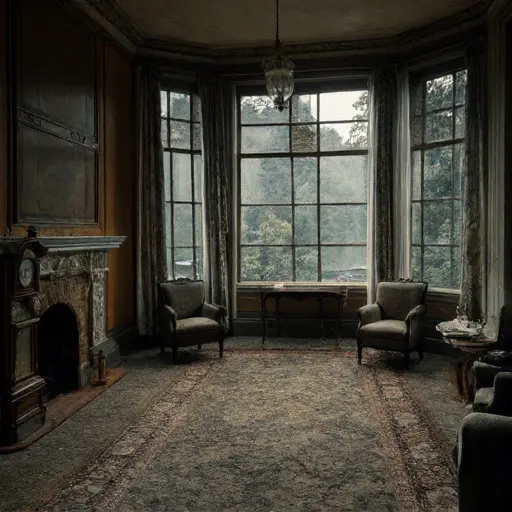
Jonas Whitmore died in 1913 during unresolved negotiations over remaining mining rights and transport claims. Legal disputes over asset ownership continued among creditors and surviving family members, none reaching final settlement.
The family departed the estate soon afterward. Geological maps remained pinned to the walls. Ledgers stayed open. Survey instruments were left exactly where they were last used. Blackwater Crest House remained overlooking the silent lake, holding the incomplete record of an industrial system that slowly exhausted itself and never resolved its final balance.