The Drowned Sato House
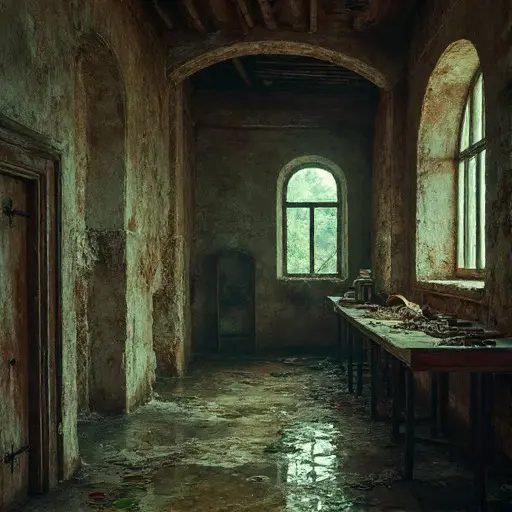
The Sato House was constructed in 1900 on the edge of the Venetian lagoon for Kenji Sato (1866–1912), an optical lens grinding master employed by maritime navigation syndicates to shape precision glass lenses, calibrate curvature accuracy, and certify optical instruments used in telescopes, ship navigation devices, and early coastal surveying equipment.
The villa functioned as both residence and optical workshop, where Sato and his assistants ground glass blanks, measured refraction precision, and maintained export calibration ledgers used to regulate the production of navigation optics across Venetian workshops and maritime trade networks. His household included his wife Lucia and his assistant Marco Bellini, both responsible for maintaining lens calibration records and polishing logs.
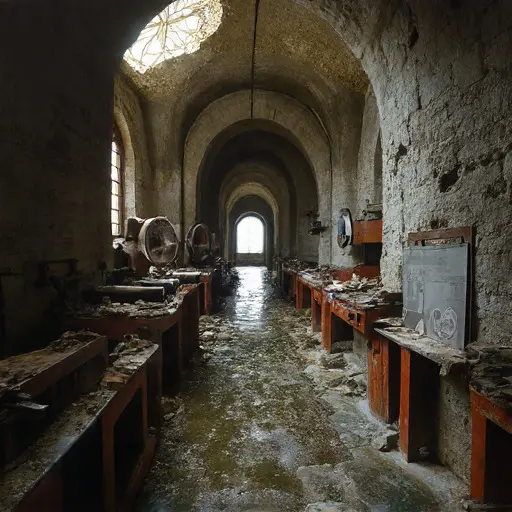
The decline began in 1908 when mass-produced factory optics and industrial molded glass techniques replaced artisanal lens grinding, eliminating demand for individually calibrated optical instruments.
At the same time, repeated flooding in the Venetian lagoon began to permanently submerge low-lying workshop districts, making precision grinding environments unstable and increasingly unusable.
Orders stopped arriving. Workshops closed. The villa’s optical craft slowly dissolved.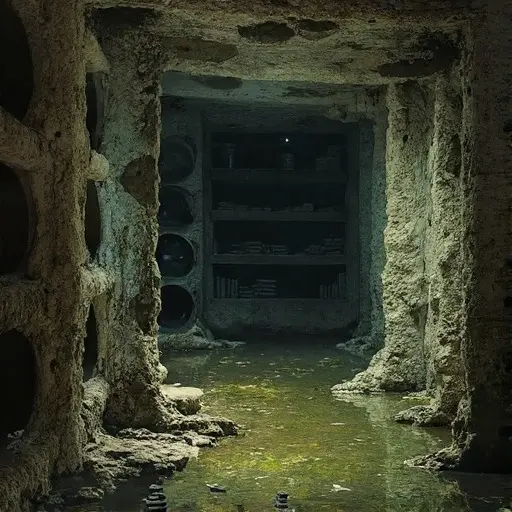
By 1912, Kenji Sato was formally removed from guild service following the dissolution of independent lens grinding houses and the consolidation of optical production under industrial glass factories.
Inside the final calibration ledger, inspectors found an incomplete curvature record for a telescope lens that was never finished after the workshop was permanently flooded during a seasonal lagoon surge.
The Sato House remains abandoned beneath the rising Venetian waters, its light unfocused, its systems obsolete, and its rooms slowly fading into glass, salt, and silence.