Quiet Dissolution in the House of the River Archive Diver
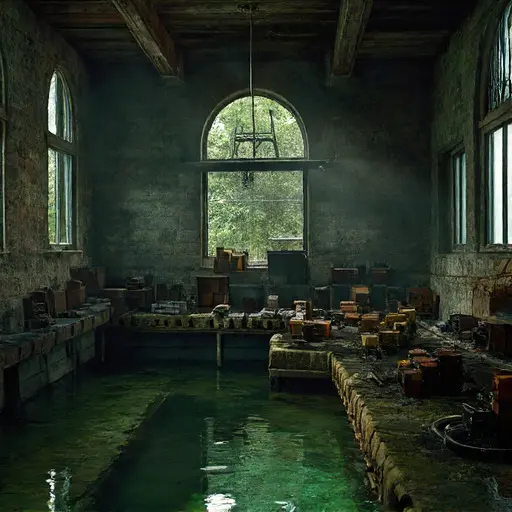
The documents are still sealed in waterproof cylinders.
Some are half-clouded from long exposure to humidity that slowly seeped through aging seals before the chamber was fully reinforced.
Each container holds layered river records, maps, and sediment-coded logs recovered from submerged civic archives.
This house belonged to Marceau.
He worked as a river archive diver, retrieving and preserving historical documents from flooded municipal record vaults beneath inland waterways and old bridge districts.
The lower archive chamber of the house was partially submerged by design.
Access ladders descended into water-filled corridors where sealed shelving units held centuries of civic records protected inside pressure containers.
The house functioned as both residence and retrieval station.
At the Submerged Index Chamber Desk
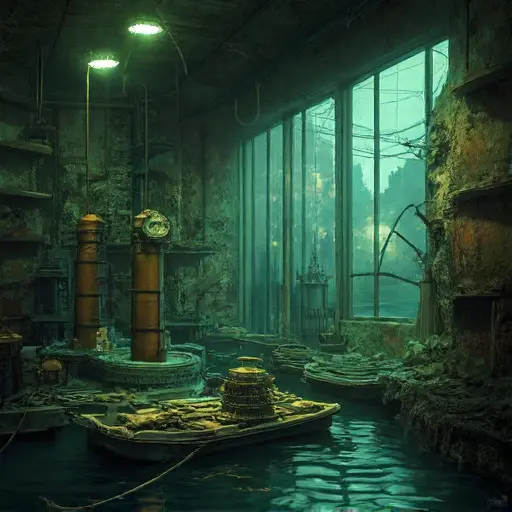
Marceau worked most often at the Submerged Index Chamber Desk.
The reinforced glass workstation was where he cataloged recovered municipal records, cross-checking water-damaged civic archives against preserved upstream duplicates stored in dry vault systems.
His partner died during a structural collapse in an older bridge archive vault when floodwaters overwhelmed a sealed storage level unexpectedly.
After that, he stopped participating in deep retrieval dives and worked only from the house-based archive system.
For years, the profession remained essential.
Historical preservation agencies depended on river archive divers to recover lost civic records from submerged districts affected by long-term urban flooding and river course shifts.
Then digital redundancy systems replaced physical recovery.
Cloud-based archival backups and automated scanning of remaining dry records reduced the need for underwater retrieval specialists.
Marceau continued anyway.
Even after funding stopped.
Even after retrieval missions were reassigned.
But the decline was not only technological.
The river itself changed course.
Upstream dam failures and sediment redirection projects altered flow patterns, increasing turbidity and making submerged visibility near-zero across previously mapped archive zones.
Then access collapsed.
A major flood control restructuring project sealed off large sections of the river basin, permanently restricting entry to submerged archival districts due to instability and contamination risk.
Marceau stayed inside the house through prolonged isolation cycles, continuing to process recovered records even after new retrieval dives were formally discontinued.
During a final flood surge event, multiple upstream systems failed simultaneously, causing rapid water level instability that overwhelmed submerged archive containment structures.
He attempted to finalize the last recovery log at the Submerged Index Chamber Desk during a prolonged communications blackout caused by infrastructure failure along the river network.
He died before the final archive index was completed.
No preservation authority retrieved the remaining cylinders.
The submerged chamber remained sealed beneath shifting currents.
The document cylinders remain sealed in the lower chamber.
The index logs stay half-completed at the desk.
And at the Submerged Index Chamber Desk, Marceau’s unfinished river archive continues waiting in silence—holding the last history no one ever returned to retrieve.