Hidden Order in the House of the Ice Pattern Analyst
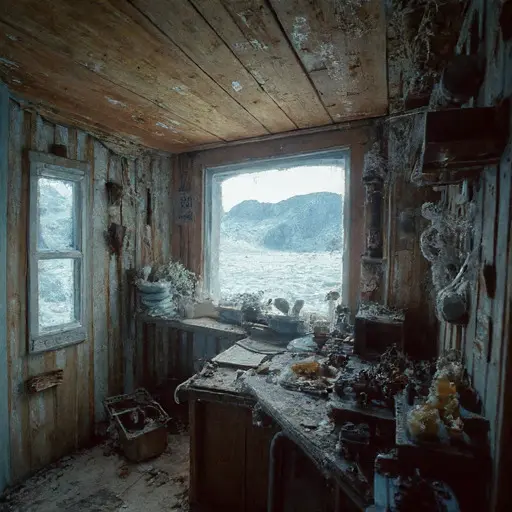
The ice cores are still labeled in thin black ink.
Some of the markings have faded where condensation repeatedly formed and froze again across the sample trays.
Each cylinder of ice sits aligned in metal racks, sorted by depth, age, and salinity signature.
This house belonged to Dr. Sigrid.
She worked as an ice pattern analyst, studying layered ice formations to interpret historical climate shifts across polar coastal regions and subglacial environments.
The study room was built directly into the house to maintain consistent sub-zero conditions needed for sample stability.
Steel racks lined the walls. Frozen core segments rested in sealed trays. Microscopic analysis tools sat beside thick notebooks filled with stratification diagrams and chemical readings.
The house functioned as a preserved slice of climate history.
At the Cryo Stratification Desk
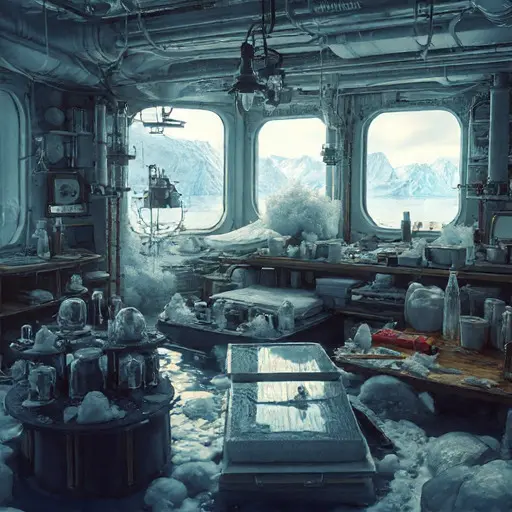
Dr. Sigrid worked most often at the Cryo Stratification Desk.
The reinforced metal surface was used to compare ice layer compression data with chemical isotope readings extracted from cores drilled across the coastal ice field.
Her partner died during an earlier expedition when a sudden ice shelf fracture collapsed the field platform they were working on.
After that, she stopped joining field drilling teams and worked entirely from the base house.
For years, the profession remained essential.
Climate research institutes depended on ice pattern analysis to reconstruct atmospheric conditions spanning thousands of years, using layered ice as a record of environmental change.
Then remote sensing replaced core extraction.
Satellite-based climate modeling and automated ice-penetration imaging reduced the need for physical sampling in many regions, shifting analysis away from small field stations.
Dr. Sigrid continued anyway.
Even without active research assignments.
Even without external funding.
But the decline was not only institutional.
The ice itself began changing faster.
Accelerated warming cycles destabilized coastal ice integrity, causing unpredictable layering distortions that made long-term comparative analysis increasingly unreliable across seasons.
Then access failed.
A sequence of severe polar storms disrupted supply routes and permanently closed multiple coastal research stations due to structural instability and unsafe ice shelf conditions.
Dr. Sigrid remained in the house through extended isolation periods, continuing to document changes in ice structure from newly retrieved samples until field collection stopped entirely.
During a final polar anomaly event, rapid temperature oscillation caused widespread ice fracturing across the region, making existing stratification models obsolete within a single season.
She attempted to complete a final climate reconstruction set at the Cryo Stratification Desk during a prolonged communications blackout caused by infrastructure collapse in the polar network.
She died before the final dataset was finalized.
No institute retrieved the remaining cores.
The station was left sealed in ice.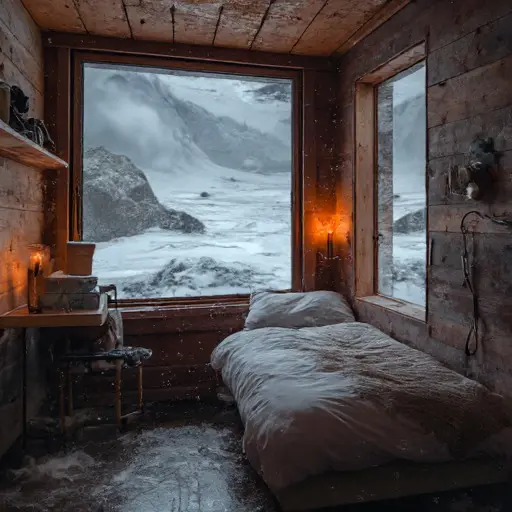
The ice cores remain stacked in their trays.
The notebooks stay open to unfinished reconstructions.
And at the Cryo Stratification Desk, Dr. Sigrid’s final climate analysis continues waiting in silence—holding the last patterns she never returned to complete.