Eclipsed Permanence in the House the Wind Notation Scribe Never Published
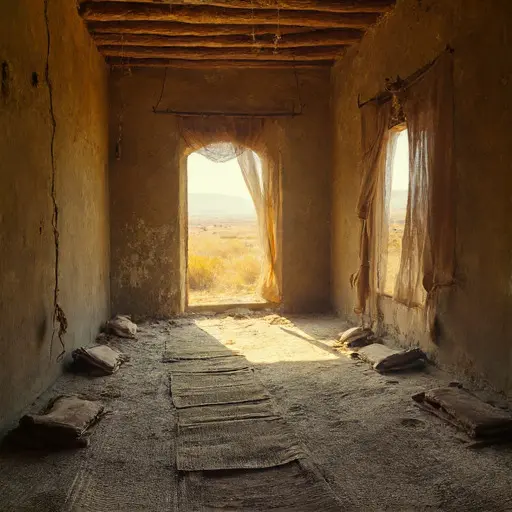
The air still carries marks.
Not sound.
Not movement.
But recorded patterns of wind written into ink lines that curve and break like invisible rivers across parchment.
This house belonged to Yeren.
He worked as a wind notation scribe, recording atmospheric flow patterns, steppe wind currents, and seasonal air shifts used by migration guides and environmental mapping councils.
The transcription room was oriented along the widest plain-facing wall.
Hollow reed tubes were mounted to capture tonal wind changes. Ink slates documented pressure direction shifts. Large parchment scrolls were pinned to wooden frames where airflow was translated into symbolic notation.
The house did not resist the wind.
It listened to it.
Beneath the Aeration Script Frame
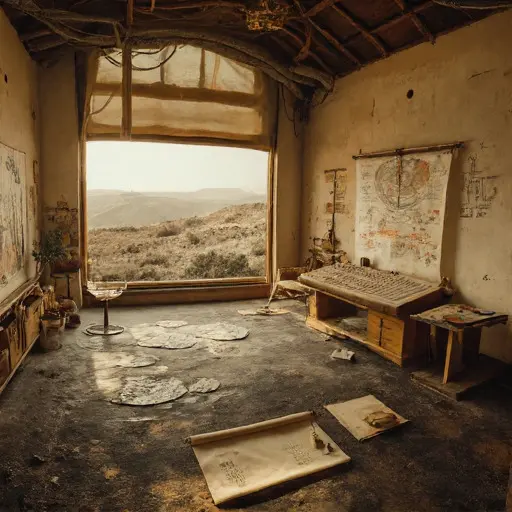
Yeren worked most often beneath the Aeration Script Frame.
The broad wooden structure held layered wind recordings stretched across parchment sheets, where airflow was translated into symbolic directional grammar used by steppe navigators.
His partner died during an earlier migration season after a prolonged sandstorm disrupted caravan routes across the northern plains.
After that, he stopped accompanying field observers.
For years, the profession still held importance.
Migration councils, ecological monitors, and nomadic route planners relied on wind notation scribes to predict seasonal passage conditions across vast open steppe systems where visual landmarks were unreliable.
Then satellite meteorology replaced ground notation.
Automated atmospheric modeling systems began simulating wind flow digitally, eliminating the need for human-recorded airflow transcription across open terrain.
Yeren continued anyway.
Even without commissions.
Even without readers.
But the decline extended beyond technology.
The climate itself destabilized.
Expanding desertification altered wind behavior across the steppe, producing irregular turbulence zones that broke historical airflow patterns and rendered long-term notation systems increasingly inconsistent.
Then access collapsed.
A prolonged regional drought cycle forced mass migration of remaining nomadic routes, emptying the steppe corridors that once provided consistent observational reference points for wind documentation.
Yeren stayed inside the house during extended dust seasons, recording fragmented airflow patterns through reed tubes even when external reference continuity no longer matched historical systems.
During a final atmospheric instability cycle, multiple dust-front collisions crossed the region simultaneously, disrupting all remaining wind tracking instruments and collapsing the external acoustic structure of the observation system.
He attempted to finalize a full seasonal wind script during a prolonged blackout caused by regional grid failure and airborne particulate saturation.
He died before the final notation could be archived.
No migration council retrieved the records.
The steppe routes changed permanently.
The wind kept moving without transcription.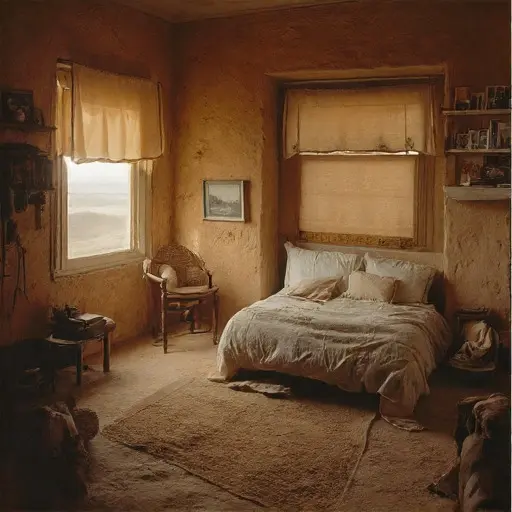
The inked wind charts remain pinned.
The reed tubes stay silent but intact.
And at the Aeration Script Frame, Yeren’s unfinished wind notation continues waiting in silence—holding the last breath of a landscape he never returned to fully translate into record.