Unforgiving Stillness in the House the Meteor Marker Never Updated

The fragments still sit in numbered trays.
Each one tagged, weighed, and aligned with observation records that stopped mid-season.
Some pieces are metallic black.
Others shimmer faintly like burned glass under sunlight.
This house belonged to Dr. Arman.
He worked as a meteor marker, tracking and classifying meteor impacts, atmospheric entry fragments, and celestial debris patterns for highland observatories and planetary mapping institutes.
The observation room was built at the highest point of the plateau to minimize atmospheric distortion.
Optical lenses rested on reinforced stands. Impact logs filled iron-bound notebooks. Fragment trays were arranged in orbital patterns according to fall trajectory and density mapping.
The house was built to read the sky after it had already broken.
Beneath the Impact Vector Table
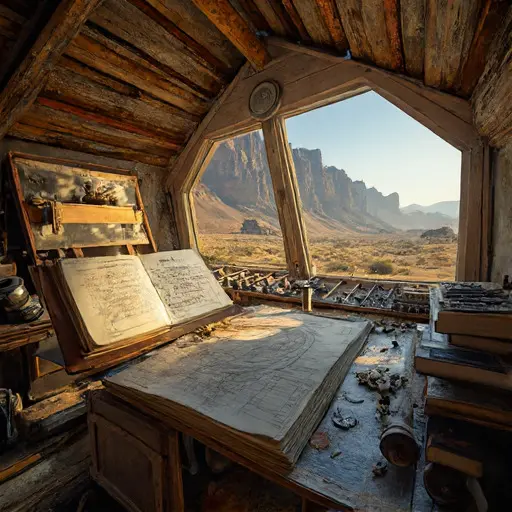
Dr. Arman worked most often beneath the Impact Vector Table.
The reinforced basalt desk was where he calculated entry angles and atmospheric breakup signatures from recovered meteor debris collected across the plateau basin.
His partner died during an earlier expedition season after a remote field station collapse caused by a sudden impact shockwave event.
After that, he rarely left the observatory during active meteor seasons.
For years, the profession remained critical.
Planetary research institutes depended on ground-based meteor marking to refine orbital prediction models, atmospheric entry behavior, and debris field mapping for scientific and defense applications.
Then satellite impact modeling replaced field marking.
Automated detection arrays and orbital debris simulation systems took over, reducing the need for physical recovery and manual classification of meteor fragments.
Dr. Arman continued anyway.
Even without institutional demand.
Even without new assignments.
But the decline was not only technological.
The atmosphere itself began changing.
Increased particulate density from upper-atmospheric dust anomalies made meteor entry paths less predictable and fragment recovery increasingly hazardous, destabilizing long-term observation consistency.
Then the plateau became inaccessible.
A series of seismic microfractures altered the terrain structure, triggering controlled closure of the region due to risk of secondary impact instability and ground collapse near known crater zones.
Dr. Arman remained in the observatory through extended isolation periods, continuing to log meteor activity from limited visible passes during unstable sky conditions.
During a final meteor surge event, multiple atmospheric entries occurred within a compressed time window, overwhelming observation systems and fragment tracking equipment simultaneously.
He attempted manual recalibration of the Impact Vector Table during a power instability event caused by regional grid failure.
He died before the final trajectory log was completed.
No planetary institute retrieved the observatory data.
The plateau remained closed.
The sky continued breaking.
The fragment trays remain numbered.
The trajectory charts stay half-calculated.
And at the Impact Vector Table, Dr. Arman’s unfinished meteor record continues waiting in silence—holding the last sky he never returned to fully map into understanding.