Unraveling Quiet in the House the Seed Linguist Never Translated
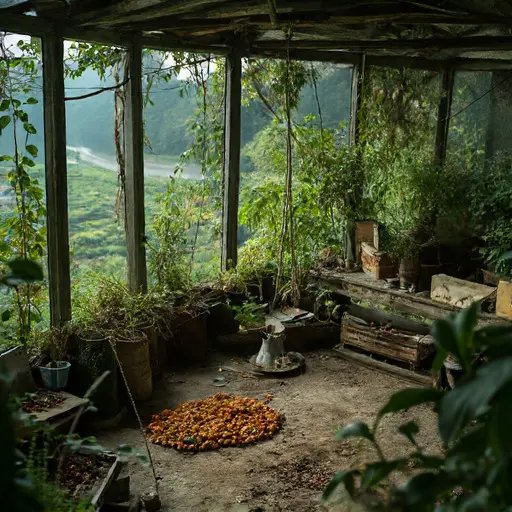
The seed envelopes are still labeled in ink.
Some handwriting has blurred where moisture once gathered against the glass walls.
Others remain sharp, carefully preserved in wax-sealed packets arranged by origin rather than species.
This house belonged to Dr. Lian.
She worked as a seed linguist, decoding plant lineage markers embedded in seed structures, cross-referencing botanical “language” patterns used in agricultural genetics and heirloom crop preservation.
The greenhouse-room was the heart of the house.
Not for growing—but for reading.
Pods were dissected and mapped. Seed coats were cataloged under magnification. Translation charts of botanical traits covered long drafting tables like pages of a living dictionary.
The house felt like a conversation with nature that never ended.
Beneath the Germination Lexicon Shelf
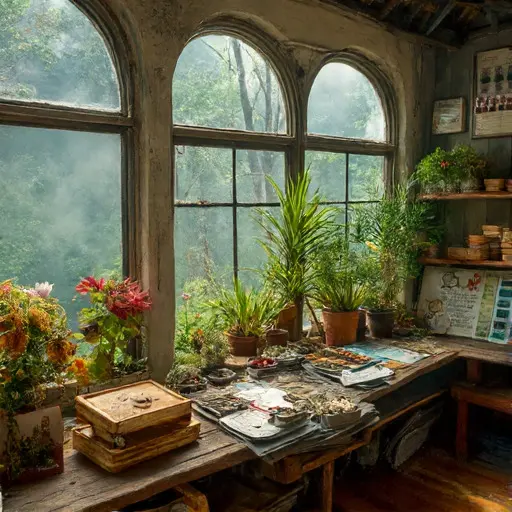
Dr. Lian worked most often beneath the Germination Lexicon Shelf.
The long suspended shelving unit held categorized seed “phrases”—clusters of genetic traits arranged like sentences waiting to be interpreted into crop lineage maps.
Her partner died during an earlier agricultural quarantine period caused by a regional plant disease outbreak.
After that, she stopped collaborating with external seed banks.
For a time, the profession still mattered.
Agricultural institutes depended on seed linguists to preserve heirloom crop diversity, decode adaptive traits, and maintain genetic continuity for regions threatened by monoculture expansion.
Then gene sequencing automation advanced.
AI-driven genomic decoding replaced manual botanical interpretation, rendering seed linguistics obsolete in formal agricultural science.
Dr. Lian continued anyway.
Even without institutional access.
Even without recognition.
But the decline extended beyond science.
The valley’s agricultural system began shifting.
Large-scale hybrid crop distribution replaced heirloom farming, and traditional seed exchange networks collapsed under standardized commercial agriculture, erasing the communities that once preserved botanical language diversity.
Then the crops failed.
A regional soil pathogen spread through irrigation channels, disrupting germination cycles across multiple terrace systems and rendering many seed strains nonviable without intensive laboratory intervention.
Dr. Lian remained in the greenhouse through long seasons of humidity and decline, documenting altered seed structures even as viable samples grew rarer.
During a final monsoon season, flooding disrupted access roads and cut communication to the valley for weeks.
She continued working at the Germination Lexicon Shelf until rising water began seeping into the lower greenhouse structure, damaging archived seed catalogs.
She died before evacuation reached the site.
No agricultural institute reclaimed her records.
The greenhouse remained sealed in humid stillness.
The seed envelopes remain sorted.
The translation charts stay half-decoded.
And beneath the Germination Lexicon Shelf, Dr. Lian’s unfinished botanical language continues waiting in silence—holding the last genetic meanings she never returned to translate into understanding.