Relentless Tranquility in the House the Salt Calligrapher Never Finished
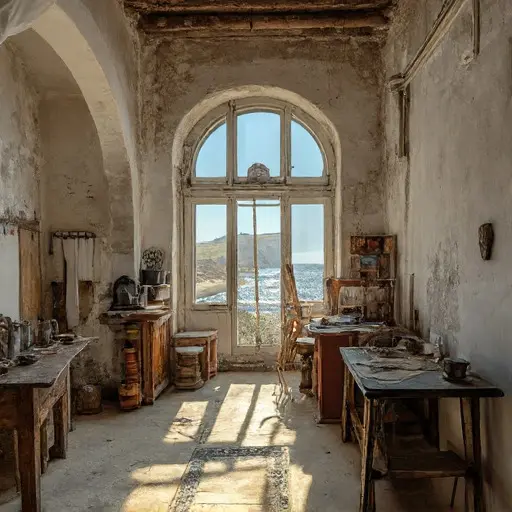
The ink has crystallized at the edges.
Not fully dried.
Not fully alive.
It forms fragile salt-like patterns along the brush rests, as if the ocean outside reached inward and changed the chemistry of the room itself.
This house belonged to Selim.
He worked as a salt calligrapher, creating ceremonial scripts, maritime records, and coastal inscriptions used in navigation houses, coastal archives, and ritual documentation across shoreline communities.
The writing studio faced directly toward the sea cliffs where wind constantly shaped the land.
Ink stones were carved from mineral-rich rock. Brushes were made of reed and feather. Manuscript sheets were hung along drying lines that stretched across the room like quiet threads of memory.
The house was not built for permanence.
Only for inscription.
Beneath the Tide Script Desk
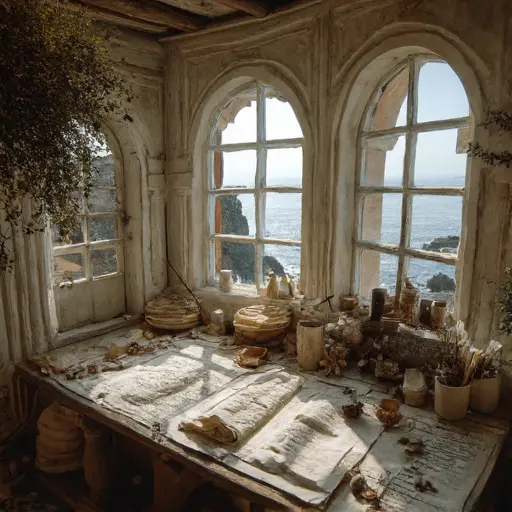
Selim worked most often beneath the Tide Script Desk.
The wide stone desk near the sea-facing window was where he composed coastal inscriptions meant to endure salt air, wind exposure, and long maritime journeys carried across trading routes.
His wife passed away during an earlier coastal epidemic years before his work declined.
After that, he stopped traveling to external archives.
For a time, the profession still held significance.
Harbor cities and navigation houses relied on salt-resistant calligraphy to mark tides, routes, and ceremonial coastal boundaries etched into buildings exposed to ocean conditions.
Then digital systems replaced script.
Electronic navigation records and printed industrial signage replaced hand-inscribed coastal documentation, making salt-resistant calligraphy obsolete in official use.
Selim continued anyway.
Even without commissions.
Even without readers.
But the decline extended beyond culture.
The coastline itself began changing shape.
Rising sea erosion and salt saturation altered cliff structures, increasing wind-driven mineral corrosion that made traditional parchment preparation increasingly unstable. Ink absorption became unpredictable, and drying times no longer followed historical patterns.
Then his health declined.
Years of inhaling salt-laden air and fine mineral dust from ink grinding led to progressive neurological fatigue that reduced his ability to maintain long script sessions.
One final inscription cycle began during a season of extreme coastal winds that prevented any external deliveries from reaching the village.
Selim attempted to complete a coastal registry scroll intended to document disappearing maritime routes along the cliffs.
But storms intensified faster than forecast, and structural damage to the roof disrupted ventilation inside the studio.
He died at the Tide Script Desk before the final line was completed.
No archival body retrieved his manuscripts.
The house remained open to the wind.
The ink stones remain cracked with salt.
The parchment still hangs in partial scripts.
And at the Tide Script Desk, Selim’s unfinished calligraphy continues waiting in silence—holding the last inscription he never returned to finish into permanence.