Unyielding Calm in the House the Tide Recorder Never Filed

The water marks are still visible on the lower wall.
Faint brown lines showing where the tide once reached during an exceptional flood cycle.
They were never painted over.
Never cleaned.
Just recorded and left as memory.
This house belonged to Amina.
She worked as a tidal hydrologist recorder, documenting coastal water movement patterns, sediment shifts, and seasonal flood behaviors for environmental monitoring agencies.
The recording room faced directly into the marsh system where water rose and fell with slow, deliberate rhythm.
Steel measuring poles stood outside the window. Glass sediment jars lined the interior shelves. Handwritten tide ledgers filled wooden crates labeled by year and storm cycle.
The house functioned like a living instrument.
It did not interpret the water.
It observed it.
At the Estuary Baseline Desk
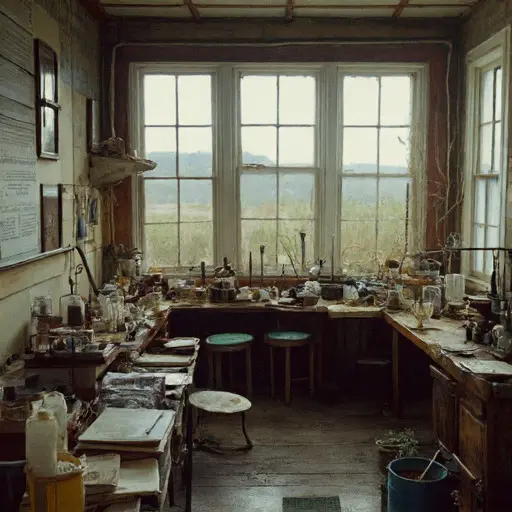
Amina worked most often at the Estuary Baseline Desk.
The long reinforced table was where she compared daily tidal readings against long-term flood cycle data collected from surrounding marsh stations.
Her partner died during an earlier coastal storm season.
After that, she rarely left the house during peak tide periods.
For many years, the profession remained essential.
Environmental agencies depended on localized tidal records to predict marsh flooding, land erosion, and saltwater intrusion into agricultural zones along the coast.
Then satellite hydrology replaced field stations.
Remote sensing systems began mapping tides globally with higher frequency and precision, reducing the need for human-recorded coastal baseline data.
Amina continued recording anyway.
Even without submission channels.
Even without acknowledgment.
But the decline was not only institutional.
The wetlands themselves began shifting faster.
Rising sea levels and sediment disruption altered the marsh geometry, making long-term comparative baselines increasingly unstable and harder to calibrate across seasons.
Then access changed.
Coastal conservation zones were restricted after repeated storm damage, limiting field entry to large automated monitoring teams and excluding small independent stations like hers.
Amina stayed.
Recording through cycles of storms and calm.
But her health declined as prolonged exposure to damp air and seasonal mold blooms within the marsh house triggered chronic respiratory illness that worsened over time.
During a final extended flood season, water levels rose higher than any recorded baseline in her logs.
The Estuary Baseline Desk became partially inaccessible as marsh overflow entered the lower structure of the house.
She continued recording from the upper room until supply routes and communication systems failed during a regional weather blackout.
Amina died quietly during that isolation period, surrounded by unfinished tidal entries and rising water that slowly reshaped the land beneath the house.
No agency retrieved her records.
The marsh absorbed the lower rooms.
The house remained standing at the edge of shifting water.
The tide ledgers remain stacked by year.
The sediment jars still hold layered coastal history.
And at the Estuary Baseline Desk, Amina’s final tidal record continues waiting in silence—holding the last flood cycle she never returned to file.